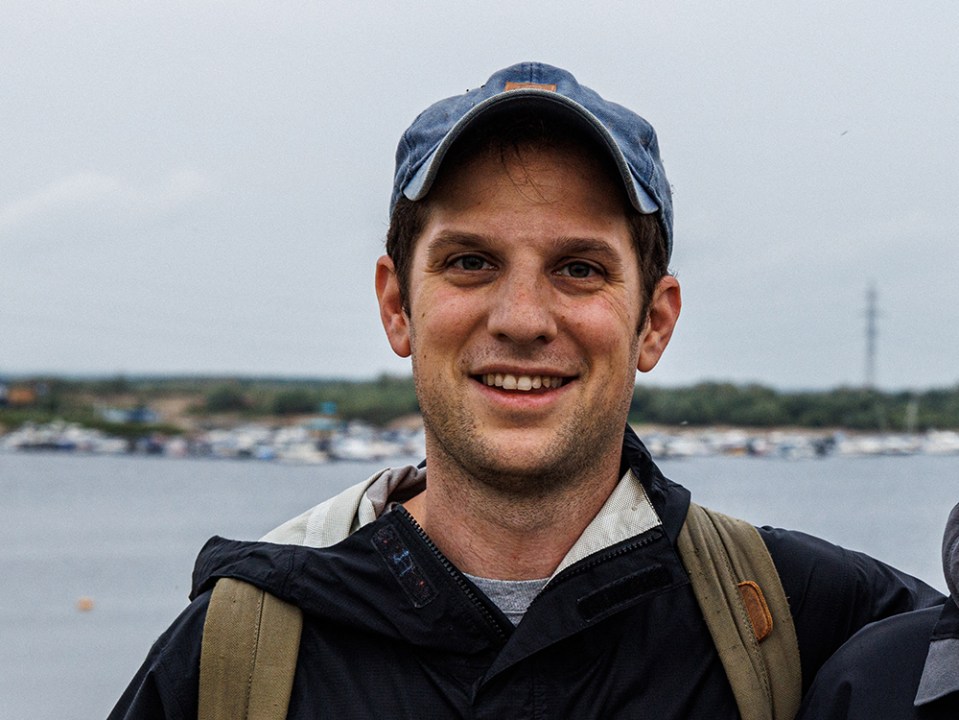
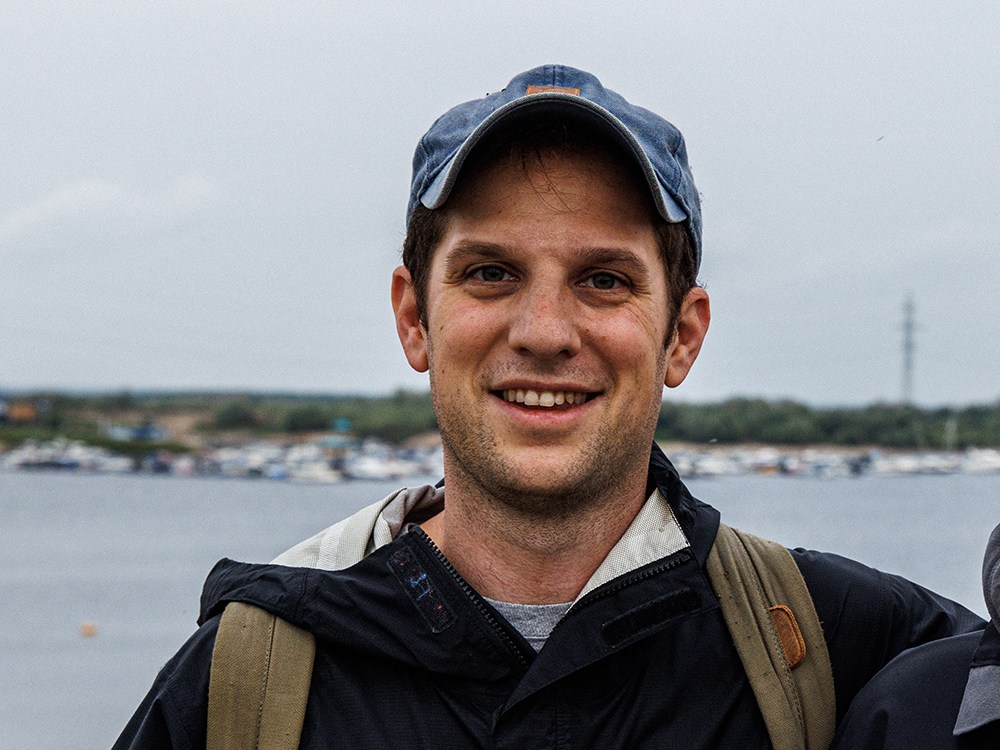
In 2017, Evan Gershkovich arrived in Moscow to work at the Moscow Times. Both his parents had emigrated from the USSR in 1979; yet once they’d met and settled in New Jersey, they were determined that their children should grow up knowing their Soviet roots. Evan and his sister Danielle – Vanya and Dusya at home – had Russian lessons every Saturday, even if they made Dusya sob. They watched Soviet cartoons and read Krylov’s fables, not Aesop’s. It wasn’t until Evan chose a career in journalism, however, that Moscow called. Russia, with its habit of newsworthiness, is the gift that keeps on giving to the international press. By 2023, he was making plans to settle permanently in Moscow. The one thing he was not intending was to become a major news story himself.
That March, Gershkovich, researching a piece on military production, flew to Yekaterinburg to meet a source who worked in an ordnance plant. After lunch his source suddenly thrust a stack of papers into Evan’s hands with detailed figures on output. Right on cue, masked FSB officers rushed into the restaurant, shoved Evan to the ground and arrested him for espionage, while the source faded quietly into the background.
It was a blatant sting. Gershkovich understood this immediately, and almost as quickly thought: ‘They’ve taken me for a swap.’ He was flown back to Moscow and held in pre-trial detention in the infamous Lefortovo prison. But he was more of a hostage than a prisoner. He needed to be returned in good shape, so his treatment was the best they could manage – which wasn’t saying much, of course. For 16 months, he calmly endured captivity in a cramped cell with unpredictable cellmates. He exercised. He wrote a journal. He created rather good-sounding meals out of the prison chow and a few extra ingredients. His fortitude even impressed the warders. But as an addition to Russia’s venerable prison-memoir genre, Gershkovich’s experience can only convey a fraction of the casual terror of the system. Recent books by Russian citizens, such as Masha Alekhina’s Political Girl and Vladimir Pereverzin’s The Prisoner, are inevitably more penetrating.
What is fascinating, however, is Gershkovich’s account of the complex game of hostage diplomacy in which he was entangled. It began perhaps as far back as 2008, when a Russian arms trafficker called Victor Bout was arrested in Bangkok by the Thai police in cooperation with Interpol and the US Drug Enforcement Agency. In the years that followed, two former US marines were arrested in Russia as spies, as well as Brittney Griner, the US basketball player, who was accused of drug smuggling after hash oil was found in her luggage. ‘It’s always good to have an American in the closet,’ a Russian official remarked to Gershkovich. For their part, the Americans arrested another drug smuggler and several foreign agents. Griner was swapped for Bout in 2022, by which time the former marine Paul Whelan had spent four years in a Russian jail. US officials worried that other American citizens in Russia might be targets.
Moves were afoot, meanwhile, to exchange the opposition leader Alexei Navalny. An FSB assassin in prison in Germany called Vadim Krasikov was suggested, but the US initially resisted the idea of releasing a convicted murderer. It was during this lull that Gershkovich was arrested, sparking an international uproar.
Now the White House was under pressure, and negotiations cranked up again. In the autumn of 2023, four Russian spies were offered in exchange for Navalny and Gershkovich, but Putin refused – there would be no deal without Krasikov. It’s unclear why Krasikov was considered so important, but perhaps Putin simply wanted to send a message to FSB operatives everywhere: you won’t be abandoned if you do my dirty work.
Just as a swap seemed about to go through in February 2024, news came of a tragedy: Navalny had died in an Arctic punishment cell. The man, so superhumanly cheerful and robust, seems to have been poisoned with a frog toxin. He died in agony and alone, detonating an explosion of grief and horror around the world. In the West, there was near panic at this evidence of Russian willingness to kill off their prisoners, and within a month they suggested a new exchange – 16 prisoners, including eight Russian dissidents, in exchange for Krasikov and seven other Russian agents, hackers and so on. Putin agreed immediately, and by 1 August Gershkovich was free and safe, along with 15 other innocent people. The deal was hailed as a triumph.
In retrospect, however, one can imagine Putin’s glee: he’d retrieved his FSB killer, while at the same time permanently solving the problem of Navalny. He’d used the West’s righteous protest against the arrest of a journalist as a spy and Navalny’s murder to rush them into the decision he wanted. Against such ruthless negotiations, is it any wonder that President Trump’s hapless envoys Steve Witkoff and Jared Kushner make no headway?





Comments