Long before Asne Seierstad arrived at the bookseller’s house in Kabul, she studied in Moscow. ‘I tried to be one of them,’ she says, gently scathing of her young self. ‘In all earnest, I sought out the Russian soul.’ Decades spent writing about the post-Soviet world have stripped away her early romanticism. Her new book on Russia has an antihero as its central figure: Andrei Medvedev, a thief, alcoholic, hired thug and mercenary who fought in Ukraine then defected, escaping over the border to Norway. As she follows his story across Russia in 2023-24, encountering the full gamut of oligarchs, angels, monks and drunks, it’s Russians’ own self-image that often feels wilfully blind. They quote Fyodor Tyutchev: ‘Russia cannot be understood with the mind… It must be simply believed in.’ The verse seems yet again to have become a mantra for Russians, a 160-year-old insistence on mystical exceptionalism, now recycled as a licence not to think.
As a Russian type, the addictive, unstable Medvedev is frankly terrifying. His story is above all about violence – state and individual, impulsive and planned – and its corollaries: pain, callousness, neglect and always, everywhere, alcohol. Vodka, in Medvedev’s world, numbs and comforts, enlivens and inevitably enrages. The punches fly.
The statistics around domestic violence in Russia are disputed, since instances that ‘do not cause serious injury’ were decriminalised in 2017. But in 2008 the Russian interior ministry estimated that around a quarter of all Russian women experienced abuse. Andrei, who used to try to prevent his father from attacking his mother, was beaten from infancy. When he was 12, his mother was run over by a drunk tractor driver. After that, Andrei was dragged up by drunken relations and care homes. He was unpredictable and hysterical. Prevented by a kindly gym teacher from going after his mother’s killer, he was given his first glass of braga, alcoholic grape must. Within a year of his arrival in Norway he was arrested for drunkenly beating up his girlfriend. A mere border is not enough to separate Andrei from his demons.
‘Is he the right person to represent Russians in your book?’ asks his former gym teacher, very reasonably. Seierstad searches out better candidates: intellectuals, actors, friends from student days in Moscow and St Petersburg, now wealthy, glamorous figures in the arts. By contrast they seem passive and bewildered. They live well, the restaurants are full and the theatres busy; yet ‘where once we had feelings… now we have only fear’. They worry for their careers, that a wrong word on social media can get you sacked. Above all, they tremble for their sons, with the recruitment officers circling: one boy has been hiding indoors for nine months since the call-up arrived. ‘The brave have left already,’ says one. Comfort, and the sense that you are leading a sophisticated, civilised life – these things are hard to relinquish, particularly when the alternative is so frightening. Would we behave any differently? I doubt it. Yet there is an unspoken criticism in Seierstad’s account of their acquiescence.
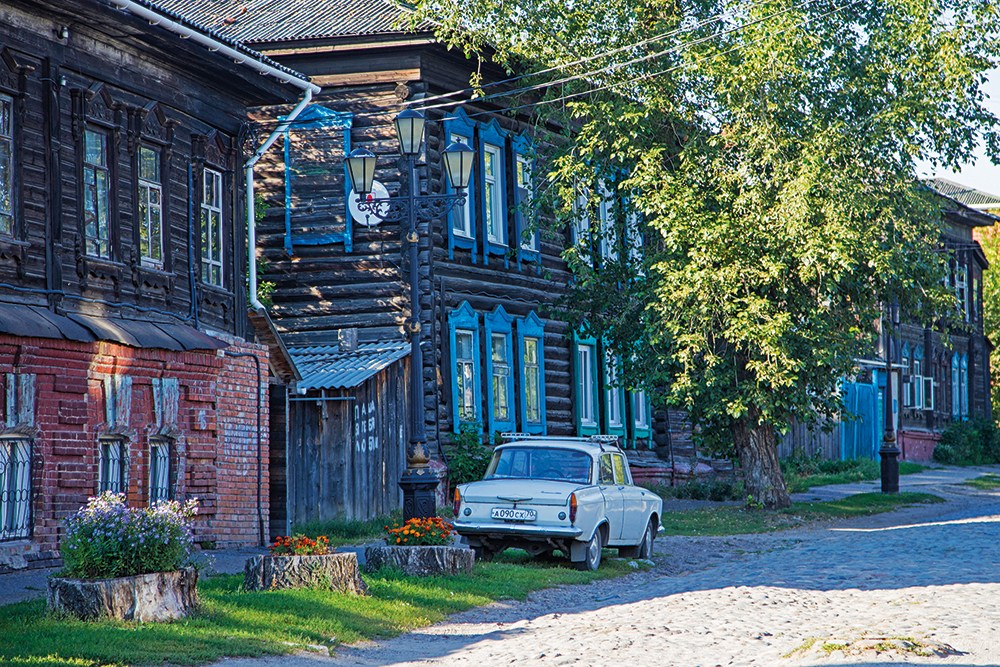
Out in the glubinka – deep Russia – she finds Medvedev’s former home: Ust-Bakchar, five hours north of Tomsk, in Siberia. It’s unexpectedly idyllic, a pretty village of wooden houses with burgeoning vegetable gardens. Andrei’s aunt Alya is the sort of warm, extremely capable woman recognisable to anyone who has travelled in Russia. She single-handedly manages a farmstead, two teenage sons and a job as a nurse, and like many in the remote countryside, appears less crushed than the Muscovites. She, for example, has no qualms about calling the war a war.
For every Alya, however, there is an Andrei: the generations of their family are hollowed out by addiction and grinding poverty. His grandmother died of drink. His younger sisters were adopted by a couple who beat them sadistically. His brother, along with so many other young men, is ‘on a course’, a euphemism for being at war in Ukraine. As in Moscow, few actively support the war and most regret it . But they are willing to suspend their disbelief: ‘Those at the top have the best overview.’ In the cities, prosperity holds the population to ransom, whereas in the provinces, poverty does the same: exhausts them, drives them to the temporary relief of the bottle, which only digs the pit of deprivation and suffering deeper.
Seierstad’s initial impression of Siberian outspokenness soon ebbs away, too, as those around her become suspicious. Who is this foreign author? (She avoids the word journalist, particularly as at the time she’s travelling the Wall Street Journal reporter Evan Gershkovich is still in a Russian prison.) Their fears – and her own – are exacerbated by mysterious phone calls checking up on her from ‘the Norwegian consulate’. This turns out to be the paranoid Medvedev himself, keeping tabs on her. Everyone is suddenly too busy to meet. When, in a malicious mood, he actually reports her to the FSB, she realises it’s time to leave – and, as she puts it, to ‘go over to the other side’.
She does not ignore the heroic other Russians who oppose Putin and the war. In a moving section of the book she meets oppositionists, both well known and anonymous. Dmitry Muratov, the editor of Novaya Gazeta, who has received the Nobel prize for his efforts to report the truth, is ‘full of energy and determination’, despite violent attacks on him. This exceptional strength of character is typical of the resistance to Putin, made up of a lone liberal politican, a few journalists, members of NGOs and private individuals who fight on against the lawlessness, corruption and ‘the most powerful oppression machine in our history’. In percentage terms they are, of course, a tiny proportion of the nation, yet they exist, a persistent thorn in Putin’s side.
In the cities, prosperity holds the population to ransom, whereas in the provinces, poverty does the same
Seierstad, however, makes them an endnote to her narrative, important, but not central. Instead she concentrates on Medvedev as he stumbles unthinkingly from children’s home to prison, then into employment as a goon for hire. He is the mindless, paid muscle who poses as a member of a right-wing organisation and beats up liberals. He is also, for a fee, the violent provocateur at anti-government protests who justifies the ensuing police crackdown. He’s one of the fighters who spearheaded early incursions into East Ukraine where the so-called people’s militias (largely Putinist creations) fought the Ukrainian army. Medvedev’s experience pulls back the veil on so much of the invisible and deniable mechanisms of control in Russia. He’s an agent of repression who has the attraction of being dispensable. He’s a monster and a victim – an abused child constantly reliving his early pain. No one would miss him much if he fell.
At one point his elderly teacher Valentina makes a throwaway remark on the pattern of state violence and popular revolt in Russia, saying: ‘The pain is passed down… That’s how it is in all families.’ The deeper that Seierstad probes into Medvedev’s life, the more relevant, to my mind, this comment seems. From early childhood, Andrei has had all the symptoms of PTSD, as did his father. A broader pattern emerges: the Medvedev family’s experience writ large in the behaviour of the nation. Russia itself, like Andrei, feels trapped in a cycle of classic trauma responses: hypervigilance to perceived attack, aggression, emotional numbness and the constant urge to self-medicate with alcohol. Putin’s decision to go to war may seem irrational and wildly self-destructive to the international community, his callousness about the high casualty rate crazy. But perhaps on some deep psychological frequency, his actions make sense to many Russians, still stuck in the unprocessed pain of the Soviet period.
To be clear, Seierstad does not claim that Medvedev is typical. As always under oppressive regimes, there is a vast percentage of the country that is not represented by its leadership. Recently we have seen crowds of young Russians protesting against the ban on Yabloko, the only political party to campaign for peace. Yet Never Say War is a portrait of the Russia that’s now in the ascendant, its most bloodthirsty medieval guise – a tragic view, leavened by Seierstad’s humane and sharp-eyed prose. A salutary read.




Comments