
“Europe is desperate for Energy, and yet the United Kingdom refuses to open North Sea Oil, one of the greatest fields in the World.” Donald Trump said this month on Truth Social. It is, to use the President’s phrase, “Tragic!!!” But the necessity of oil hasn’t always been recognized.
Back in 2008, while running for the White House, Barack Obama declared that one of the major challenges facing the US is “what we will do about our addiction to foreign oil.” His solution was to switch America to renewables. In that address, known as the “New Energy For America” speech, Obama said, “We simply cannot pretend, as Senator McCain does, that we can drill our way out of this problem.” He went on, adding: “Breaking our oil addiction is one of the greatest challenges our generation will ever face. It will take nothing less than a complete transformation of our economy.”
In June 2013, Obama again mocked the idea of increased oil and gas drilling. During a speech at Georgetown University, Obama introduced what he called a “new national climate action plan” that he claimed would make the US “a leader – a global leader – in the fight against climate change.” In that speech, Obama used the word “climate” two dozen times. He claimed Congress should “end the tax breaks for big oil companies, and invest in the clean-energy companies that will fuel our future.”
The line from that speech that still resonates today is this: “We can’t just drill our way out of the energy and climate challenge that we face. That’s not possible.”
Vladimir Putin helped fund the anti-shale gas propaganda that led European countries to ban fracking
Those speeches haven’t aged well. I’m not picking on Obama. That said, his rhetoric captured the anti-hydrocarbon/anti-drilling sentiment that prevails among climate activists and, unfortunately, among Europe’s political leaders. As the Battle for Hormuz continues, it’s clear that the global economy has become too dependent on the hydrocarbons and other strategic commodities that flow through the narrow waterway.
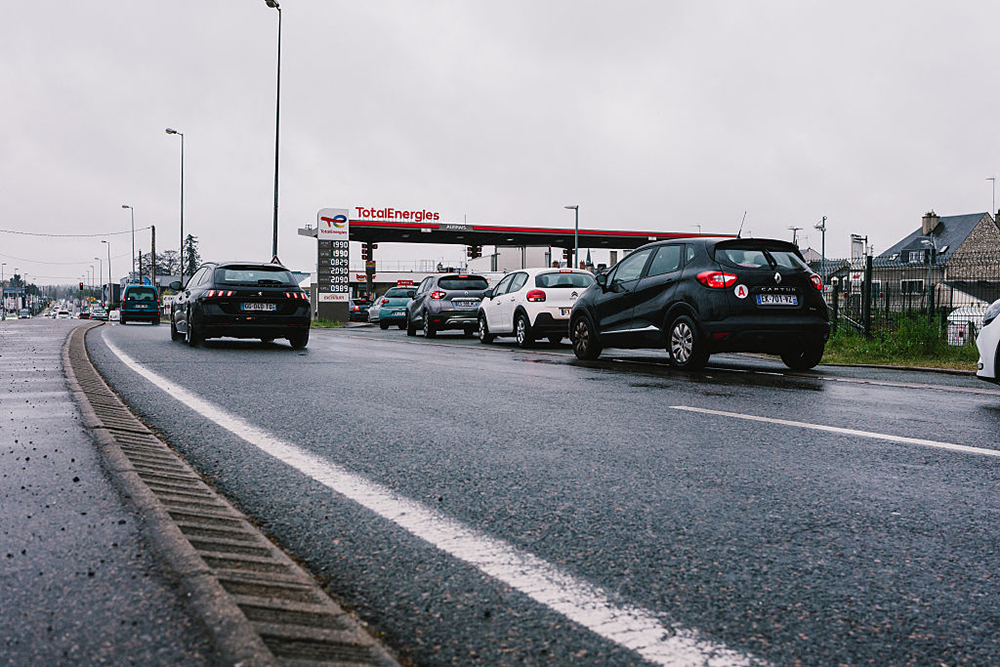
Europe’s energy strategy was built on imports and delirious hope. Both just ran aground in the Strait of Hormuz. Since February 25, three days before the US and Israel launched the air war against Iran, the price of natural gas delivered to the TTF gas trading hub in Holland has jumped by about 55 percent. Meanwhile, the US has been fully insulated from the energy price shocks hitting Europe and the rest of the world. Indeed, since late February, natural gas prices in the US have fallen by about 4 percent. To drive that point home, on April 9, the spot price at TTF was $15.56 per million BTU. Meanwhile, the price of that same amount of energy at Henry Hub in the US was $2.71.
What’s the difference? The answer is simple: the US actively drills for oil and gas. Europe doesn’t. Europe’s refusal to drill has made it heavily dependent on imported hydrocarbons and, therefore, left it at the mercy of the energy price spikes now slamming consumers around the world. Like it or not, it’s time for Europe to drill, baby, drill.
Before diving into the numbers, I will make two rather obvious points. First, Germany and Belgium were foolish to close their nuclear power plants over the past few years. Doing so made them more reliant on natural gas and, thus, more vulnerable to the price swings of imported gas.
Second, it’s essential to understand why European climate activists were so effective in getting their anti-drilling and anti-hydraulic fracturing policies made into law. In 2010, the Guardian sounded the alarm when it published an article saying that
Halliburton had used hydraulic fracturing on a well in Poland. The article was headlined, “Controversial gas ‘fracking’ extraction headed to Europe.” A year later, the process was banned in France.
Russian President Vladimir Putin and his cronies helped fund the anti-shale gas propaganda that led seven European countries to ban fracking. In 2014, Anders Fogh Rasmussen, then secretary-general of NATO and former prime minister of Denmark, said: “Russia, as part of their sophisticated information and disinformation operations, engaged actively with so-called non-governmental organizations – environmental organizations working against shale gas – to maintain European dependence on imported Russian gas.”
In 2016, the Wilfried Martens Centre for European Studies in Belgium published a report that found the Russian government gave about €82 million ($96 million) to “NGOs whose job is to persuade EU governments to stop shale gas exploration.” Britain imposed a ban on fracking in 2019.
Those fracking bans suppressed Europe’s oil and gas production, which left the continent at the mercy of the global market. Thanks to the shale revolution, US oil production nearly tripled between 2010 and 2024. A similar success story can be seen in the US natural gas sector. In 2010, the US produced 20.7 EJ of gas (roughly 55.6 Bcf/day). By 2024, gas production had nearly doubled to 37.1 EJ. Furthermore, by 2024, the US was producing more gas than it was consuming, enabling it to become the world’s largest LNG exporter.
Meanwhile, in Europe, oil and gas production is falling. Oil production fell by about 2.5 EJ between 2010 and 2024 while gas production fell by 4 EJ in the same period. While it’s true that gas consumption fell by 5.6 EJ over that time frame, the result was the same: Europe became more dependent on imports of gas, particularly in the form of LNG from the US.
The root of Europe’s declining oil and gas production is easy to see by looking at the rig count. Across Europe, excluding Ukraine and Turkey, there are only 42 drilling operational rigs. (Ukraine has 46 rigs running; Turkey has 28.) Meanwhile, the countries in the Middle East, as well as the US, are operating more than 500 rigs. Put simply, Europe has outsourced its drilling to other countries, and in doing so, it has outsourced its energy security.
Of all the countries in Europe, the United Kingdom provides the best example of a country that refuses to drill, consigning itself to ruinously high energy prices. The UK was once self-sufficient in natural gas. Now, it imports nearly half of the gas it needs to fuel its economy. Furthermore, only six rigs are running in the UK, and all are offshore.
Just over a year ago, during a trip to London, I wrote an article, “Britain is committing ‘national economic suicide.’” I explained that Britain has enormous oil and gas resources and could quickly reduce its energy prices if it began drilling. In February 2025, Deloitte had published a study commissioned by Egdon Resources, which estimated that the shale formations in Lincolnshire, known as the Gainsborough Trough, could contain 16 trillion cubic feet of natural gas, enough fuel to supply all of Britain’s gas needs for several years. Deloitte estimated the gas field could generate some $180 billion in GDP for Britain and dramatically reduce its need for imported gas.
By refusing to drill, the UK has become an energy weakling that’s rapidly deindustrializing
Despite the potential windfall, the Labour government blithely dismissed the idea of producing domestic shale gas. Shortly after the news about the giant onshore gas field in Lincolnshire broke, a government spokesman said: “We intend to ban fracking for good and make Britain a clean energy superpower to protect current and future generations.”
The hard truth is that “clean energy” is a bullshit slogan used by climate activists to persuade gullible politicians to adopt policies that result in economic suicide.
The second hard truth is that by refusing to drill, the UK has become an energy weakling that’s rapidly deindustrializing due to its ban on hydraulic fracturing, carbon taxes and crushingly high energy prices. That deindustrialization will now accelerate due to the Battle for Hormuz. The punchline here is so obvious that Ray Charles could see it. Since 2010, thanks to favorable geology, private ownership of mineral rights and continuous innovation in drilling and hydraulic fracturing, the US has seen its oil and gas production jump by 38.5 EJ. Over that same time period, Europe’s oil and gas output has fallen by 6.5 EJ.
Let me put the 38.5 EJ increase into perspective – it is the largest jump in energy production by a single country in human history. That rise in energy production is one-and-a-half times Africa’s energy consumption (21 EJ in 2024). It’s also roughly equal to two times Saudi Arabia’s oil production. And all of that increase occurred because the US drills more wells than any other country on the planet. And by drilling, the US has given itself a significant margin of energy security and saved its consumers untold billions of dollars.
After Russia invaded Ukraine, European politicians and bureaucrats should have sobered up about their energy and climate policies. They didn’t. And now consumers throughout Europe are paying the price, and they’ll keep paying a very high price until Europe’s elites recognize that they can’t outsource their oil and gas production to the Middle East, the US and other locales. To paraphrase the late Al Davis, Europe only has one choice: “Just drill, baby.”






Comments