
Growing up, I remember a set of strange colored mallets that occupied a dusty corner of the family garage. My mother had purchased them as a novelty, I learned, in an effort to take up croquet when she bought her first weekend home upstate. She had fond memories of playing croquet as a child, but to me it always rang somewhat ironic: the city slicker’s romantically anachronistic idea of, “What else is there to do in the country?”
So when I got invited to this year’s Annapolis Cup – the 42nd annual croquet match between St. John’s College and the US Naval Academy – I wasn’t sure what to make of it. My first instinct was to assume it was a gag, a silly put-on for charity. As my Maryland friends made clear, however, the cup is a fiercely competitive and cherished tradition in the small Annapolis community.
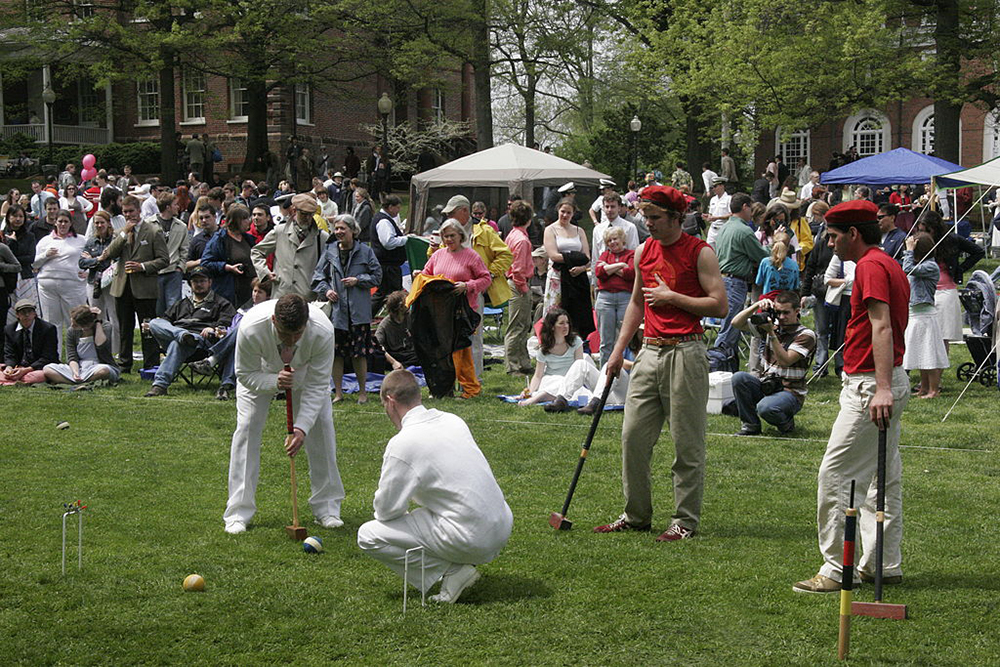
Gone are the days of backyard croquet; players weighed shots with heavy professional mallets
Croquet, which involves hitting a ball through small hoops (or wickets) with a mallet on a large grassy course, can be both posh and provincial. First codified as a sport in England in the mid-19th century, it quickly spread from aristocratic estates to America’s coastal elite. By the mid-20th century, however, croquet became better known as a middle-class backyard pastime, after religious opposition organized against the formally co-ed association team structure. Hence how my mother grew up playing croquet on 1950s weekend trips out of Queens.
One place croquet retains its elite trappings is at St. John’s – a bookish liberal arts college with a colonial-era campus in the heart of Annapolis, which played the sport consistently, if informally, throughout the 20th century. As legend goes, the first Annapolis Cup began in 1982 after a Naval commandant remarked to a St. John’s freshman that the Midshipmen could defeat the Johnnies at any sport. “How about croquet?” the Johnnie replied. The first official match took place the following year to improve relations between the rivals. The Johnnies won easily, a trend that continued through 32 of the next 42 annual matches despite the typical mismatch in physicality. As one Midshipman commented, “The Johnnies are out practicing croquet every afternoon! Alabama should take football this seriously!”

The Johnnies host on their campus each year, in what feels like an unfair home turf advantage until you walk on to their sprawling front lawn. It’s a picturesque scene with the college’s Great Hall looming in the background, but the conspicuously unmanicured terrain makes for highly technical gameplay.
Meandering through the crowd, I was struck by both the dress and enthusiasm, which I can only compare to that of the Preakness or Kentucky Derby. Nerds and jocks converged on the lawn in a friendly but evidently fierce rivalry, alongside local patrons whose families have called Annapolis home for generations coming out to show support. Despite a lack of formal dress code, men wore ostentatious blazers, madras and seersucker, while the women donned their biggest hats and extravagant florals to usher in spring. Revelers danced in the courtyard as the Navy’s marching band played.
The players themselves, a mix of co-ed college kids, appeared elite. Gone are the days of backyard croquet; players in sports shades weighed shots with heavy professional mallets. It feels fitting the cup now has an array of corporate sponsors and fashionable merch from cult brand Rowing Blazers. It’s also fitting, if somewhat ironic, that Maryland should carry on the elite Anglo tradition of croquet. Maryland was founded as a religious haven by the Catholic Lord Baltimore, and remains a heavily Catholic state. Yet in the horse world, the state is widely known for (almost exclusively) continuing the tradition of steeplechase and foxhunting in the US. These Catholics seem to think of themselves as the inheritors of the English aristocracy. Well, at least someone’s doing it.






Comments