
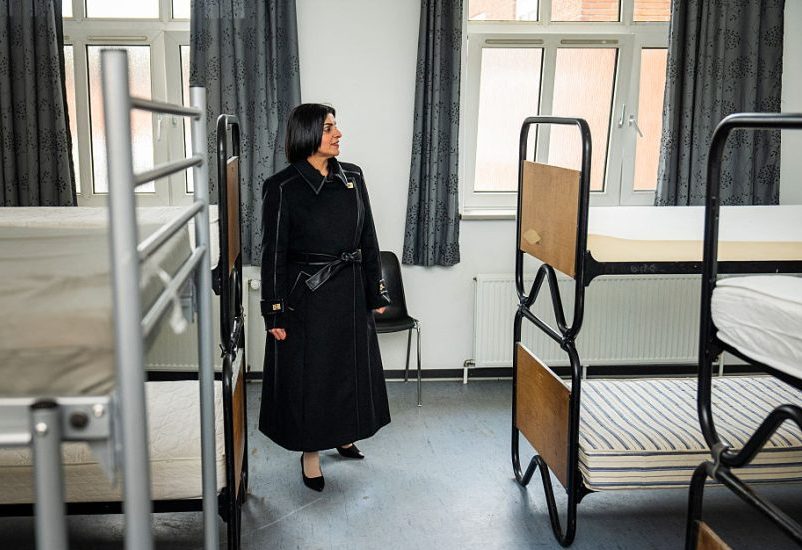
As of Monday, migrants arriving in Britain no longer have the right to claim permanent asylum. Home Secretary Shabana Mahmood has changed the rules so that now migrants will be eligible only for temporary refugee status. Asylum seekers’ applications will be reviewed every 30 months, and they could be returned to their country of origin if it is deemed safe.
There are caveats. People who have already submitted an asylum claim (100,000 submissions in 2025) are not affected by the new rules. Nor are unaccompanied children, who will continue to receive five years’ protection.
Mahmood hopes that these new measures will weaken the appeal of Britain to migrants. She has been influenced by a trip last week to Denmark. The left-wing government in Copenhagen has been the only one of its political ideology in Europe to take a tough line on immigration and asylum. In the last decade they have slashed asylum claims by more than 90 per cent, while ignoring the objections of human rights groups.
Many Britons will treat Mahmood’s rule change with scepticism
For the Danes, it’s logical to control one’s borders. ‘If you’re from the left, then you must have a strict immigration policy because it’s always the working class which pays the price of immigration…never the rich or bourgeois,’ said Kaare Dybvad when he was immigration minister in 2023.
Many on the British left disagree, despite the issue of immigration being the top priority for voters. The BBC says that as many as 40 Labour MPs have expressed disquiet about the prospect of any tinkering with settlement rights, describing them as ‘un-British’. Andy McDonald, the Labour MP for Middlesbrough & Thornaby East, warned that ‘focusing so negatively and aggressively on migration is a sign of political weakness and a capitulation to Reform’s poisonous agenda’.

It hasn’t been a weakness for Denmark’s left-wing PM, Mette Frederiksen, who has been in power since 2019. Last week she called a snap general election and opinion polls show her Social Democrat party is on course for a resounding victory later this month.
Mahmood spent two days in Denmark last week to get a better understanding of how the Danes have been so successful in controlling asylum and immigration. Last year, for example, they granted only 839 asylum permits, their lowest ever number.
Mahmood met Rasmus Stoklund, the minister for immigration, and heard that the government will soon pass a ‘ghetto law’ that will knock down apartment blocks where half or more of residents are non-Western. In an interview with LBC radio, Stoklund justified the law by saying:
We don’t want parallel societies. We won’t accept them and we won’t accept the norms of imams or anyone else trying to dominate areas of Denmark.
This isn’t so dissimilar from the recent comments of Sir Jim Ratcliffe, the billionaire owner of Manchester United. He lamented the ‘colonisation’ of Britain by immigrants, remarks which drew a furious response from Labour. Keir Starmer called Ratcliffe’s observations ‘offensive and wrong’, and demanded an apology.
That is one reason why many Britons will treat Mahmood’s rule change with scepticism. Is the heart of her party really in it? It will also surely be met with a legal challenge, as any proposals to tighten border control inevitably are.
Last summer, the government launched with much fanfare its ‘one in, one out’ migrant initiative in conjunction with France. Starmer swore blind that it was going to be a game-changer. After six months, Mahmood admitted that 350 migrants had been sent to Britain from France, and 281 had gone in the opposite direction. Last month, sixteen migrants launched a High Court challenge against the scheme, arguing that it fails victims of trafficking.
This isn’t just a British phenomenon; last summer Belgium tried to get a better grip on immigration by tightening rules for family reunification and restricting reception rights for some asylum seekers. Last week, Belgium’s constitutional court temporarily suspended the measures because of concerns they infringed human rights laws. The same happens in France, where the Socialist-controlled constitutional council routinely strikes down any attempt to tighten immigration and asylum policy.
Mahmood is probably sincere when she talks of the importance of addressing the ‘legitimate grievances’ many feel about immigration. It is what she described as ‘responsible’ politics. Alas, a great many in her party, supported by the human rights industry, are committed to acting irresponsibly.






Comments