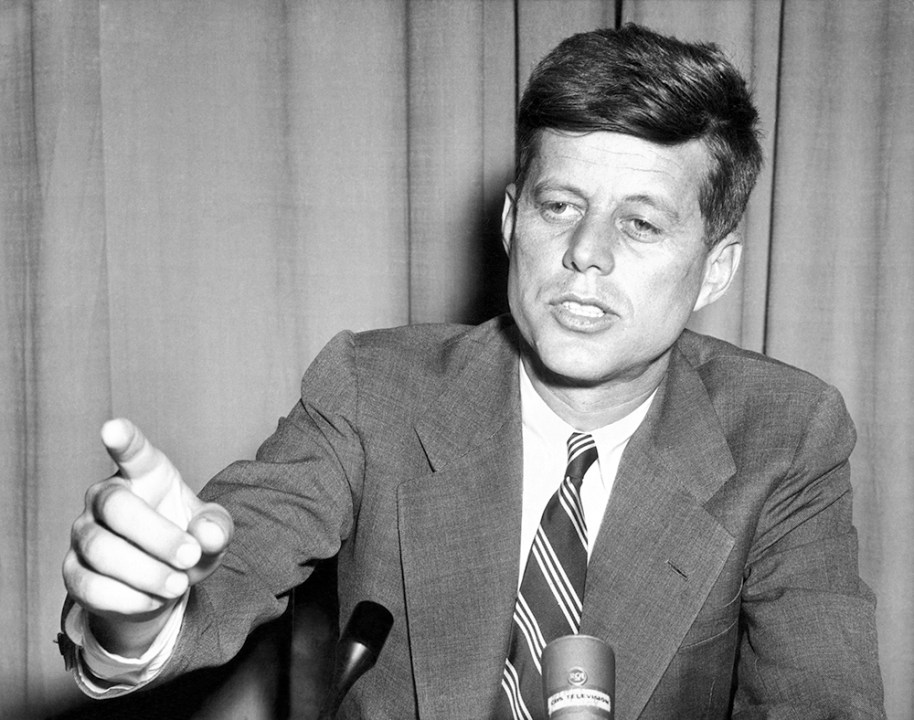
It is often said that you should never meet your heroes. According to a new book about John F. Kennedy, the 35th US president had only one hero, and it is hard to deny that he should have heeded that advice before agreeing to meet Winston Churchill aboard Aristotle Onassis’s yacht, Christina, in 1958. At the time, the wealthy, well-connected Kennedy was a handsome senator with an impossibly glamorous wife. He seemed destined for the White House. By contrast, Churchill was old, partially deaf and firmly established as an elder statesman.
Yet their eagerly anticipated encounter proved a disaster. It is unclear what possessed Kennedy to wear a white tuxedo jacket that evening. Perhaps as a James Bond aficionado, he hoped to emulate his great fictional hero. Regardless of his sartorial motivation, Kennedy had evidently not considered that Onassis’s staff would be decked out in precisely the same garment. In an unfortunate scene – reminiscent of Halifax confusing Hitler with the footman – Churchill took one look at Kennedy and mistook him for a waiter. The rest of the meeting was no less awkward. A combination of Churchill’s deafness and Kennedy’s ‘unfamiliar, high-pitched New England voice’ led to a brief, sketchy exchange.

According to Joel Nelson, the author of this intriguing, engaging and well- written book, ‘Kennedy’s dream of speaking with Churchill had died on Onassis’s boat’. That is undeniable – but what effect did Britain’s great wartime leader have on the US president more broadly? As the slightly hyperbolic title of his book suggests, Nelson argues that the older man’s influence was decisive and all-encompassing. However, the evidence for this bold claim is not always entirely convincing. We are told, for instance, that Kennedy admired Churchill’s mastery of language, especially ‘those great rolling phrases’ that were both ‘powerful and simple’. But being spellbound by Churchill’s linguistic ability was not unusual. Equally, that the young American, like Churchill, worked as a journalist before entering politics does not prove Kennedy’s desire to emulate his hero’s every move. Quite simply, his foray into journalism was, and remains, a well-trodden path.
However, Nelson has clearly done his research and is on firmer ground when he reveals that Kennedy instructed his congressional aides to gut the newspapers of every single reference to Churchill. Later, his wife was bemused to discover that Kennedy even copied Churchill’s sleeping habits. According to Diana Cooper, Britain’s wartime prime minister donned pyjamas for his post-lunch slumber, leaving him ‘like a daisy at 2 a.m. when others are exhausted’. In an effort to match his hero’s boundless energy, Kennedy followed suit. ‘If you could have only one thing,’ he once said of Churchill, ‘it would be that energy. Without it, you haven’t got a thing.’
This ‘obsession’ with Churchill long predated Kennedy’s time in politics. On his return from England in 1939, the usually laid-back Jack threw himself into his thesis at Harvard, which focused on the Munich Agreement and was largely based on Churchill’s view of Appeasement. During his time in England, Kennedy had befriended many of the country’s gilded youth, and as Churchill moved in the same circles there was always the tantalising prospect of a meeting. During a ball at Blenheim, full of pomp and splendour, including liveried footmen ‘more suited to the 18th century than the age of the airplane’, Kennedy was left awestruck, describing it as the best night of his life. Like the Tory MP in Alan Hollinghurst’s The Line of Beauty, who is driven to distraction by fleeting glimpses of Margaret Thatcher, JFK gazed admiringly at Churchill making his stately way through the gathering.
Churchill took one look at Kennedy in his white tuxedo aboard Onassis’s yacht and mistook him for a waiter
That the young Kennedy was able to enjoy such exalted company was thanks to his father. In a book of this kind, there is inevitably a great deal of padding, and Joe Kennedy is at times as much a part of the story as his son. Overbearing, obsessively competitive and highly ambitious, Kennedy senior comes across as a ghastly man, who had multiple affairs and even encouraged his sons to be sexually promiscuous. Franklin D. Roosevelt barely tolerated him, and when he appointed him his ambassador to London, the president snapped: ‘The first time he opens his mouth and criticises me, I will fire him.’
A staunch appeaser, who described the Anschluss as an ‘adjustment’ and danced for joy after news of Munich filtered through, Joe loathed Churchill. He even instructed his gardener to burn his copy of Churchill’s The Gathering Storm, and was then mortified to find his son reading it. But the father could do nothing, as the son had become a convert.
Still, Nelson’s claim that Kennedy’s Churchill fixation ‘altered the course of history’ is hard to sustain. The Bay of Pigs invasion was conceived under Eisenhower, though it was Kennedy who authorised it. Channelling Churchill’s attitude towards Suez, the president said that he did not know whether he would have started it, ‘but having started it, I would never have allowed it to end in anything but victory’. Churchill aside, however, Castro was a thorn in America’s side and, as a relatively young and inexperienced president, Kennedy felt under pressure to prove himself as a tough anti-communist. As for the Cuban Missile Crisis – perhaps the defining foreign policy event of JFK’s presidency – Churchill’s influence was marginal. Apart from the president’s eyes shining with ‘a particular glitter’ when one of his aides mentioned Churchill, the only other connection came when Kennedy explained that the lessons of the 1930s compelled him to take firm action to avoid a third world war. But with the exception of Jimmy Carter, it is hard to imagine that any modern US president would have acted differently.
Ultimately, Nelson’s work has many strengths: the story is well-researched, stylishly told and, at times, quite convincing. But even if one fully accepts his thesis that Churchill ‘defined’ the Kennedy presidency, it would hardly be very surprising. After all, history has been kind to Churchill, and, as Kennedy knew, that is partly because Churchill wrote much of it himself.




Comments