
I spend rather too much of my time mentally ranking foodstuffs, as if at any moment I might be called upon to deliver an ordered list of pizza toppings or commercially available chocolate bars, and that the task would have some sort of bearing on national security or the welfare of my family. Should a jambon beurre or a falafel wrap sit higher on the list of Lunches From Pret? (I’m pretty sure it’s the jambon beurre.)
The rankings change according to the season, day of the week, and my mood. But when it comes to sweet baked goods, I feel like I’m being asked to choose between my children. How does one pick between an almond croissant and a yum-yum? Are brownies and cookies in the same category as one another? Do seasonal bakes count?
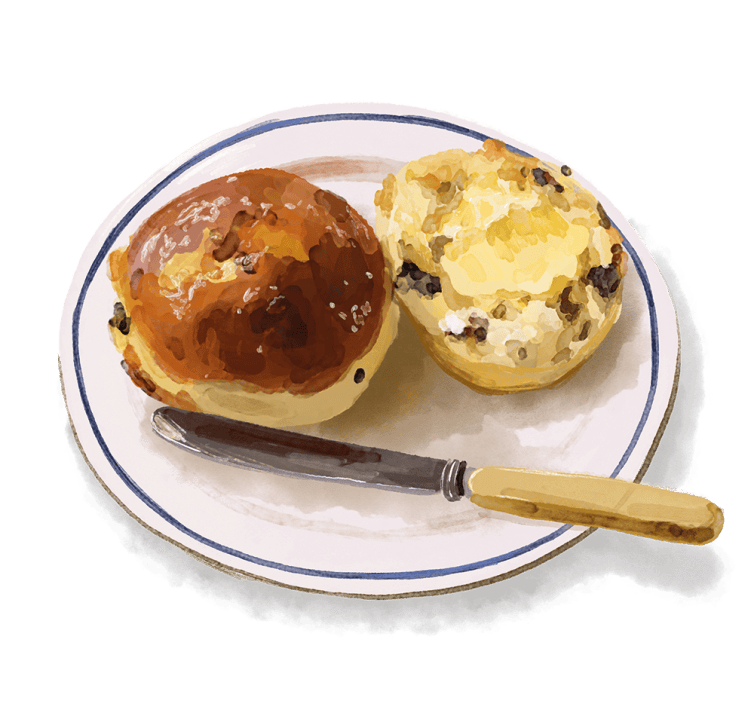
But I really think that of the cornucopia of baked goods from all around the world, made with so much skill and creativity, a sticky bun remains my number one. When push comes to shove, what I want is a crumb softer than cashmere, a wide surface area for thick butter, and a taut, golden crust. Round and domed, please, just too big to fit in the palm of the hand, and sticky enough that it leaves a residue of syrup on the fingers.
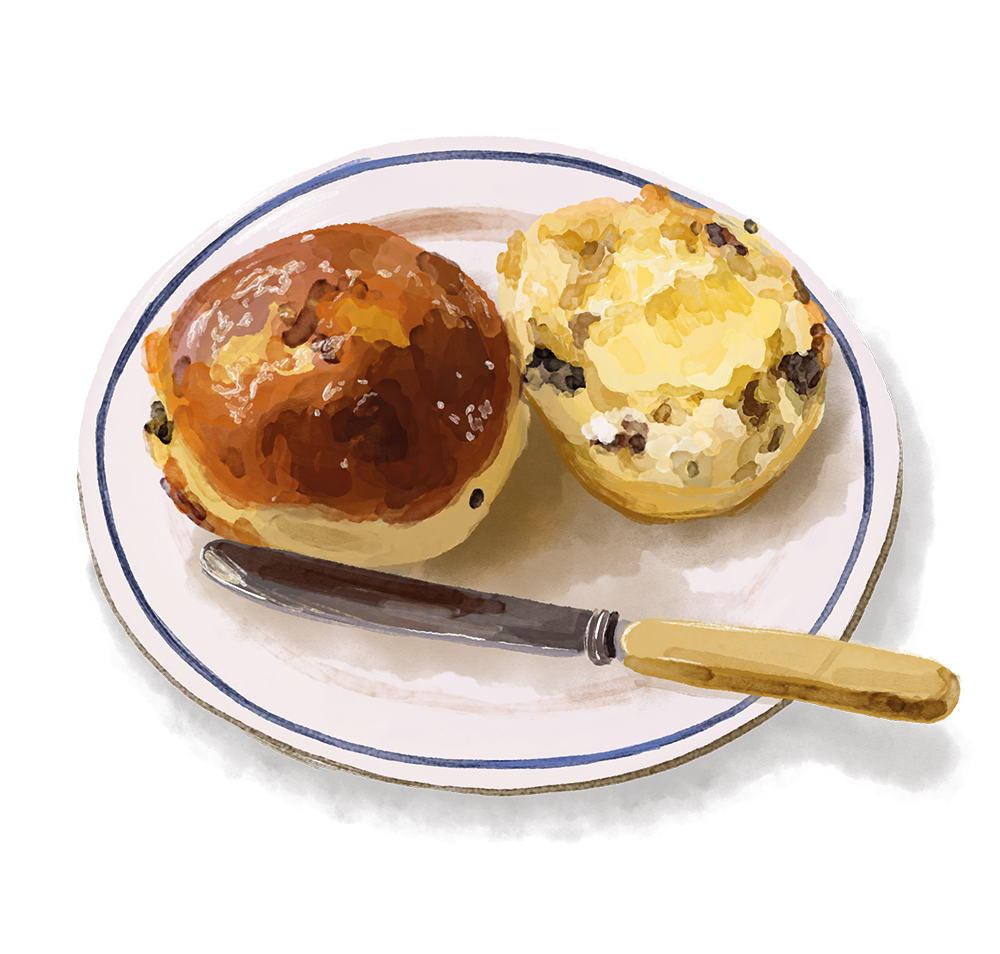
The Cornish bun is made with clotted cream, which gives it a soft and luscious crumb
When it comes to flavour, saffron would always top my personal rankings. Saffron is, as far as I’m concerned, magical. Spun gold, like something Rumpelstiltskin would produce if he were culinarily inclined, it has a taste that is at once wholly distinctive and hard to pinpoint. Honeyed, earthy, clean and slightly bitter, and somehow like warm metal. Not to mention the colour. In the jar, the threads are a fiery red, but diffused in water they turn it an orangey yellow. Once baked into a dough, the finished product is the colour of egg yolk. It truly is magical. And while saffron is beautiful in savoury dishes, in lamb tagines and paellas and fish stews, its earthiness is made for sweet baked goods. What the writer Kate Colquhoun calls the ‘militant, tobaccoey bitterness of saffron’ is perfect as a foil to sugar, butter and fruit.
So a sticky bun made with saffron is pretty much as good as it gets. It is also, happily for this time of year, gently festive. In the south-west, the saffron bun is often called a revel bun, because it was traditionally enjoyed on high days and holidays. In Cornwall, the buns would be made on Good Friday and cut with a cross, while for Christmas they were shaped into little cottage loaves. During the first world war, saffron buns were an integral part of the Christmas care packages sent to soldiers from Newquay who were fighting abroad. As we creep towards Christmas, I’m happy to use that as an excuse, if excuse were needed, to bake these lovely buns.

The Cornish bun is made with the region’s celebrated clotted cream, which gives it a distinctively soft and luscious crumb. In the 18th century, saffron grew in the milder climes of Devon and Cornwall and Essex, but really nowhere else in England, and so the spice became a calling-card in Cornish baking. Early recipes refer to the buns as cakes, and they tended to use fortified ‘sack’ wine as a flavouring, with the whole thing covered in rosewater-flavoured sugar icing. Today the buns are simpler, no sack wine, no rosewater, no icing. Just sweet, saffron-infused, and studded with dried fruit and little jewels of candied peel.
Then there’s the serve: for my money, there’s only one way to eat these buns. I concede that, made with clotted cream and hailing from Cornwall, there is an argument for piling more cream on top, but I remain loyal to butter. The halved buns deserve cool, salted butter on their beautiful even crumb. It requires a generous hand in the spreading of the butter – but what doesn’t?
Serves: 10
Hands-on time: 20 minutes, plus proving time
Cooking time: 20 minutes
- 300ml whole milk
- 2 generous pinches of saffron
- 100g clotted cream
- 50g butter
- 550g strong white bread flour
- 1 teaspoon fine salt
- 7g fast action yeast
- 70g caster sugar
- 75g raisins or sultanas
- 40g chopped citrus peel
For the glaze
- 50g caster sugar
- Bring the milk to a simmer in a small pan. Remove from the heat and add the saffron threads, the clotted cream and the butter, and stir. Leave to infuse for 30 minutes, until the milk
is just warm. - In a large bowl or stand mixer, mix together the flour, salt, sugar and yeast, then add the infused milk. Using a dough hook, knead the mixture for five minutes, or ten if you’re doing it by hand. Add the fruit and peel, and knead for a further five minutes. Cover the bowl, and leave to prove in a warm place for an hour.
- Knock the air out of the dough and divide the dough into ten pieces, then roll each piece into a ball. Space these out on a baking tray, cover loosely with clingfilm, and leave to prove for 30 minutes. When the dough is ready, it will bounce back when pressed gently with a finger.
- Preheat your oven to 200°C/180°C fan. Bake the buns for 20 minutes.
- Make a syrup by combining the glaze sugar with an equal amount of water in a small pan. Bring the sugar and water to the boil, then simmer for another minute.
- When the buns are baked and still hot, immediately brush them with the syrup. Leave to cool completely.
Join Olivia Potts for Patisserie in Paris on 12-16 April 2027. For more details about this Spectator Club trip, go to spectator.com/tastings.





Comments