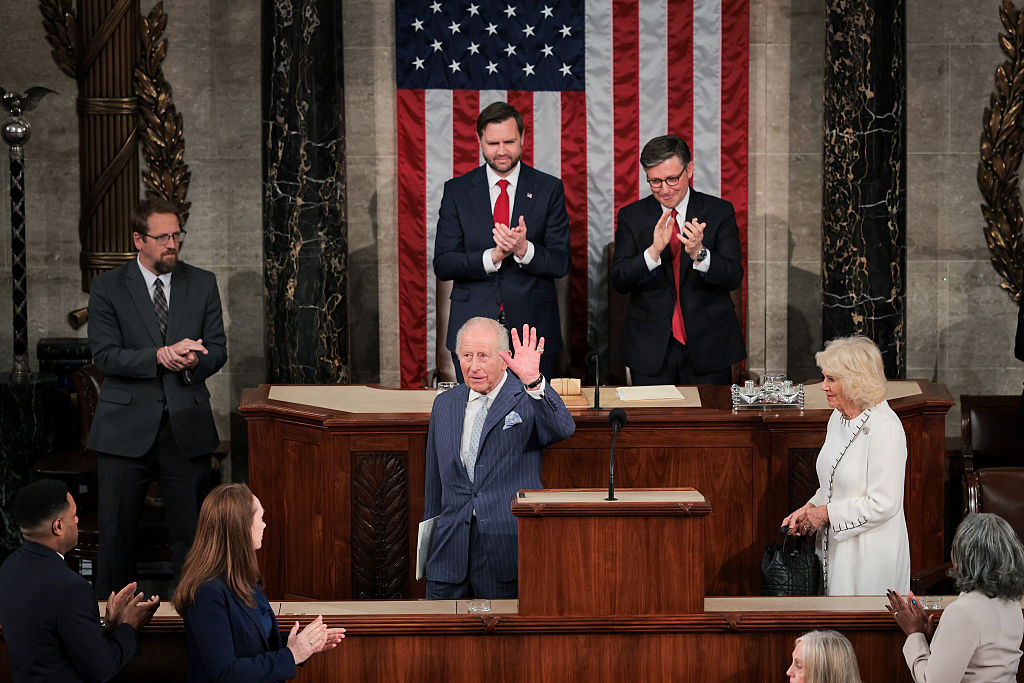
President Trump lavished praise upon King Charles from the Oval Office at the outset of his four-day state visit to the United States. The US president called the monarch ‘a man of class’. ‘It’s great to have a king in here,’ he said. A conspicuous absence of ‘No Kings’ protests in the presence of a real king had not gone unnoticed. But it was Charles’s address to a joint session of Congress that was eagerly awaited on both sides of the Atlantic.
This was a speech notable for its well-delivered gravity, rather than its jokes
His most substantial public speech since he acceded the throne in September 2022, there was a good deal riding on its success. His mother had addressed Congress in May 1991. Her text was an uncontroversial message of ‘collaboration and respect’ between the two nations. Then, as now, the speech took place against the backdrop of war in the Middle East – the Gulf War had concluded a few months before. But the stakes were higher this time round, for any number of reasons. The assassination attempt on Trump on Saturday being only the most recent.
Charles began with an amusing reference to Oscar Wilde, ‘our countries have everything in common, except of course language.’ But then he went into more serious discussion of how ‘we meet in times of great conflict.’ He referred to Saturday’s shooting – ‘such acts of violence will never succeed’ – and an ovation duly followed. There were many more, dragging the speech out to over half an hour, rather than the billed 20 minutes.
The speech acknowledged disagreement and past conflict between America and Britain, and not just in 1776. Charles stated that ‘ours is a partnership born out of dispute, but no less strong for it.’ Yet it also emphasised shared values, history and the ‘irreplaceable and unbreakable’ bond between the two countries (more applause).
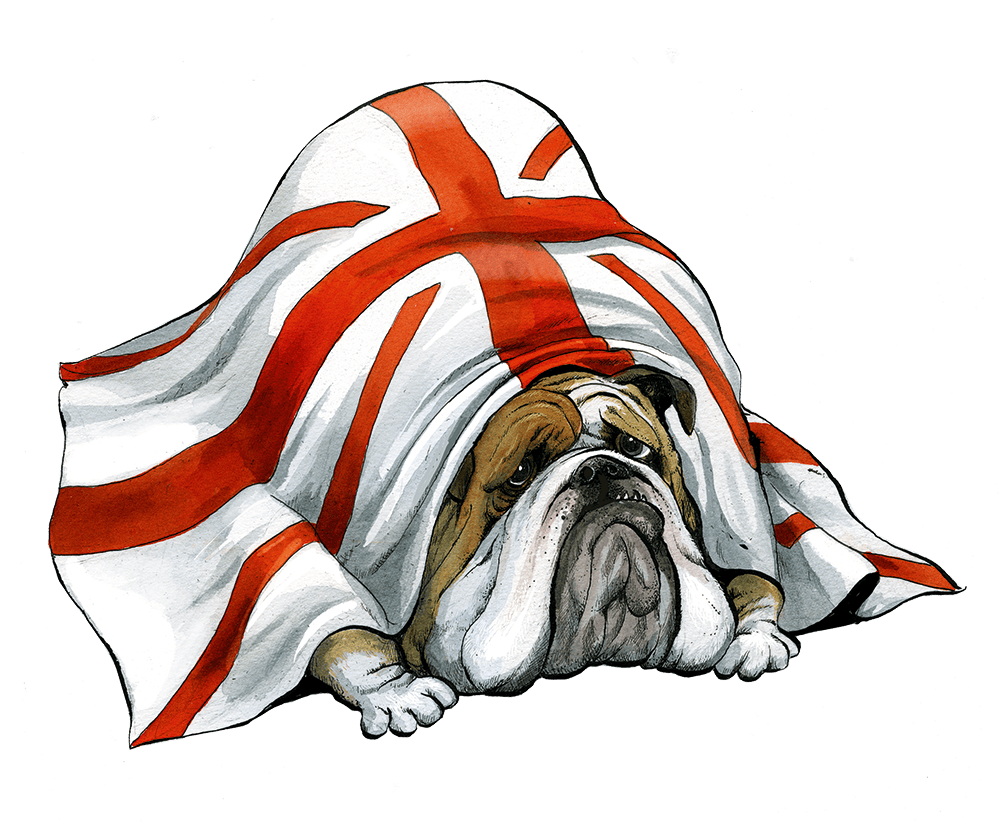
It was his 20th visit to the United States, and there was a good joke about how he was not there ‘as some part of some rearguard action’ to take back the former colony, but instead to celebrate all things American. All of this – even references to the Magna Carta – was met with whooping and cheering, quite unlike what the King ever receives in his own country. No wonder that he looked like he was enjoying himself.
Still, this was a speech notable for its well-delivered gravity, rather than its jokes. Some of it seemed designed to challenge various myths that exist – Charles’s extolling of his Christian faith seemed a deliberate answer to those who have called him a secret Muslim. Although he went out of his way to praise the interplay of other faiths. When he talked of ‘generosity of spirit’ and how the Anglo-American alliance was ‘a partnership… more important today than it has ever been’, there was a clear tacit reproach to those on both sides of the Atlantic who have rubbished the special relationship.
It was an address that drew upon history. Charles reminded his listeners that he was the 19th British monarch who had existed since the foundation of the United States and referred to his mother’s presence before Congress 35 years before. He talked about his grandfather George VI and grandmother Queen Elizabeth’s successful visit to America in 1939 to elicit Roosevelt’s support for the coming war. And even referred to his beleaguered Prime Minister Keir Starmer, lucky to be in post after being engulfed by scandal and controversy.
If there was an underlying theme to the speech, it was that of solidarity amid violence. Whether it was the attempted shooting last weekend, 9/11 or war. Unlike Russell Brand, the King was able to cite a verse from Isaiah without difficulty, saying: ‘It is my hope – my prayer – that, in these turbulent times, working together and with our international partners, we can stem the beating of ploughshares into swords.’
It was a speech that seemed more aimed towards a Democratic, or even old-school Republican audience, than the MAGA one. Although the latter constituency was no less fervent in their applause than their colleagues. Certainly, his talk of ‘shared security’ and how that ‘unyielding resolve’ needed to be maintained for the defense of Ukraine was a clear, if tacit, rebuke to Trump, whose support for that nation has not always been steadfast.
There were further pointed comments when it came to environmental issues. He spoke of ‘the diversity of nature’ and suggested that ‘nature’s own economy’ was the basis for our prosperity and security. If the camera had cut to the President at that precise point, it would probably have found him scowling at what he would undoubtedly have perceived as a dig.
Those who have denounced Charles as a ‘woke king’ will have had their ammunition. And it was certainly far from a perfect address. There will be those who regret the absence of any explicit reference to the victims of Jeffrey Epstein. A woolly allusion to how we must ‘support victims of some of the ills that, so tragically, exist in both our societies today’ could easily have been missed, which was probably the intention. And the wide-ranging speech was perhaps too wide ranging at times, losing focus in the process.
In trying to keep everyone happy, but perhaps betraying the monarch’s liberal ideals too often, it ran the risk of Clinton-esque triangulation. Making one wonder what these two legendary adulterers would have made of one another in the mid-Nineties.
Its stirring peroration was complete with allusions to Lincoln and the Gettysburg Address. And the hope that we will ‘let our two countries rededicate themselves to each other in the selfless service of our peoples and all the peoples of the world…God bless the United States and God bless the United Kingdom.’ It was hard not to feel that this well-delivered and pointed prayer for unity and strength was exactly what the King needed to say – and that he said it well. God save the King, indeed.




Comments