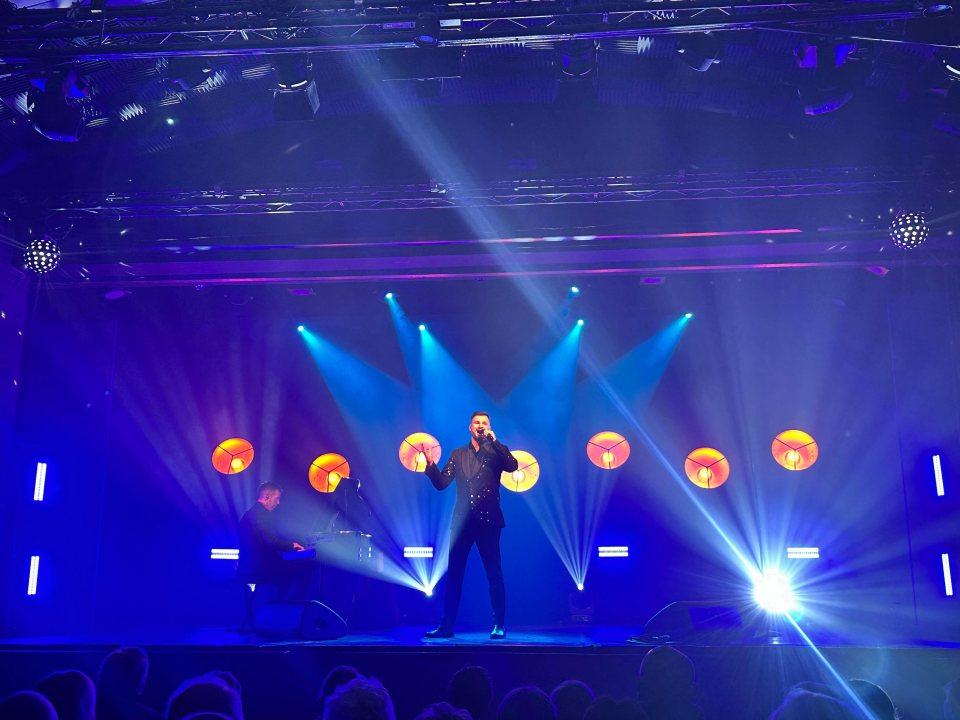
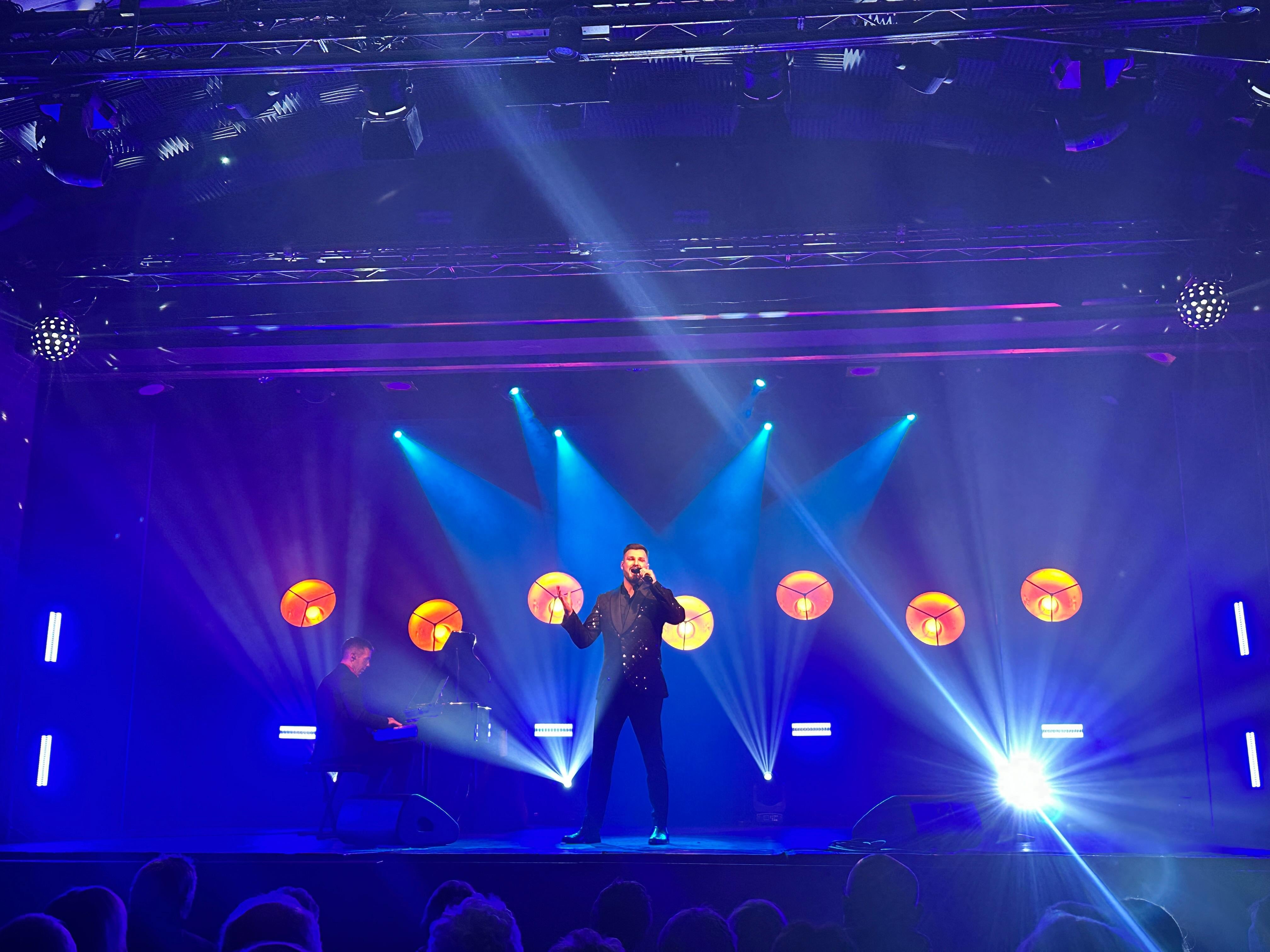
I’m backstage with classical crossover singer Karl Loxley and his pianist Tim Abel at Stratford-Upon-Avon’s Rother Street Arts House. The sound and lighting team are setting up in the empty theatre for what will be one of the final shows in Loxley’s ‘Songs of Christmas’ tour. Since 2015, when Loxley sung Puccini’s ‘Nessun Dorma’ on the TV talent show The Voice, he’s been on a mission to make classical music cool. I’m here to see exactly what that involves – and if he’s succeeding.

Loxley is charming, expansive and – at least when I interview him, a couple of hours before showtime – relaxed. Appearing on The Voice, he tells me, was ‘a very nerve-wracking experience. I don’t think I would have the nerve to do it now. I think when I was 24, going on there, I didn’t really have such anxiety or nerves, I just kind of went for it’. Ten years on, with three albums to his name and millions of fans on Spotify and YouTube, he still gets nervous: ‘I like to play characters. I like to not be Karl, but play a role. Then suddenly, when you’re doing concerts, it’s very exposing because it’s you, it’s your personality, you can’t hide behind anyone.’
Loxley discovered his talent for singing at the age of 17, while playing Jean Valjean in a school production of Les Miserables. He had lessons with Gaynor Keeble, a Royal Opera star, and at the age of 19 won a full scholarship to the Guildhall School of Acting. Loxley mainly performed in regional productions and pantomimes before appearing on The Voice, Rather than seeing the TV show as the apex of his young career, he used it as a launch pad: ‘A lot of people sit back and think Simon Cowell’s going to come knocking. [But] for me the goal was always to work from singing. If [you] can make a good living from doing what [you] love, I think you’re then living the dream.’ Loxley works hard off the stage, too, managing his tours and doing all his own marketing.
Both regular performers on cruise ships, Loxley and Abel met while Covid-testing in LA’s port as the pandemic slowly receded (‘I thought he was a waiter!’ jokes Loxley). Around 400 people attend their Stratford show, many of whom appear to be over retirement age. But there are also plenty of young and middle-aged couples, some with their children. Abel, a brilliant virtuoso, opens with a solo piano arrangement of ‘Sleigh Ride’, accompanied by a backing track and energetic light show. Then Loxley bounds on stage and launches into ‘White Christmas’. For the next 90 minutes, he sings operatic and musical pieces, pop songs and carols, ranging from Verdi to Leonard Cohen, Ed Sheeran to Phantom of the Opera. He also includes a song of his own, ‘See the Lights’, jokingly introducing it as a Christmas song ‘everyone will definitely have heard of’. The audience seems to love every minute. As we rise for the interval, a man in front of me murmurs: ‘Brilliant. Absolutely bloody brilliant.’
Purists, perhaps, would argue that Ed Sheeran should sound different from Puccini – that crossover artists cancel crucial differences between genres
It is partly his eclectic selection of pieces that makes Loxley a crossover artist. The other defining element of his performances is that every song, regardless of its genre, is sung in the same luxurious tenor. Purists, perhaps, would argue that Ed Sheeran should sound different from Puccini – that crossover artists cancel crucial differences between genres. As a classically trained pianist, I have defended that view myself. But as I reflected throughout Loxley’s show, that kind of attitude started to seem somewhat joyless and pedantic. Here was a singer loving performing, and a theatre full of people absorbed in his performance. What was wrong with that? Loxley talks to the crowd in between pieces, engaging them in a way that classical musicians rarely do. His audiences are part of the show – not a silent, distant mass beyond the footlights, ignored by the musician they’ve paid to see.
Loxley and Abel find performing an absorbing experience. ‘We spend so much time in our heads thinking about the future, thinking about the past,’ says Abel. ‘How much time do we actually spend 100 per cent focused on the present? For me, when I go on stage, it is that entire 90 minutes, you’re in that moment… We’re enjoying pure present.’ For Loxley: ‘The concerts just fly by. You think: “Was I on stage for ten minutes? Actually I was on there for about 50 minutes”.’
By the time Loxley belts out ‘Nessun Dorma’ as the evening’s finale, I am deeply moved. Snobbery about crossover classical singing now seems laughable. ‘Classical’ is an arbitrary label, and the distinctions between types of music are of secondary importance to the music itself. Music is about connection and emotion, about enjoying ‘pure present’, as Abel puts it – and that is what Loxley delivers.



Comments