
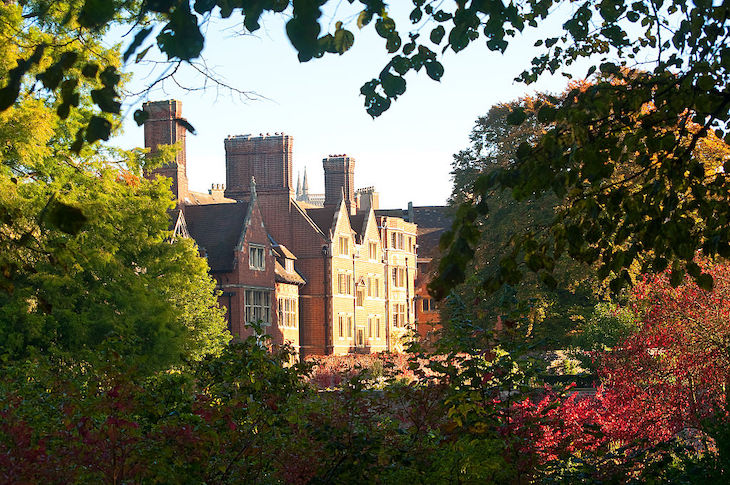
Shock horror. A Cambridge college has realised that to recruit the brightest students sometimes you have to encourage students from private schools as well as state comprehensives in poor neighbourhoods. You can almost feel the foundations of higher education quivering at Trinity Hall’s decision to write to private schools to encourage pupils to apply for certain subjects, such as languages and classics where there is presumably a dearth of applications.
Trinity Hall’s ‘targeted recruitment strategy’ has sparked fury
Predictably, Trinity Hall’s ‘targeted recruitment strategy’ has sparked fury. One college staff member said it was a ‘slap in the face’ for state-educated undergraduates. Lee Elliot Major, not the bionic man from the 1970 series but the Professor of Social Mobility at the University of Exeter, told the Guardian: ‘What is truly shocking is the implication that widening participation students are academically inferior’.
The college, of course, isn’t implying that at all. It simply wants to fill its places with the best pupils and has realised that, in order to do that, you don’t just need to reach out to lowly-performing state schools – although that should be part of any university admissions policy. You also have to advertise yourself to top private schools, including Eton, Winchester and St Paul’s Girls, and reassure them that you are not going to discriminate against them because of their background. If you do not do this, while making a big noise about your diversity policies, you will end up making those pupils feel unwanted. They will apply elsewhere because they will get the impression that they will be turned away purely on account of their background. Among those who are especially likely to be discouraged are bursary students at independent schools.

Trinity Hall is not short of initiatives to attract applications from state schools. It has been doing so for a very long time. I know that because in 1984 I was invited on an open day from my state grammar school and encouraged to apply. I did, and was accepted.
When I got to Trinity Hall, all students were invited to contribute to a bursary scheme to attract an undergraduate from Africa. Back then, around half of undergraduates were from private schools, but by last year it had fallen to 26 per cent. This meant that private school pupils, who make up around 7 per cent of school pupils nationally, are over-represented statistically. But that is a very different thing from being discriminated against: to make that charge makes the false assumption that intelligence, as well as application, is evenly-distributed among the population.
Look at exam results and you can see why Trinity Hall might just be wondering whether its diversity drive has ended up discouraging applications from the brightest students. Last year, it fell to a lowly 18th position in the Baxter table which collates exam results from Cambridge colleges and ranks them accordingly. In my day, it was top of the equivalent table (although I regret my own Bishop Desmond – or 2:2 – didn’t help keep it there). It is hardly wrong that the college should seek to improve its academic performance by making sure it is not missing out on private school applications.






Comments