
1) He’s the most effective speaker we’ve had in a PM for years
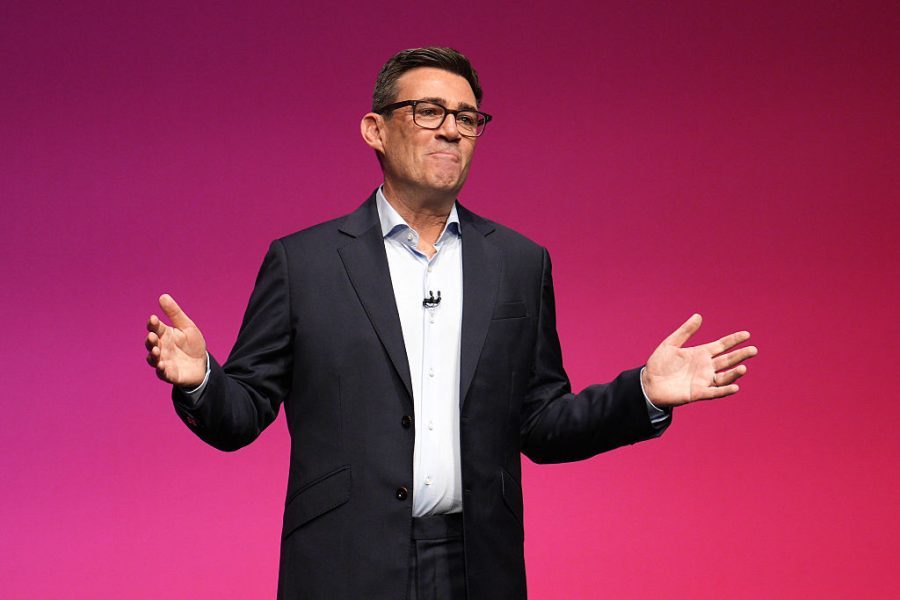
I’ve been attending party conferences since 2001 and in that time I’ve heard around 70 leaders’ speeches from all the parties. This was one of the most important and defining – I expect it will remain among the half-dozen most memorable. It was big on heart, rather than brain, at times hugely emotional and strangely moving as Burnham became overcome when discussing the recent death of his father. This was both big and bold and nostalgic but also intimate, quiet, drawing you in, gently elegiac for what has been lost in a way you could appreciate (even if you don’t accept Burnham’s diagnosis of what has gone wrong). I judge speeches on ‘the tingle factor’, whether I get that prickle up my spine. It was not Kinnock ’85 or even the best of Blair’s speeches but it was as good as anything we’ve seen since.
It was not Kinnock ’85 or even the best of Blair’s speeches but it was as good as anything we’ve seen since.
2) He wants to go big or go home
We knew it was going to be big as soon as we heard the PM had taken his ministers into a lengthy political cabinet before he got to his feet. This was because his team had kept the details tight and needed sign-off from his top team. As someone who spends a lot of time demanding that politicians tell us who they are, have an analysis of where we have gone wrong and a plan to fix it, as well as a means of doing so, this was, to a degree, a breath of fresh air. ‘You may disagree with some or all of what I’ve said,’ he said at the end, ‘but I’ve given you what you all say you want’ – i.e. clarity and a plan. He was undeniably bold: a National Care Service, a pledge to introduce electoral reform, a national commission which opens the door to rejoining the European Union.
3) His idea of ending division is for everyone to agree with him
Burnham came on stage for his big speech at Labour conference to the Farm’s ‘All Together Now’. He declared that his creed and said this moment marks the end of division. ‘A Britain for everyone,’ he promised. He claimed he was eschewing the ‘tubthumping’ political speech he wanted to give. ‘I’m going to give you a real speech,’ he claimed, packed with ‘hard truths’. In the 55 minutes which followed, however, he outlined the most partisan left-wing set of priorities we have seen since the days of Harold Wilson. Hard truths became a wish list of Labour nostalgia. He talked about building ‘a new economy and a new politics’ but much of it was wearily familiar for anyone acquainted with the politics of the 1970s.
4) He blames Blair nearly as much as Thatcher for Britain’s malaise
Burnham explicitly called for the changes of the last 40 years to be overturned, as if the 1970s were some sort of halcyon age of British politics and society, rather than the tired denouement of a failed postwar consensus. It was as if the three-day week, Britain’s days as ‘the sick man of Europe’ and running cap in hand to the IMF never happened. As if three Labour election victories and 13 years in power, in which Burnham served as a cabinet minister, were a horrid mistake for his party. Only at the end of the speech did he suggest 1997 was also a ‘new dawn’. There was also lubricious praise for Steve Rotheram, the mayor of Liverpool, and the transformation of the city he has presided over. Liverpool is a fine place but some of us with longer memories recall that the revival began during Burnham’s hated 1980s when Michael Heseltine was local government supremo.
5) His care scheme has the same fatal flaw as all the others
Burnham thinks his path to becoming a great prime minister is to introduce a National Care Service ‘free at the point of use’, which he boasted would be ‘a landmark as significant as the creation of the NHS’. The only Labour prime minister he referenced positively was Clement Attlee. He said other politicians had been ‘too cowardly to fix something as basic as the care we give each other’. Burnham admitted he may end up paying a ‘political price’, but said: ‘Someone has to go through the pain barrier and rip the plaster off.’ Bemoaning the care given to his grandmother, he said: ‘The modest savings she had built up from the house where I was born? All taken to pay for it.’ Yet in the huddle with Labour apparatchiks after the speech, Burnham’s aides made clear that the National Care Service will only pay for care, not for the residential costs of care homes. The numerous ministers who hit the airwaves after the speech to say: ‘It’s a scandal people have to sell their homes,’ appeared not to be aware of the fact that this will continue, even if Burnham gets his way.
6) His changes to the triple lock will bring savings – but not fast
It was brave to take on the pensioners but many independent observers will welcome the proposed change. The state pension will go up by 2.5 per cent or price inflation, but this is not a double lock but a new triple lock. Instead of matching prices every year, with some attendant spikes, pensions will rise so they remain in the same ratio with earnings. This will remove the ratchet effect of random annual spikes and save £40 billion a year by 2040, but the initial impact (only beginning in 2030 in any case) will be minimal, certainly not enough to fund a National Care Service. Which brings us neatly back to the question of who will pay? Burnham said only it would not come from borrowing. Which means tax rises or spending cuts – and he offered not one cut in the entire speech.
7) Burnham has almost no interest in world affairs
What really made this a different speech from most I have heard from a national leader was what he left out. There was barely any mention of the economy or taxation, no clue about who will get hit in the Budget. We are virtually at war with Russia, but it got a glancing reference only, along with China, terrorism and Iran. We know Burnham is much more interested in domestic policy, but that means Ed Miliband – who is glad-handing the mullahs of Tehran and whose speech on Monday was disturbingly messianic, shaking with the kind of self-righteousness over the Palestinians you expect from an NUS president – has more sway and that is not reassuring. There are no votes in foreign affairs, but these are issues you expect a prime minister to tackle.
8) He offered nothing to the aspirational middle classes
I lost touch of the number of times Burnham talked about the ‘working class’ and what has been done to them over the years. His entire focus was on rescuing them, saving them, lifting them up. There was precisely nothing, rhetorically, for the striving middle classes, who will presumably have to fund all these visions of the future. He’s also done away with Margaret Thatcher’s signature policy of Right to Buy for new-build council homes, something a lot of working-class people would say transformed their lives more than any other. A simple policy of ‘build a new council house for every one sold’ would preserve the stock, but Burnham is so fixated on overturning the last 40 years that he would rather cut off a route towards home ownership and self-improvement. The former Labour spads and the Labour MP I ran into outside the conference hall all thought this was pretty awful. Then there was his pledge to ‘rebuild a system of comprehensive education in this country’ as if the Blair government had not pioneered academies, the change which Michael Gove supercharged and which have seen England zoom back up the world rankings for reading and maths. This is not what most aspirational parents dream of for their kids.
9) He has no plan for growth
Perhaps worse, Burnham presides over an economy in drastic need of jump leads and barely said anything about it during an hour of oratory. We were treated to his ‘theory of growth’ – that if you take essential services into public control and give power to hack local politicians, business will magically prosper. There was no mention of harnessing and incentivising wealth creators and their animal spirits, no understanding of where the government’s money comes from or how it can be boosted, only a desire to apportion the pie to the people Burnham nostalgically thinks of as Labour’s own.
10) He wants to spend more on welfare
Chancellor John Healey used his speech to say it was morally right to reduce welfare spending. There was none of that here. Most great speeches involve leaders telling their parties things they don’t want to hear – that was the essence of every Blair speech, which were aimed at the TV audience at home rather than the conference hall. It was also what Kinnock did in 1985, calling out Militant. But Burnham instead embarked on a soliloquy about how unfair life is for the young and made clear more money would be spent in the short term to help them. There was no mention of tough love to encourage people into the workplace, no acknowledgement that raising national insurance reduced the number of jobs available to the young. His reforms would come ‘not through crude cuts, that should never be the Labour way, but [by] investing in people’. Look at the polling and you can see why he didn’t risk this in the room. Some 42 per cent of voters nationwide think savings should be made from welfare. Just 23 per cent of Labour members agree. Nationally, six out of ten would cut overseas aid; just 25 per cent of Labour members agree. Twenty-eight per cent of voters would cut climate spending; only 12 per cent of Labour members agree. This speech was for them.
11) He wants to rejoin the customs union at least and perhaps overturn Brexit altogether
Burnham said that Brexit had done ‘more harm than good’ and that later this year he would set out options for a new ‘consensus’ around Britain’s relationship with the EU around the time of the much-delayed UK-EU summit. He’ll offer several models of what our relationship with the EU might look like. As someone who has written four books on the subject I can tell him for free that there won’t be a consensus and that it is a moot point whether the EU would want us back. Certainly, they would drive a painful bargain if we sought to re-enter the customs union or single market. Labour’s policy under Keir Starmer was simple: ‘As close as possible without freedom of movement.’ Any attempt to move closer, as Burnham says he wants, is unthinkable without throwing open the borders again and losing any control over EU entrants. To put it mildly, this is not what the British public wants.
12) He wants to build a left-wing coalition of voters – even if that destroys the Labour party
So why re-open Brexit? And why pledge that Labour will offer electoral reform at the next election, the details to be worked out in the meantime? The conclusion is obvious. Burnham is trying to build a coalition of the willing among left-wing voters. He hopes that by offering PR and the EU he can coax back Green and Lib Dem voters to Labour’s side. This was made explicit at the end when he said: ‘If you agree with enough of what I’ve said get behind this plan and get behind each other. It’s time to draw a line and move behind a decade of drift and division.’ The cherry on this cake was a commission to look at electoral reform. It suggests Burnham thinks Labour will need a coalition to govern after 2029. But proportional representation will hugely boost Reform, which he claims he wants to avoid, and could see hard-right activists like Tommy Robinson in parliament. It would also destroy the Labour party, which would likely break into Corbynite, soft-left and old-right factions. Major unions like Unite, the GMB, Aslef and the Prison Officers Association are all against PR. This is the only way in which Burnham really threw down the gauntlet to his own side.
13) He needs an election
The most telling thing about most of the big pledges was that they are things which will be in the next Labour manifesto; they in no way fix Britain’s problems now. He can only achieve these things with an election win. At the moment he can’t call an election because the polls show a hung parliament and the loss of more than 160 Labour MPs. Burnham’s gamble is that his programme (which is closer in several regards to the 2024 Lib Dem manifesto than Starmer’s) will bring back enough left-wing voters that a post-conference bounce will make such a gamble much more attractive in the spring.
14) We won’t know about now until the Budget
All of which means we won’t see the colour of Andy Burnham’s (demands for our) money until the Budget on 28 October. Only then will we see how he plans to navigate us through the stormy waters of an inflationary economy. But if today was anything to go by the pips of the middle classes will be squeaking soon.
In short, this was an important speech, at times a great one, but in many ways a misguided one.
Ambition: A+
Delivery: A
Content: Large room for improvement



Comments