When I read the headline – ‘two people stabbed in Golders Green’ – my initial reaction was not one of shock. It was the grim recognition that something which should be unthinkable no longer is.
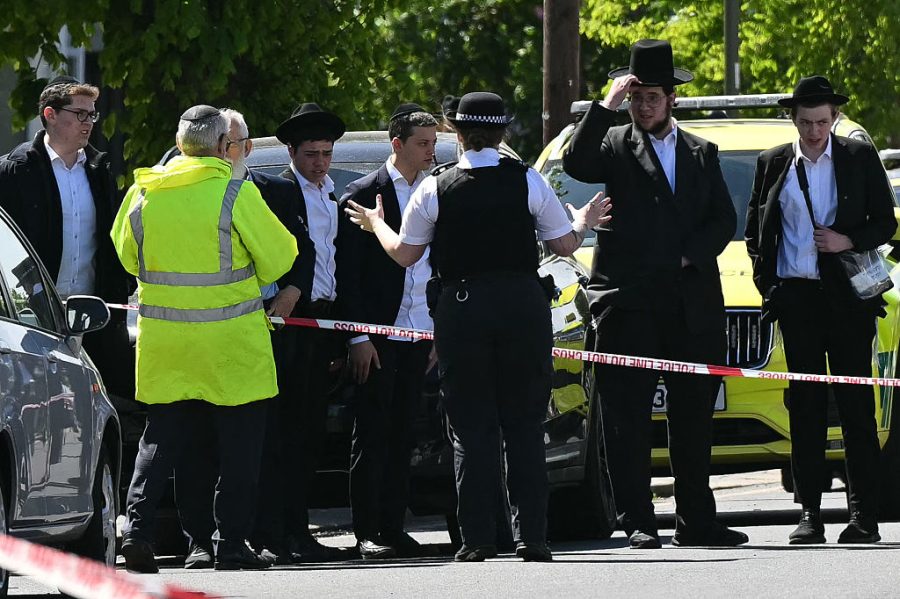
Just hours ago, a man armed with a knife was seen running through the high street, targeting Jewish people in the area. Shomrim, the Jewish community security organisation, responded immediately and detained a suspect before police arrived and made an arrest. The victims are being treated by Hatzola, the same organisation whose ambulances were set on fire across the road from today’s incident just last month.
In parliament, Keir Starmer described the attack as ‘deeply concerning’. This is not deeply concerning. This is an outrage.
Golders Green is not an abstract symbol. It is a living, breathing community – the heart of north-west London’s Jewish life, lined with kosher restaurants, synagogues and families who have been there for generations. Many of the Jewish people who settled here came from Eastern Europe before and after the second world war, arriving in a country they believed would keep them safe.
Simply standing with us, sadly, no longer provides any sort of comfort
My mother grew up spending her days in Golders Green, at her grandmother’s home on Golders Green high road. ‘You always felt very safe there,’ she told me today. ‘I never thought twice about being there and walking up and down.’ She paused before adding: ‘I have never, in my entire life growing up in this country, felt scared to be Jewish. Until now.’
My mother echoes what the Jewish community has felt with every incident, every headline, every moment of grim recognition – that with each attack, something erodes a little further. A sense of belonging. A sense that this country is as much ours as anyone else’s. Until what is left is a community that has simply learned to be afraid.
This is the second serious incident targeting this specific community in a matter of weeks, the heart of Jewish life in north-west London. The visibility of the community, the kosher shops, the Orthodox families walking to synagogue on a Saturday morning, the mezuzot on the doorframes are not incidental details. They are the point. Jewishness itself is what is being attacked.
For months we have watched chants of ‘globalise the intifada’ ring out through the streets of British cities, largely without consequence. The Iranian regime has made no secret of its ambition to export violence beyond its borders, and the fingerprints of that ideology have been felt increasingly close to home. When hatred is allowed to march openly through the streets, when it is granted the language of liberation and the cover of politics, it does not stay abstract. It finds people willing to act on it.
Most hatred, however ugly, requires some pretext, a grievance, however distorted or fabricated. What we are seeing in Golders Green strips even that away. There is no argument being made. There is only a place and the people in it and a decision that they should not feel safe there.
And yet the response from those in power continues to arrive in the careful, measured language of concern. ‘Deeply concerning’. ‘Monitoring the situation’. ‘Standing with the community’. These are words designed to respond without acting. The Jewish community has heard them so many times now that they land less as reassurance and more as confirmation that nobody is coming to help.
Simply standing with us, sadly, no longer provides any sort of comfort. What is required is not more expressions of solidarity. It is a reckoning with how we arrived here, in a country where a man can run down the street with a knife targeting Jewish people in broad daylight. Every Jewish area, my mother said, is being targeted now. She is right. And the question of where it ends cannot keep being deferred until the next incident makes it impossible to ignore any longer.
The community, as it always does, will keep going. Hatzola will keep answering calls. The shops will open tomorrow. That resilience is admirable. But it should not be mistaken for acceptance. A country that continues to treat the safety of its Jewish citizens as a problem to be managed rather than a failure to be urgently addressed is not a country that is living up to what it claims to stand for.


Comments