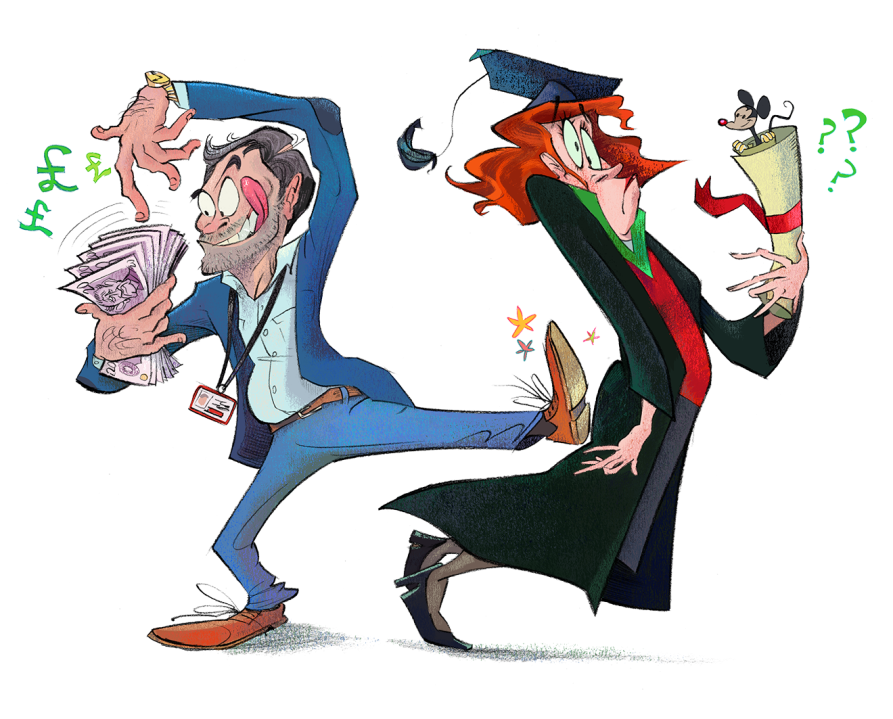
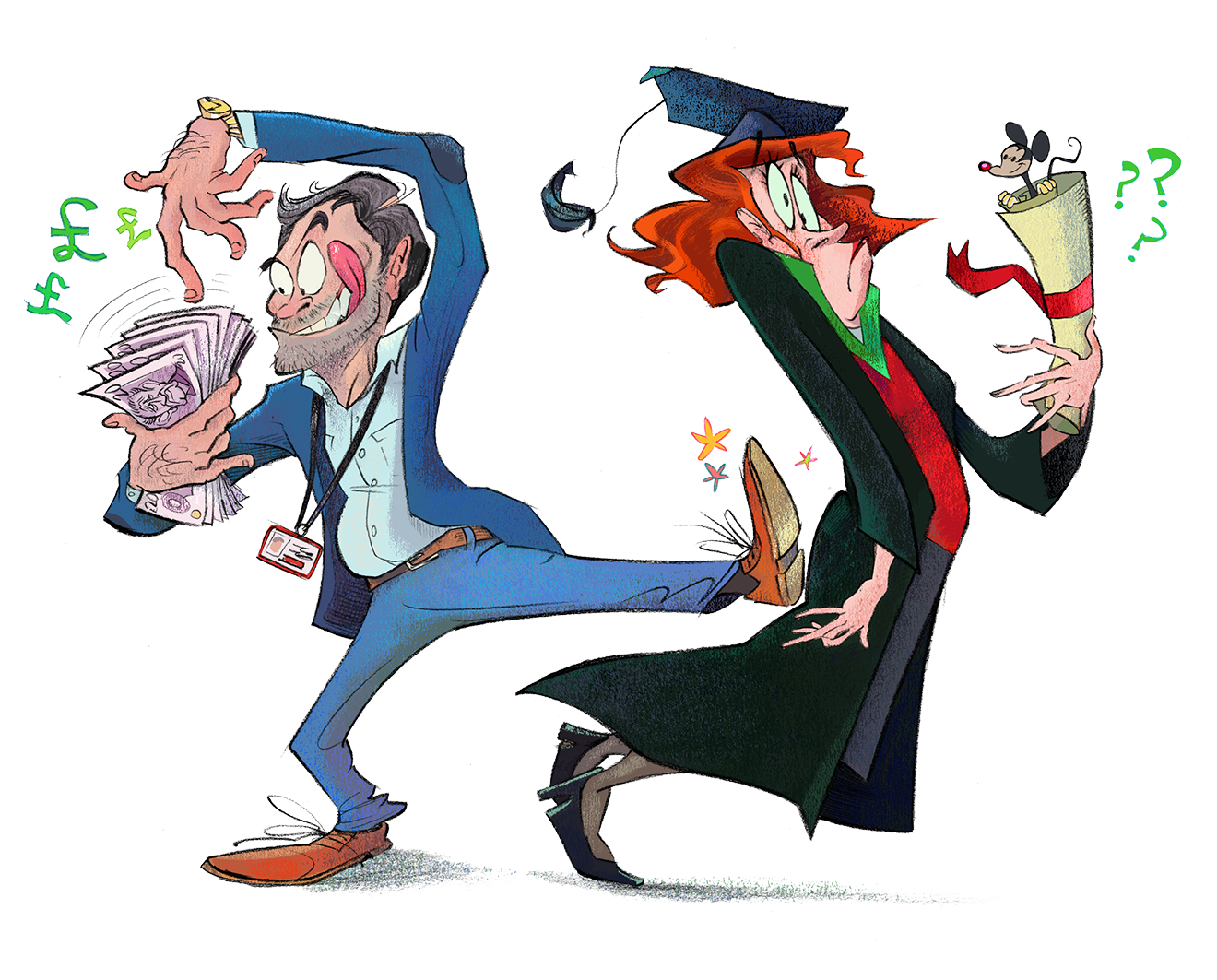
Nestled in an industrial estate just outside Coventry, Arden University might well be Britain’s most inconspicuous educational establishment. But if you consider a university to be a business (and Arden clearly does), it is arguably the best performing in the country. The figures are striking: Arden was given the permanent power to award degrees in 2021 and over the past decade has expanded its headcount from 2,000 students to just over 32,000. In other words, once a minnow, it now has more students than either Oxford or Cambridge.
That’s not all. Unlike almost every other university in the country, Arden is a private, for-profit institution. Last year, it made a post-tax profit of over £64.7 million – profit which, in recent years, has tracked its rise, with an increase of more than £20 million from just the year before.
‘Whether you’re constrained by location, cost, time, or other life commitments, we’re passionate about giving you access to higher education that fits into your busy, modern life,’ Arden boasts on its website. Apparently it is ‘blended’ and ‘online distance learning’ gives it an edge. This, it argues, makes it ideal for those who would otherwise never have undertaken degrees.
If this were the whole story, Arden might be a remarkable success. Yet, despite being the country’s fastest-growing university, it is also, on the most common metrics used to assess student satisfaction and student outcomes, one of the worst. According to the Office for Students (OfS), of the 227 universities evaluated on its most recent Teaching Excellence Framework, Arden University ranked joint last. It received a ‘requires improvement’ grade – given where the OfS finds an ‘absence of excellence’. Only 54.8 per cent of students complete their first degree, far below the OfS’s minimum standards of 75 per cent. It is not some well-meaning charity or even motivated ex-business guru that owns Arden – instead it is 50 per cent owned by Brightstar Capital Partners, a private equity firm.

In reality, the education Arden provides is illustrative of the shaky pedagogy and general rot inside the sector. It is not just a singular institution testing the limits; it is representative of a whole new model: the franchised university. Franchises brought in at least £977 million last year; making a gross profit of £621 million. In other words, spectacularly good business.
The blueprint is for quasi-universities to flog off the right for businesses to award degrees, earning roars of approval from investors. In the process, what Arden is selling is not just its own name, but the standing of the British university degree, which has traditionally been a marker of quality.
The world that such institutions want to create is one where such credentials can be bought and sold until they lose their worth. It is, in other words, a race to the bottom. And so it is that Arden has granted the right to confer degrees to a list of partners that includes the Romanian-domiciled American Hotel Academy and the Emirati Success Point College. None of those institutions has gone through the usual rigour associated with the taxing standards of the OfS.
Even though many students drop out, most never attend a lecture or tutorial in person and plenty are juggling a career, the number studying at these institutions has exploded. Franchised student numbers rose from 50,430 in 2018/19 to 135,850 in 2022/23 – an increase of 169 per cent, according to figures from the Department for Education (DfE).
Many British universities are becoming more and more like Arden: more online, less academically rigorous and, most importantly, franchised. One example is Buckinghamshire New University, a former polytechnic. In the past ten years it has more than doubled its headcount – from just over 9,000 to nearly 18,000 students. More than half of those have been students of business and administration, subjects in which the university markets itself as a specialist.
Quality teaching is not powering this growth. Even the best performing courses are not just poor, but failing. A private firm, RTC Education Ltd, running a franchise calling itself Regent College London, was subcontracted to provide many. Regent College London was revealed by an OfS investigation to be so shoddy – relying on verbatim PowerPoint readouts – that Buckinghamshire New University was forced to cut all ties to the firm.
Another former polytechnic, Greater Manchester University, based in Bolton, is still effusive about Regent College London on its website. Despite displeasure from the OfS for continuing the arrangement, the university carries on dishing out these degrees.
The most profitable franchises are quasi-universities, often with a word connected to ‘business’ in their name. That is not incidental: business and management courses can often be taught by a more rigid formula and so it is easier to get away with lower standards. At the same time, that provides a sort of justification for franchising degrees in the first place. After all, aren’t private businesses exactly the sort of institutions that would know a thing or two about ‘business’ in the first place?
The Global Banking School Ltd, for instance, had 13,600 first-time entrants in 2023-24, and is even more profitable than Arden, with £66.6 million in post-tax profit. It teaches some of Oxford Brookes’s courses – and, as so many franchises are, is currently being investigated by the OfS. Another, the Oxford Business College, is a rare case of an institution that was so poor it was de-designated by the DfE in April 2025. Even then, its status was restored by the courts.
Franchises accounted for 53 per cent of the £4.1 million in fraud detected by the Student Loans Company
Or take the much smaller universities which are growing quickly but not obviously providing their students with much more than a credential. London Churchill College Ltd has doubled its number of students to nearly 2,000 in the past ten years, raking in £1.6 million in profit. The OfS had long-standing concerns about its academic standards too.
When it comes to enforcement, however, the DfE, OfS and the archipelago of regulatory institutions around them have been slow. That’s despite evidence that there is more than just a poor academic standard at these institutions. In 2022/23, franchised provision accounted for 53 per cent of the £4.1 million in fraud detected by the Student Loans Company (SLC) – even though students at franchised providers represented only 6.5 per cent of those taking out loans.
It seems that the OfS and others are actually being gamed by these private universities to eke out even more money from the British state. Arden, astonishingly, is receiving more than £8.3 million in ‘funding for access and success’ this year from the OfS – the second most of any English university, behind only the Open University. Such funding is meant to be allocated to ‘strategic priorities’. It is quite astounding that while important courses are being stripped away at redbrick universities, which could well do with some support, fast-growing franchises with private backers and big pockets are being doled out cash. It is, in fact, a scandal.
Others are blurring the boundaries between business and educational institution even further. A quasi-university called ‘Multiverse’, run by Tony Blair’s son Euan, suggests its courses will ‘catapult your career’. To cut costs, it has replaced peer review with AI surveillance systems, with the predictable result that people working there have complained of a sort of Kafkaesque AI-induced psychosis. Again, regulators have pointed to low standards – with a damning Ofsted report suggesting the teaching quality ‘needs attention’. Founded in 2016, Multiverse now has 8,565 students.
Every year, at some of Britain’s best universities, lecturers squeal at cuts to traditionally important, intellectually rigorous subjects. Recent victims include 150 jobs at Exeter, Nottingham’s Music and Modern Languages School and Edinburgh’s Scots Literature and Celtic Studies courses. Many good universities which don’t have the deep pockets of Oxbridge are struggling.
Meanwhile, the growing ranks of bunk institutions have worked out that it’s easier simply to give up trying. They turn to the business world for justification, presenting what they do as a world apart, perhaps in some sense superior, from traditional universities. Regent College London boasts of its ‘career-focused degrees’; Arden of ditching the ‘traditional exam model’.
Using such jargon as an excuse to jettison responsibilities, they nevertheless make sure to claw in up to the sweet £9,790 annual tuition fee for each student that passes through their virtual halls. Britain’s universities might be in bad nick. Unfortunately, worse ones seem to be springing up ready to take their place.






Comments