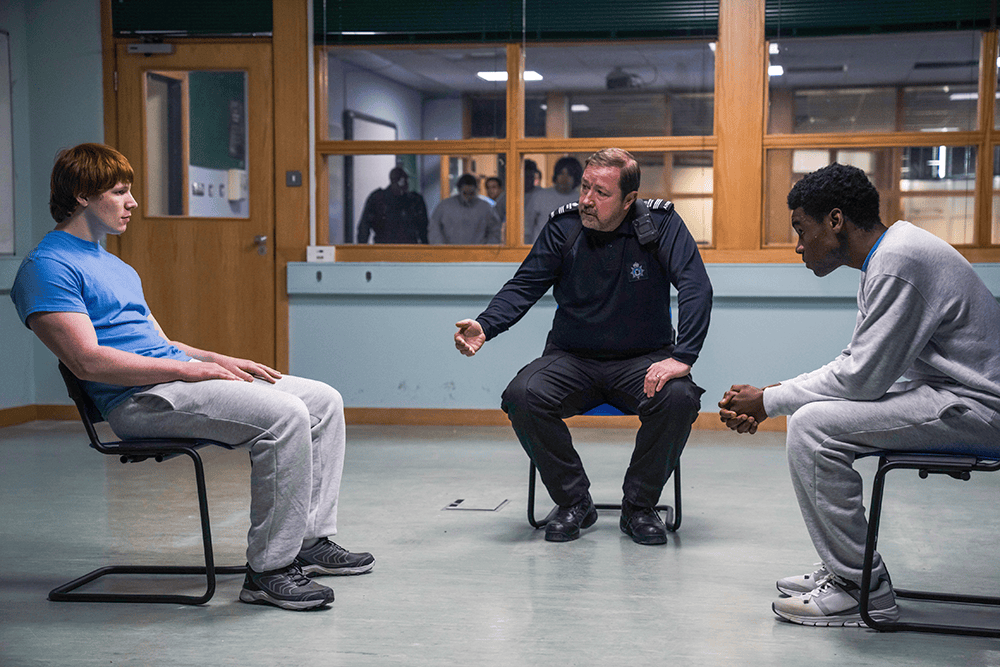
Jimmy McGovern is a writer whose sleeve is rarely heart-free. Since cutting his teeth on Brookside in the early 1980s, he’s served up one crunching drama after another (Priest, Hillsborough, Broken etc. etc.), all of them characterised by a mix of dark personal stories and even darker social issues conveyed in a way that leaves us in little doubt about how we should respond. Granted, there are some concessions to light and shade – but if there’s such a thing as unsubtle nuance, then McGovern has mastered it.
Even so, Time may be the most crunching of the lot. The first series of this anthology show took place in a men’s prison and spared us none of the violence, mental illness and institutional failures involved. The second, set in a women’s prison, didn’t either. Now we have the third, featuring a Young Offenders Institute (YOI), where those elements blaze away once more. In bad news for fans of the law of diminishing returns, though, the programme’s emotional punch – however undisguised its delivery – lands as squarely as ever.

This time, the new cast is led by David Tennant as prison officer Bailey, who can remember a better time when YOIs offered libraries, training and education. But he also accepts, as a matter of realpolitik, that chronic understaffing means it isn’t coming back any time soon. Instead, the main policy now is to keep the boys apart – mainly by locking up them and their testosterone for 23 hours a day – so that they don’t attack each other.
When Bailey explained this to new chaplain Marie-Louise (Siobhan Finneran), the only recurring character in all three series, she was duly aghast at its barbarity. Yet, in one of those moments of unsubtle nuance, when she did inadvertently allow the inmates to mingle, the result was a massive fight. The same applied when Bailey’s colleague – much against Bailey’s advice – organised a ‘reconciliation meeting’ between a sweet, stammering black kid and a white psycho. Two minutes later, the black kid had been stabbed to death with a sharpened pen.
This distinction between the sweet and the psychotic among the inmates continued through this week’s two episodes. On the one hand, for example, there was Peter with his touching love for his girlfriend and baby; on the other, his Scouse mates with their old-school commitment to horrifying violence.
Again, though, the fact that this characterisation could most kindly be described as ‘broad-brush’ doesn’t prevent it from having a gut-wrenchingly powerful effect – especially when the psychos bully the sweet into performing some horrifying violence of their own.
So might Bailey ever be able to disinter his long-buried idealism and actually help the inmates – as McGovern is at some pains to spell out that he should? At this stage, it seems unlikely. Nonetheless, given that this is a show that doesn’t have much time for Hemingway’s idea that changes tend to happen gradually then suddenly – far preferring to cut straight to the suddenly – I wouldn’t completely rule it out. After all, McGovern’s big old sleeve-worn heart often ends up steering him away from the full grimness of his own implications.
Either way, the latest Time demonstrates that his long-standing ploy of both showing and (loudly) telling – while not generally recommended in script-writing handbooks – still makes for riveting television.
A 6ft goldfish in a straw hat put a kindly fin around John Simpson’s shoulder
Not surprisingly, John Simpson: 60 Years at the BBC was another reminder of a more idealistic era, when a well-spoken, well-informed BBC chap possessed an authority that virtually the entire nation signed up to. Towards the end, Simpson came as close as he could bear to acknowledging that those days may be gone. But before that, we had a kind of 70 Up whisk through his greatest journalistic hits, together with his reflections on them.
Occasionally, Simpson did risk what in gentler times might have been regarded as indiscretions. Mrs Thatcher, he told us, ‘liked tall younger men’, which ‘gave me an advantage over shorter, tubbier political correspondents’. Colonel Gaddafi was an inveterate farter. There was also the traditional foreign reporter’s tale about being given hallucinogenic drugs at an Amazon-village ceremony – which in his case resulted in a 6ft goldfish in a straw hat putting a kindly fin around his shoulder. ‘I was off my head,’ Simpson added, perhaps unnecessarily.
On the whole, however, the reflections were of the suitably considered – i.e. slightly bland – sort that you’d expect, even want from an old BBC hand. And they naturally included the assertion, repeated in various formulations, that the BBC (‘kind of my religion’) has been an unshakeable force for good.
Older viewers, I’m guessing, will have enjoyed the programme without learning anything enormously new. Younger ones, I’m hoping, will have thought how nice it must have been to be able to trust what you were being told. If, that is, any of them were watching.






Comments