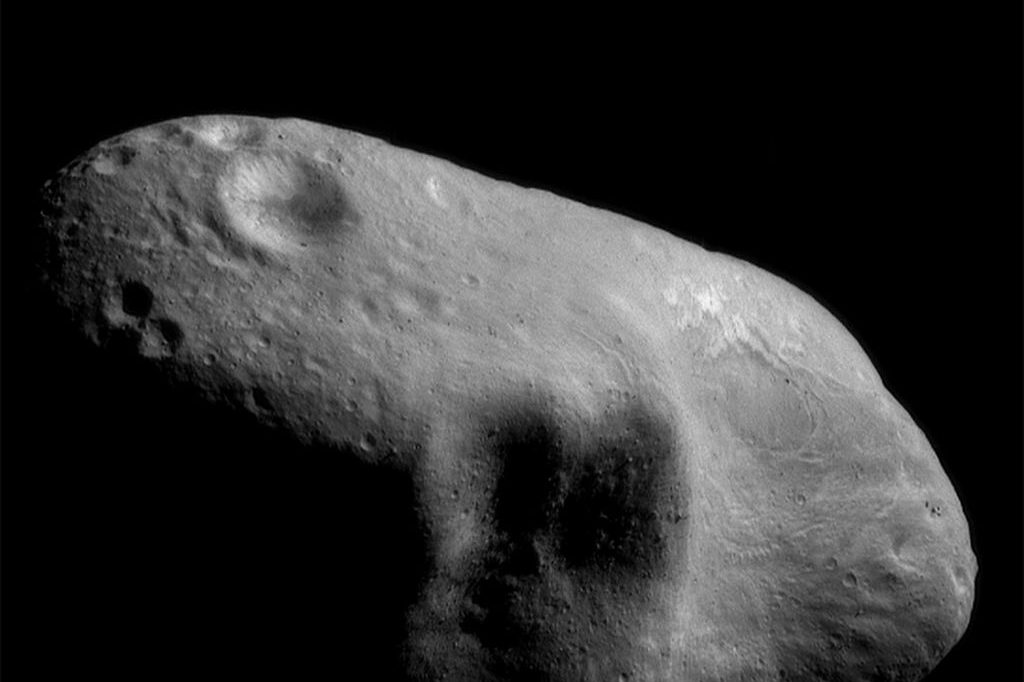
“Giant Asteroid” has been a popular also-ran in the last three presidential elections, at least judging from bumper stickers, and those wiseacres who preferred planetary annihilation to Hillary, Biden, Kamala and Trump may finally get their wish in 2032, when the newly discovered asteroid 2024 YR4 has — according to current calculations, liable to change — about a 3 percent chance of hitting Earth.
The geekoisie has been all a-twitter over this forecast, as visions of tsunamis and extinction-level events and the hot astrophysicists who adorn disaster movies dance in their heads.
“There is no situation in life but has its advantages and pleasures — provided we will but take a joke as we find it,” wrote Washington Irving, so I went on a weeklong comets-and-asteroids-destroy-our-world binge. I kicked it off with Lucifer’s Hammer (1977) by Larry Niven and Jerry Pournelle, an entertaining page-turner in which an Earth-clipping comet makes the waters rise and civilizations fall. The novel is indelibly stamped with its time and milieu: 1970s Southern California right-wing techno-libertarianism.
When the big one hits the survivors gather around two poles, which we might think of as the Ayn Rand Gang and the Hippie Hordes. The former are partisans of, to borrow a more recent term, the Science: rational, practical, hands-on men and the women they lay their hands on. The latter, the Luddites, follow a crazy-ass preacher and want to blow up the nuclear power plant.
My sympathies are naturally with the Luddites, but talk about stacking the deck: it turns out they’re also… cannibals!
That’s not playing fair, guys.
I’m guessing that Elon Musk has read Lucifer’s Hammer, which Niven and Pournelle stipple with pleas for space colonization. I can hear Neil Young in the Luciferian breeze — “Flyin’ mother nature’s silver seed to a new home in the sun” — though something tells me ole Neil might not be sure which side he’s on.
On a wintry Saturday night, as the winds gusted and the snow fell heavily outside and I locked the doors against any cannibals who might be roaming the shire for a midnight snack, I settled down with ample libations for a triple feature of Armageddon (1998), Deep Impact (1998) and the infamously execrable Meteor (1979).
I confess that I gave up on this last film partway in. The killer rock was about as menacing as Jake from State Farm. I do hope this cinematic dog wasn’t the last thing on star Natalie Wood’s mind when she fell off that deck.
Deep Impact has Morgan Freeman as president, a teenaged astronomer as the comet discoverer, and a megawave that makes the one that overturned the SS Poseidon look like the splash in a kid’s bathtub. It borrows the idea of a survivor lottery from When Worlds Collide, the 1933 best-seller by Edwin Balmer and Philip Wylie, which was adapted for a 1951 film starring the luminous Barbara Rush.
Armageddon is a Michael Bay production, all explosions and frantic shouting and un-PC humor and shit blowing up — and that’s only in the first ten minutes. It’s Bruce Willis, Billy Bob Thornton, Owen Wilson, Steve Buscemi and Liv Tyler versus a rogue asteroid, and you don’t buy it for a second.
Assuming 2024 YR4 cuts us a break, the big winner of the coming Asteroid Sweepstakes will be the military-industrial complex and its aerospace division. Just as war and the threat thereof have been the most destructive engines in the growth of the American state, so has the curated fear of What’s Out There proved a boon to Big Government. The sky-is-falling lobby came into its own in 1957, when the Soviets launched the Sputnik satellite. President Eisenhower dismissed Sputnik as “one small ball in the air,” but congressional hysterics went bonkers. “We are in a race for survival, and we intend to win that race,” declared Senate Majority Leader Lyndon B. Johnson.
“We” means the American taxpayer, and the most immediate spawns of Sputnik were the National Defense Education Act — through which the feds began their assault on education, theretofore a local responsibility — and NASA.
The great American historian Walter McDougall has explained how technocrats exploited media-stoked fears to “break down longstanding resistance by Republicans and Southern Democrats to federal involvement in education generally as well as other social areas and began the greatest flood-tide of legislation in American history, a tide that, as Lyndon Johnson recalled, ‘all began with space.’”
With Mars-coveting Elon Musk riding herd, I’m afraid we’re in for another round of Big Science welfare.
Lucifer’s Hammer co-author Larry Niven offered the classic plea of the Chicken Little lobby: “The dinosaurs became extinct because they didn’t have a space program. And if we become extinct because we don’t have a space program, it’ll serve us right!”
2024 YR4 — and American taxpayers — have been warned.
This article was originally published in The Spectator’s April 2025 World edition.





Comments