
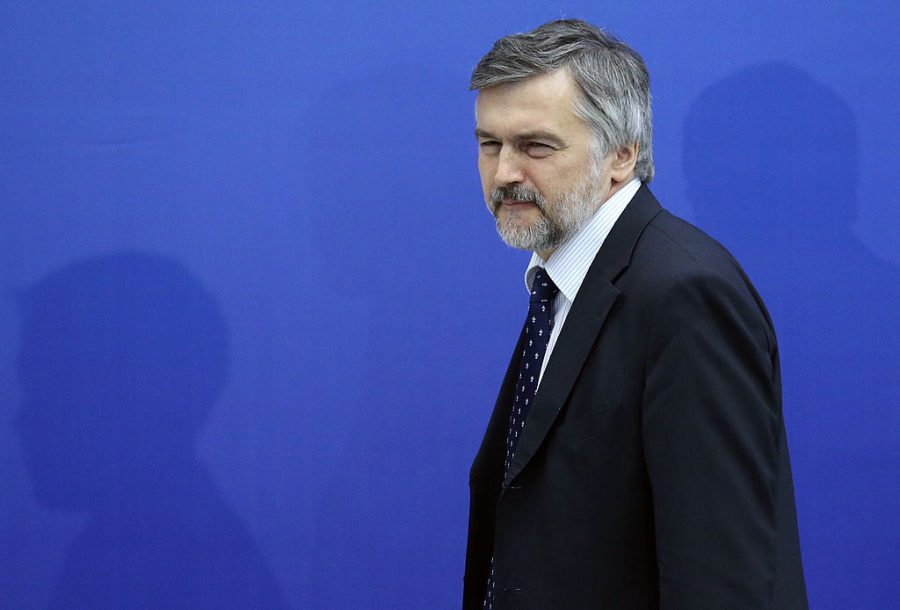
In a sign of the unease about Vladimir Putin’s ongoing war in Ukraine that exists behind closed doors in Moscow, one of Russia’s most senior bankers was fired yesterday after a series of critical comments he made earlier in the year about the fragility of Russia’s economy. Warning that Russia was “falling behind” globally both technologically and economically, Andrey Klepach stated the country would fail to win the economic “war of attrition” against Ukraine. “The Ukrainian economy, despite everything, is surviving,” he said.
Klepach, chief economist at Russia’s second-largest, state-owned bank VEB, gave a speech in May, during which he linked the pressure on the country’s economy with Putin’s invasion of Ukraine. The comments came to light on Friday, three months after Klepach originally made them.
Remarkably, Klepach rounded off his presentation by warning that the costs to Russia from the war with Ukraine “were mounting” at home. Citing a worsening quality of healthcare and rising inequality, he suggested that a “social crisis could arise – and at a moment when no one is really expecting it.” More surprising yet were the examples he used to back up his point: “no one expected the February Revolution” of 1917; the collapse of the Soviet Union in 1991, meanwhile, “was not a fatal inevitability.”
The depressing thing about Klepach’s firing is that what he said was neither radical nor false
It goes without saying that to make such critical comments about the war in Ukraine is highly dangerous in Putin’s Russia. Spreading anything deemed to be “fake news” about the Russian army – even through the loosest of references – can carry punishments of up to 15 years in prison. The vaguest expression of opposition to Putin’s regime can put a person in danger: just yesterday a German national living in St Petersburg was detained by the FSB for donating the equivalent of $10.60 to the Anti-Corruption Foundation founded by the murdered opposition leader Alexei Navalny.
Klepach – who gave his speech to a group of economists at a roundtable event – will surely have understood the risk his words carried. He was reportedly fired by VEB’s CEO, Igor Shuvalov, “at the behest of the authorities” as a direct consequence of what he said in May. Given his prominence, it seems unlikely that criminal proceedings will be opened against Klepach – he himself told the Russian newspaper Vedomosti that he would “see what happens next.” That said, there is every chance the authorities will decide to make an example of him.
Russia’s economy is coming under distinct pressure at the moment thanks to the war in Ukraine. Although the country’s latest GDP figures, published last week, show that the economy grew by 1.3 percent between April and June, economists believe the rebound is temporary. The consequences for inflation and growth resulting from Ukraine’s campaign of strikes on Russian oil refineries and warehouses belonging to the online retail platform Wildberries over the past month are not expected to show up in official data for a few months yet.
At the end of July, the Russian central bank cut its GDP forecast for this year to “up to 1 percent.” The bank’s chief, Elvira Nabiullina, came under pressure – including from Putin personally – to lower the bank’s interest rate to 14 percent last month, despite inflation running at 6 percent. Meanwhile, the Kremlin is running out of ways to finance its rocketing defense spending (government procurement rose nearly 40 percent between January and July compared to last year) and the resulting deficit in the Russian state budget.
The screws on the Russian economy will continue to tighten the longer Putin’s war in Ukraine rumbles on. The depressing thing about Klepach’s firing is that what he said was neither radical nor false. For now, he is the only one in his profession brave – or foolish – enough to state the obvious. It’s unlikely he will be the last.





Comments