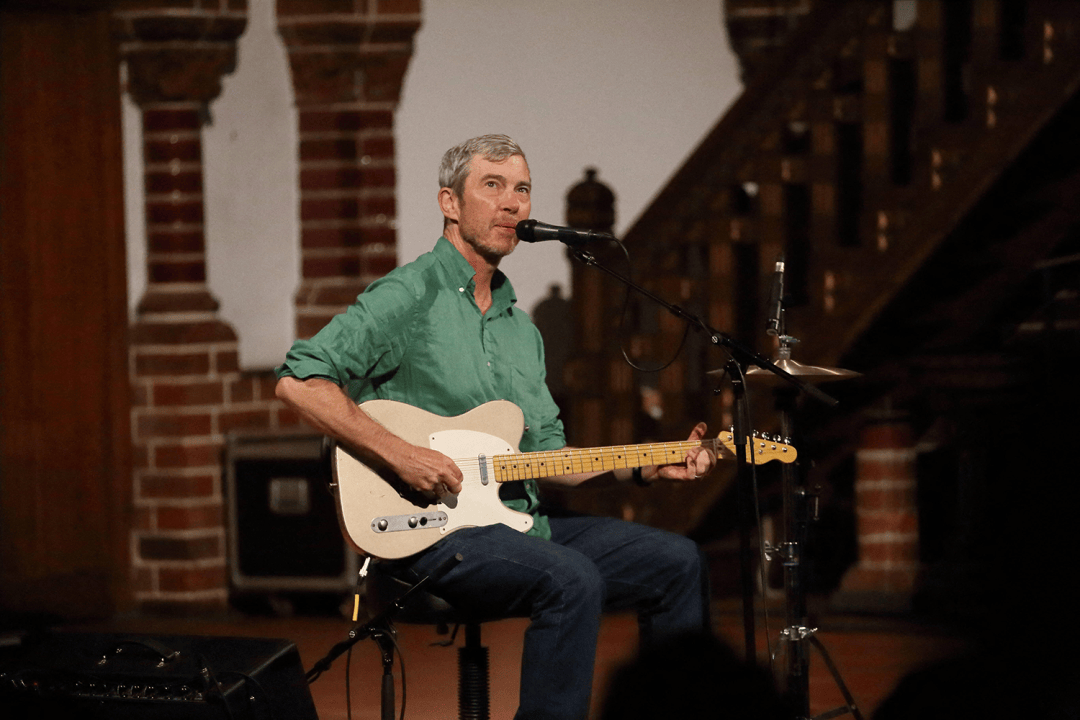
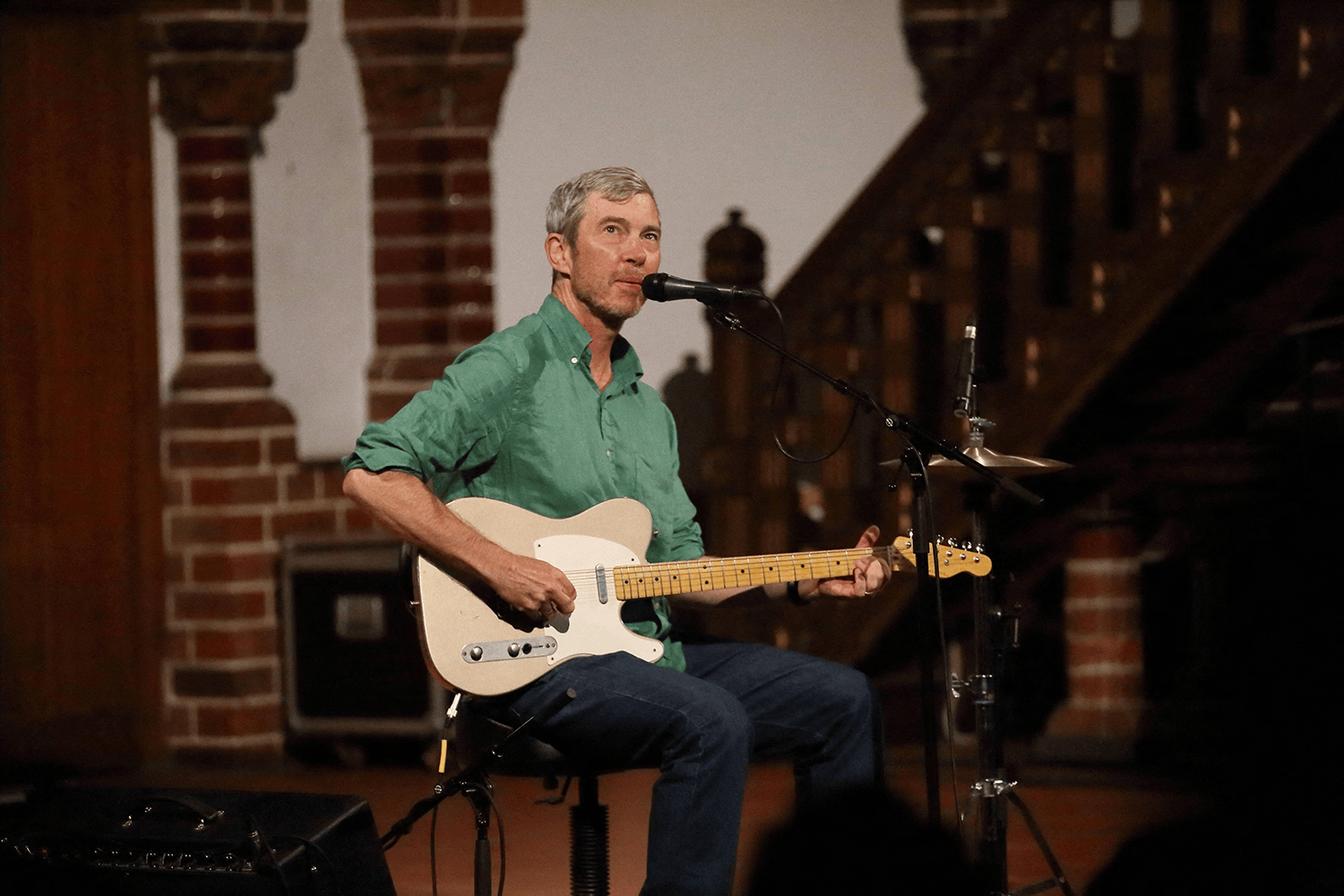
It’s as difficult to pin down exactly what Bill Callahan does as it is to explain what makes it so compelling. Now 60, Callahan has been releasing music since the early 1990s, first as Smog and more recently under his own name, which has been variously categorised as indie-folk, lo-fi, alt-country and Americana. Really, he’s just an idiosyncratic singer-songwriter with a deeply cool voice and an unusual way around a song.
That voice is Lou Reed by way of Death Valley. A wobbly conversational baritone, by turns comedic, moving and unsettling, it’s the perfect vehicle for his series of unreliable narrators. Callahan writes like Randy Newman exiled to a dude ranch, his lyrics a potent mix of soul clichés – ‘Gabriel, come blow your horn!’; ‘Yes, I am your lover man!’ – wry humour and strange, anxious poetry, the kind that advises, during the life-in-song philosophising of ‘Pathol O.G.’, that ‘it’s important to not treat your lifeboat like a yacht’.

His words as sung communicate a sly carnality, a profound sense of male loneliness and, lately, the more tender observations of a late blooming family man. Callahan also has a fondness for the mantra-style repetition of certain phrases which recalls Van Morrison. Like Morrison, his songs are mostly rooted in the simple structures of folk, blues and country, but frequently fly off their moorings into unmapped spaces.
In all aspects, the show by Polwart and Milligan was near enough perfect
Pure expression seems to be the game. ‘I’m more of a drunk professor than a craftsman,’ he said in an interview earlier this year. ‘I like happenstance and coincidence and mistakes.’ Perhaps that was why his acoustic guitar was ever-so-slightly out of tune for most of the evening.
His backing band was Matt Kinsey on electric guitar, Jim White on drums and Dustin Laurenzi on saxophone and clarinet. An unusual configuration, and one with a licence to roam. While the Willie Nelson-style moves of ‘Highway Born’, the woozily beautiful ‘Sycamore’ and trance-like ‘Let’s Move to the Country’ oozed a kind of zen-country simplicity, just as often the quartet spiralled into free jazz and atonal noise.
‘And Dream Land’ sounded like five different songs crashing into each other, at least one of which might have been written by David Bowie. ‘Coyotes’ began like a Neil Young ballad, rolling slow and sweet, before careening off into another dimension entirely. ‘Partition’ was cowboy krautrock, complete with snatches of Dolly Parton’s ‘Jolene’. White – a fine artist in his own right and longstanding member of Australian trio the Dirty Three – contributed an amusing shaggy-dog monologue to ‘Lonely City’, with reference to posh Edinburgh students and the local river, the Water of Leith.
Most of the material was taken from Callahan’s recent album, My Days Of 58, but that seemed almost beside the point. The concert was not so much about the individual pieces as the accumulation of energy and atmosphere between the players. The entire evening could be summed up by the chorus of ‘Drover’, the final song of the set. This was a rough and exhilarating ride over ‘wild, wild country’.
A deconsecrated church (with punishing pews intact), the Queen’s Hall is one of those enveloping venues which seems to encourage artists into flights of excellence. Of late, I’ve discovered another one in Edinburgh. I recently saw Karine Polwart and Dave Milligan play at the Pianodrome, a unique performance space/creative concept located in a community centre in Bruntsfield. In this space, Pianodrome have created an intimate amphitheatre made entirely from upcycled pianos. It’s an ingenious, atmospheric and engaging way to frame a live performance.
In all aspects, the show by Polwart and Milligan was near enough perfect. It kicked off at 9 p.m. and lasted an hour – time to have dinner beforehand and a drink afterwards. The enclosed space, with standing lamps lighting the corners of the amphitheatre and the performers close enough for us to see every flicker of emotion and expression, brought out something special in the music. Milligan’s fluid and empathetic piano accompaniment and Polwart’s clear, unaffected voice – slightly weathered by a cold, she told us, not that you’d notice – wove an enchanting spell. The set included ‘Wild Mountain Thyme’ and a version of ‘Craigie Hill’ to rival that by the mighty Dick Gaughan. This would have been a fine show in any location, but it was elevated by its surroundings. I fancy most music would be improved by a visit to the Pianodrome.





Comments