Iheard some odd things working as a teaching assistant. On one occasion, in December, I asked a nine-year-old if he knew what he would be getting for Christmas. His answer? A bed. When I spoke to the headteacher about it, she told me he lived with his single mother and five siblings in a two-bedroom flat. He had spent his entire life sleeping one night in a bed, one night on the floor, alternating with his brother.
Not long after this, I was told to be ‘sensitive and understanding’ of any misbehaviour from another boy in the class. This was because the school had just discovered the family – mother, father and four children – had been made homeless after ‘causing trouble’ in their council-provided accommodation. For three months they had been living in two tents in a nearby forest.
In the same class were two boys I shall call David and Robert. Both were middle-class, had two parents at home and private tutors supporting their education. David was hoping to go to our local £25,000-per-year independent school, telling me: ‘If I don’t get in, my dad’s a doctor so he’ll just pay the fees.’ Robert was even more ambitious – fully expecting to go to City of London School for Boys.
Should some of the money he made from his characters go to children who were mocked by classmates?
The boys in my first two stories were white. David and Robert were black. I wish it didn’t matter. But unfortunately it does.
Advocates for slavery reparations, such as the Labour backbenchers causing so much discomfort for Andy Burnham this week, argue that historic slavery’s effects persist in modern racial inequalities. One of the biggest celebrities making this argument in public life is Sir Lenny Henry.
In his recent book, The Big Payback: The Case for Reparations for Slavery and How They Would Work, co-written with Marcus Ryder, he looks at the cost of reparations for Britain’s role in the transatlantic slave trade. He accepts an estimate of £18 trillion, a figure that makes HS2 look like a whip-round for the office Christmas party.
How would that work in practice? The logical thing would be to divide the cash equally among Britain’s black population. With roughly 2.5 million recipients, each person would receive about £7.2 million. A family of four would get nearly £29 million.
What would happen to race relations when your black neighbours became millionaires overnight? How will your average white Brit feel when his operation is cancelled because the NHS has run out of money, while Gary and Sue next door drive to the Bupa clinic in their new Ferrari because their grandparents came from Trinidad? Speaking of grandparents from Trinidad, won’t we all be trawling our family trees for a distant connection, in the same way many searched for Irish ancestry after the Brexit vote? At least Ancestry.com will do well out of it.
There would also be plenty of work for accountants, lawyers and sudden-wealth advisers. Who else is going to explain to a family that has never had more than a few thousand pounds in the bank how to invest £29 million without buying a yacht, a football club and a villa in Marbella by Tuesday?
And who qualifies as black? What about people of mixed heritage? Someone with one black grandparent? One black great-grandparent? Would a reparations scheme require officials to investigate family trees and calculate how much blackness entitles someone to a cheque?
There is another question, though, and it brings the argument closer to home. If people should pay up to make amends for historic wrongs, what about Sir Lenny himself?
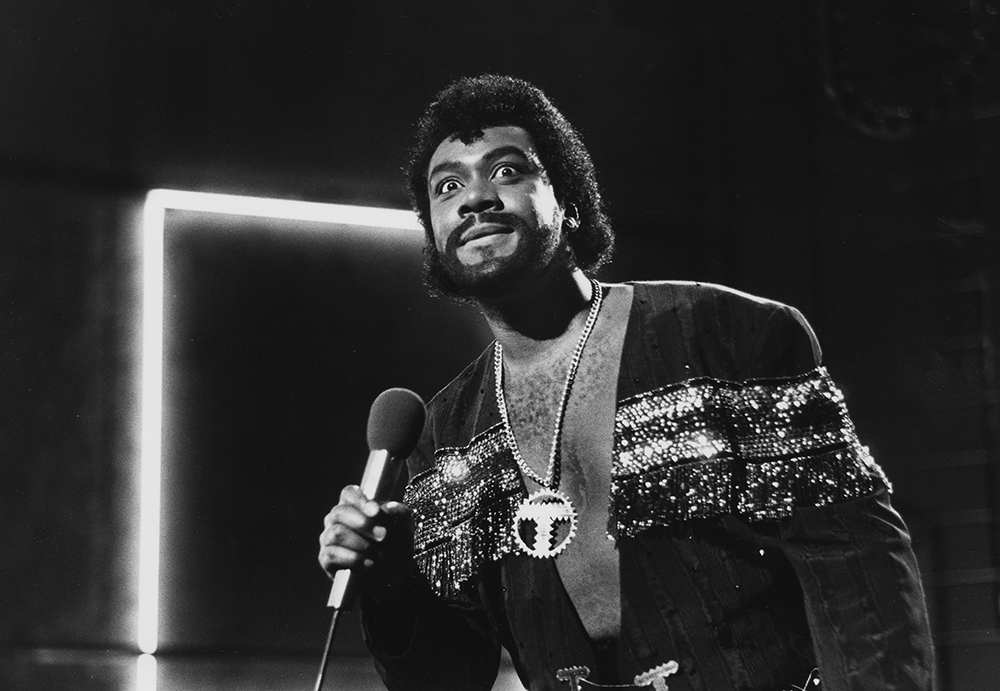
Henry became the best-known black entertainer on British television for his comedy characters, many of which have, by modern standards, not aged well.
Algernon Razzmatazz was a Rastafarian with a huge woolly hat, exaggerated mannerisms and a Jamaican accent. Delbert Wilkins was a pirate-radio DJ whose material relied heavily on the assumption that black people from Brixton were criminals. There was also Theophilus P. Wildebeest, Trevor McDoughnut and an African comedian in a grass skirt and tribal body paint whose catchphrase was ‘Katanga!’.
Henry has reflected on the stereotypes in his comedy, explaining that older comedians in the clubs where he learnt his trade were doing the same thing. In other words: everyone else was doing it, so he joined in.
Those who oppose slavery reparations might argue that slavery was normal in its time, that other countries did it and that people were simply following the conventions of their age. Is Henry’s justification for his comedy any different? Of course, slavery was an atrocity on an altogether different scale to some racist comedy tropes. But those tropes did cause real harm. I know, because I went to school in early-1980s Essex.
The all-boys comprehensive I attended was a ghastly place, almost unimaginable now. Every boy had a nickname, the nastier the better. Mine was ‘Leper’, because I had eczema. A boy with acne was ‘Pizza’; the only black boy in my class was ‘Katanga’.
I got over being called Leper. But what about the boy we called Katanga? Did he get over it, too? Did he laugh along, or go home and dwell on it? Did it become a memory he recalled with a shrug, or something that stayed with him for years?
All of which leads to important questions. My own experience working in schools tells me that disadvantage and poverty suffered by children today are more likely caused by class than they are by race. David and Robert are going to be fine. Does Sir Lenny really think these boys are more deserving than white children with no bed, or white children living in a forest because they have no home?
Should Sir Lenny pay reparations for the hurt his comedy caused in the 1970s and 1980s? Should some of the money he made from those characters go to children who were mocked by classmates using the very stereotypes his characters embodied? Henry now says that his comedy was wrong. He also says he used racist humour because everyone else was doing it.
But if this justification does not excuse Britain’s role in the slave trade, why does it excuse his role in the historical harms of his comedy? Which leads to one final question: Sir Lenny, where shall we send the invoice?





Comments