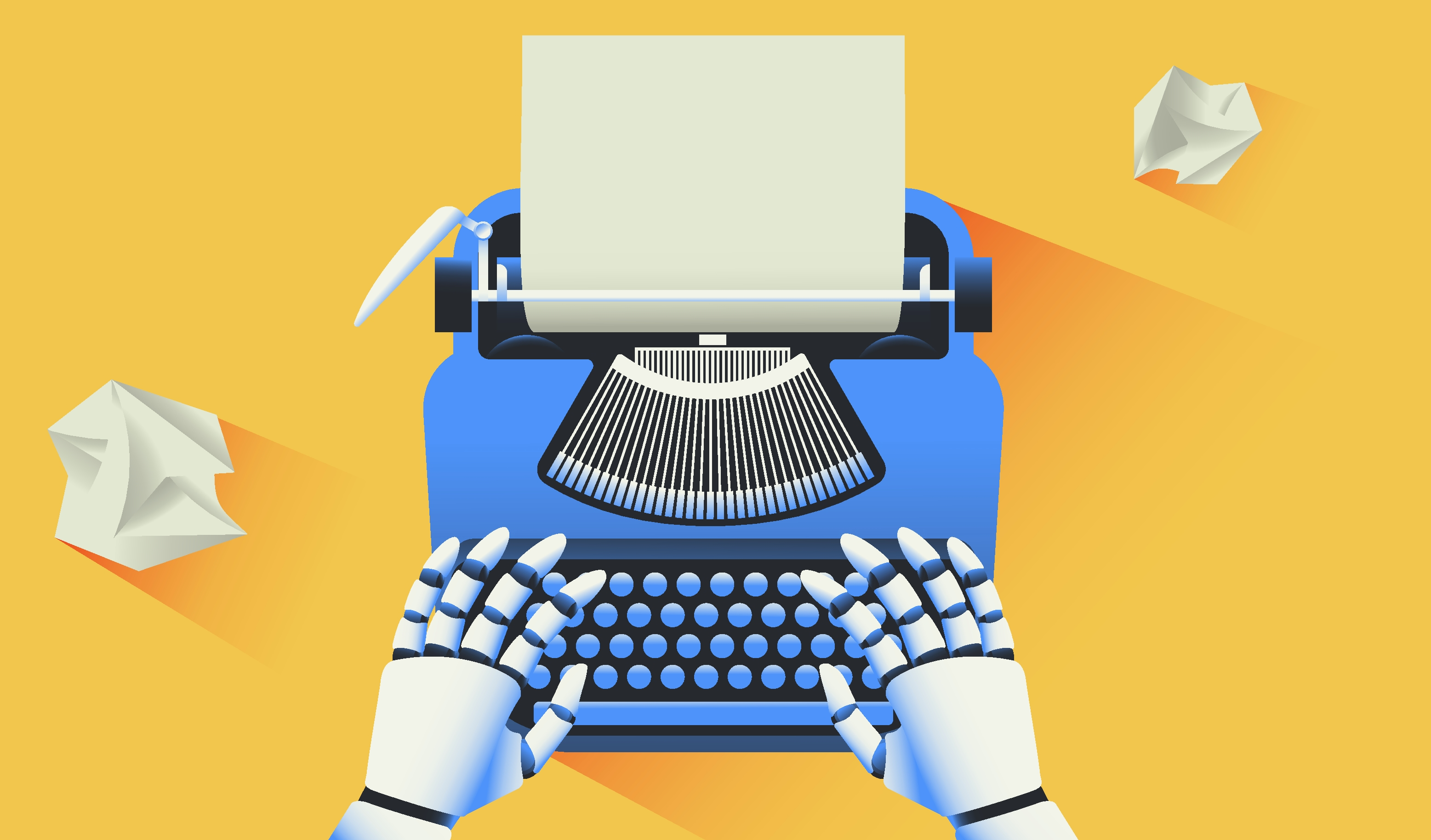
This week I was replaced by AI. I saw it coming, but it didn’t make the news any easier to deal with. To be honest, it terrifies me for the future of our species. If that sounds a bit over the top, hear me out.
I am a writer. Not only that, I am a commercially successful one. Although you probably haven’t heard of me, I’ve published more than 300 short stories in women’s magazines over the past 15 years. From ghost stories in Woman’s Weekly to tales of romance in Take a Break Fiction Feast, I write them all. Sorry – wrote.
“Dear Geoff,” the email said. “Going forward, our in-house team will be using AI tools to compile future editions, but we thank you for your many contributions to the magazine over the years. Kind regards, Rebecca.” Or to put it more bluntly: “We’ve replaced you with a robot.”
I enjoyed writing all my stories. Sure, they were not exactly high art. I never expected a call from the Pulitzer panel. But coming up with characters, throwing them into difficult situations and seeing how they coped, writing dialog that felt real, inventing satisfying-yet-believable twists, was all fun to write and, I hope, fun to read.
So I began typing my reply to Rebecca. I hadn’t even finished the first sentence when the truth occurred to me: Rebecca doesn’t exist. If a women’s magazine no longer needs writers, why does it need an “in-house team”? A vision rose in my mind of someone arriving at an office in the morning, switching on a computer, then going home again while the computer produced a magazine.
But the end of my career didn’t surprise me, because three things told me this was coming. The first was when my dad died two years ago. There was no funeral – he didn’t want one – but some close family had a small get-together where we planted a tree in my mum’s garden. “Has anyone thought of any words we could say?” my mum asked. No one had. So I thought it would be amusing to give ChatGPT a few prompts to write a poem. My dad would have appreciated that. Within a few seconds I was reading out “A West Ham Fan,” a poem filled with humor and pathos. It was good.
The second thing that happened was a song appearing in my YouTube feed. “Pocket of his Raincoat” was sung by Paul McCartney with a simple acoustic guitar backing, a Beatles ballad with wonderfully esoteric lyrics and a haunting melody. I love the Beatles and here was a song up there with “Yesterday” and “For No One.” Why had I never heard it before? Then I noticed the performer: the AI Beatles. I had discovered a new favorite Beatles track neither written nor performed by the Beatles themselves. I was listening to a machine.
And the third thing. A few months ago, as an experiment, I prompted ChatGPT to write me a story I could sell to a women’s magazine: “Make it 700 words long, a love story, humorous, with an unexpected and emotionally satisfying ending.” As soon as I hit return on my computer the story immediately began scrolling out on my screen. That story – funny and as good as any I have ever written or read – has sat on my computer ever since, an unsubmitted harbinger of the end of human story-telling.
The unavoidable consequence of ever-improving AI is nothing less than the end of all human creativity
There is no way to stop it. What Beatles fan is going to resist listening to a new album from the Fab Four because it was written and recorded by an AI app? Who wouldn’t be curious about a new Shakespeare play or a tenth symphony by Beethoven? And if you think it won’t happen, a quick search online will show you it already is. YouTube is full of new songs from dead artists, movie scenes from actors who have never worked together, speeches and jokes from deceased politicians they never made. There are even concerts where Elvis Presley and the Beatles perform together in packed stadiums, concerts that never happened in real life. You might say all this machine imagination simply isn’t as good as the real thing. I say, give it time.
Some artists and creative industry organizations have fought back against AI. What is interesting about this fight, however, is that mostly it’s been about compensation for artists whose work is being used to train AI programs. In other words, if you want to teach AI to write a song in the style of Ed Sheeran or produce a novel in the “voice” of J.K. Rowling, the argument is not about if it should be done, but whether these artists and writers should be compensated and if so how much. What this fightback misses is the new talent, the undiscovered storytellers and songwriters who will never be published or recorded. And it misses something else, something more fundamental.
AI doesn’t just mean short story writers and wannabe popstars are losing their careers. The unavoidable consequence of ever-improving AI is nothing less than the end of all human creativity. Why? Because whether it’s a novel or a rock song, a portrait or a poem, who is going to spend the years of study and practice required to produce something that can be churned out by a computer in seconds? Even if an artist doesn’t use AI, who is going to believe them? If an unknown author writes the next One Hundred Years of Solitude, how will we know AI didn’t help? A young singer-songwriter is hailed as the new Bob Dylan? Maybe he just selected the “Dylan” option on the songwriting app. In a world where music, art and literature can be made by machine, everyone will assume it was made by machine.
There is a story about Chicago in the 1880s. Back then, experts predicted cities would be buried under horse manure because of the growing number of horse-drawn vehicles. The arrival of the car and other motorized transport made those predictions obsolete. This story comes to mind because a couple of years ago TV personality Monty Don wrote an article suggesting prized jobs in broadcasting and the arts should no longer be given to privately educated straight white men like him, and instead previously under-represented minorities should be prioritized. I was angry and wrote to Monty Don to tell him why. My son is white and from a working class background. But he worked hard, put in thousands of hours of practice, and won a fully-paid music scholarship to a private school. “Why should my son be overlooked just because he is white?” I asked Monty Don.
Monty Don never replied and now I realize it doesn’t matter. Just like Chicago in the 1880s, technology has provided an answer no one expected. Black or white, male or female, straight or gay, there will be no jobs left in the arts for anyone.



Comments