
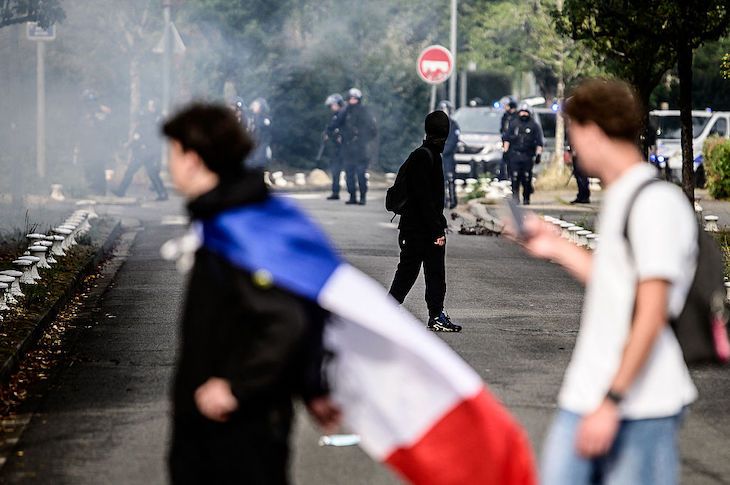
Few modern states are as conditioned by historical determinism as France. The dream, or nightmare, of revolution, riots or coup d’états is never far below the surface. Now we have nationwide school protests and blockades. Over 400 secondary schools are closed, there have been 5,000 arrests, 24 schools set alight or pillaged and over 300 police officers and 100 students and teachers have been injured.
French politics abhors a vacuum. So we are witnessing a premature start to the 2027 presidential campaign
The analogy is again of France’s youth as a tube of toothpaste: once squeezed it doesn’t go back in. The youth movement is spreading to the universities fanned by Jean-Luc Mélenchon and his ‘France Unbowed’ with its avowed theory of ‘conflictualising’ society. Could France be at yet another of those turning points of which she is so historically gourmande? Or is it again just another ‘turning point that failed to turn’, as AJP Taylor put it?
Since president Macron’s second term in April 2022, France has had six governments and five prime ministers. The political executive is neutered; parliamentary stalemate is overseen by an inert and dismally unpopular and enfeebled president relegated to international travel, like Louis XVI limited to his hobby of lock-smithing.
The country is rudderless amid ever-roughening seas. France’s financial position increasingly resembles that of Greece in the 2011-12 euro-crisis. Only five years ago, two open letters from some 1,000 French military personnel (including 20 retired generals) warned of ‘disintegration’ and potential civil war arising from lax government policies.
French politics abhors a vacuum. So we are witnessing a premature start to the 2027 presidential campaign. Polls suggest it could be the most consequential of the 5th Republic with the potential to pit radical left against nationalist right, especially in the second round. For many the ‘school’ riots are perceived as a dummy run for the widespread unrest that is likely if, as polls suggest, Marine Le Pen wins the presidency and a radical left refuses to accept the decision and appeals to the street.
When in 1862, Victor Hugo finally published Les Misérables after some 20 years in the writing, he had witnessed revolution, reaction and coup d’état at first hand, and though he approved in theory he did not much like the reality. Hugo famously distinguished between the two social angers of ‘insurrection’ and ‘riot’: the former rooted in an idea, progress and the collective will of the people; the second in a material or localised outburst of violence with no grand political principle. The first he deemed progressive; the latter destructive.
Hugo’s analysis has intriguing similarities with today’s France, which, for the moment, is living through riot not insurrection. The riots are nowhere on the scale of the student uprising of May ’68, which adhered to a semi-coherent optimistic vision of creative change. The context today is less conducive to optimism. The country in 1968 was still experiencing the prosperous Thirty Glorious Years of 5 per cent per annum economic growth, a far cry from the moribund state of today’s economy and finances. Though the general state of France is worse, discontent remains only at the anarchic riot stage. Even the national mobilisation programmed for this Tuesday 6 October will be no harbinger of radical change, but rather of resistance to inevitable change. Moreover, the brake on any movement transitioning to full-blown insurrection lies in the presidential election’s proximity and its cathartic weight in French political life. Social and political tensions will continue to grow as we approach April 2027, but the potential for serious spill-over will be capped until then. And the cap will then be lifted. Hugo would, I think, have been worried.
Forced regime change in modern advanced democracies is extremely unlikely given the powers at the disposal of the modern state. Yet the one democracy which has experienced it in modern times is France. In 1958, amid widespread civil unrest against the background of the gruelling and long-running Algerian War, General de Gaulle, backed by the French military, stepped forward to save the country again, albeit on his terms, in the so-called ‘coup d’état’ of 13 May. The ineffectual Fourth Republic was snuffed out; in came the new regime of the Fifth tailored to the General’s constitutional demands. According to one constitutional authority, it gave the president greater powers than Louis XIV.
With France still enjoying the patriotic euphoria of the highly popular two-part bio-pic of General de Gaulle’s war years, it might seem fitting if this was the moment when France’s latest turning point did turn and the country found a new and effective political formula. If only there was a de Gaulle in the wings.



Comments