
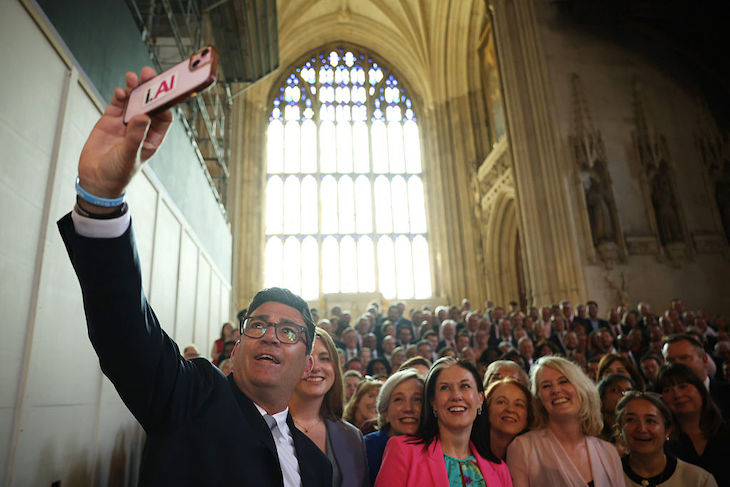
Of Britain’s 58 prime ministers to date, 31 have been graduates of Oxford University and 14 from Cambridge. But putative prime minister Andrew Murray Burnham will be the first Cambridge graduate to hold that position since Stanley Baldwin in the 1920s. It may irk the radical chic former Mayor of Greater Manchester to be bracketed with the patrician Conservative prominent in Britain’s political leadership between the world wars, but the similarities – and omens – are there.
Putative prime minister Burnham should take heed
If all goes to Burnham’s plan, both men will have entered Downing Street by the age of 56. After numerous government posts, including Chief Secretary to the Treasury (like Burnham), Baldwin’s path to No. 10 was opened in May 1923 when sitting Conservative prime minister Andrew Bonar Law was forced to resign for ill health and Baldwin stepped into his shoes.
Only the year before, the Conservatives had won a comfortable majority and (like Labour today) could have waited a few years before calling a general election. But the new prime minister wished to win a mandate from the people and to consolidate his hold over the Conservative party before legislating for potentially divisive reforms. Baldwin called a general election for December 1923 in a divided Britain clearly ill at ease with itself. Social unrest and strikes threatened. Post-war national debt was crippling, with Britain making huge financial payments to the United States.

Baldwin believed that a popular mandate would legitimise his planned drastic changes in fiscal policy. His manoeuvre backfired. The Conservatives lost their majority, allowing Labour’s Ramsay MacDonald to form its first government, albeit a minority one. But Baldwin twice returned as prime minister from 1924-9 and 1935-37.
Stanley Baldwin cuts a controversial figure in history. He was viewed until the outbreak of the second world war as a popular and effective prime minister. In 1937, The Spectator’s editor Wilson Harris lauded him as he finally chose to stand down, lamenting: ‘We shall only discover gradually what the nation has lost.’
But Baldwin’s reputation precipitously crashed with the war. His death in 1947 went unmourned.
‘Embalm, cremate, and bury’ instructed Winston Churchill, gravedigger, along with the future Labour leader Michael Foot, of his reputation. Foot’s co-authored 1940 book Guilty Men was a damning indictment of Baldwin’s governments’ failure to stop Hitler by rearming too little, too late.
Putative prime minister Burnham should take heed. Starmer has long adopted the Baldwin position of tergiversation and failure adequately to increase defence expenditure, preferring to fritter funds elsewhere. Assessment of his dismal record will come later.
Baldwin’s critics mercilessly targeted his inertia in matching German rearmament, despite pleas from defence chiefs. The historical assessment came after he had left office when Baldwin, as much as Neville Chamberlain, was deemed responsible for those baleful years of appeasement. Though criticism today is more nuanced, Baldwin’s reputation has never fully recovered. War is the great leveller for political leaders, no matter how popular or successful, as Tony Blair, in whose government Burnham served, discovered with Iraq.
It would probably never cross the minds of Andy Burnham or his advisors that there are lessons to be learnt from Stanley Baldwin’s period as prime minister
It would probably never cross the minds of Andy Burnham or his advisors that there are lessons to be learnt from Stanley Baldwin’s period as prime minister. If Burnham does follow the path of his Cambridge co-alumnus and steps into Sir Keir Starmer’s shoes as prime minister, he would do well to remember that the 1930s and the 2020s have dramatic similarities.
There is a woeful need to rearm Britain. Although the previous Conservative administration’s record on defence was poor, Baldwinian equivocation has characterised the last two years of Labour’s defence policy.
Winston Churchill could have been speaking about Labour’s defence record when he witheringly summed up Baldwin’s record on rearmament in the Commons debate of 12 November 1936 as ‘decided only to be undecided, resolved to be irresolute, adamant for drift, solid for fluidity, all-powerful to be impotent. So we go on, preparing more months and years – precious, perhaps vital, to the greatness of Britain – for the locusts to eat.’
If there is one area prime minister Burnham must get right, it is rearmament. On it hangs Britain’s reputation as an ally and its ability to defend its interests in a threatening world. History has been harsh to Baldwin for three quarters of a century, precisely on the question of defence.
Burnham would do well to remember that however popular a leader may become, war, and the threat of war, trumps all in the reputation stakes. If not, he may also be punished with a reputation as a ‘Guilty Man’.






Comments