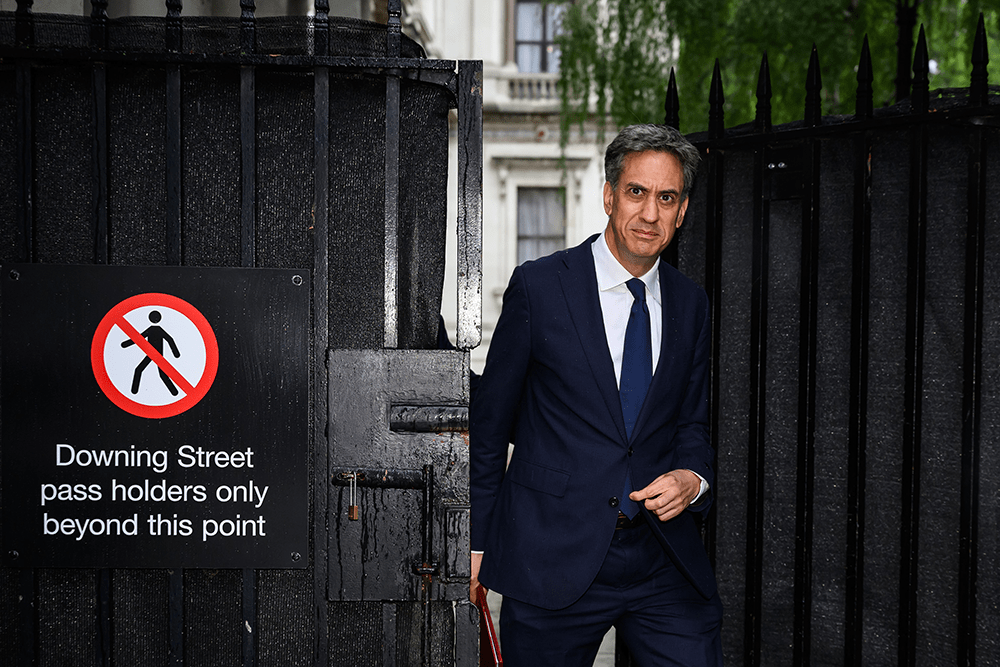


When Andy Burnham was quizzed at PMQs last week about his and Ed Miliband’s decision to sanction the Israeli government over its handling of Gaza, the Prime Minister was surprisingly frank about the trade-offs. He presented it as a decision to prevent ‘the collapse of the two-state solution’ for a peace deal in the Middle East, which he claimed was ‘dying before our eyes’. In his statement to the Commons, Miliband referred to ‘ethnic cleansing’. But Burnham also admitted: ‘We gave the most careful consideration to… all of the risks. The Foreign Secretary and I took close advice from the security services and, of course, officials in the Foreign Office and in our embassies.’
Such is the soggy consensus among MPs and the public that this righteous approach is justified that few seem to have asked what these risks were. The truth is that Burnham and Miliband ignored the advice they were given – which was that if they were determined to sanction Israel, they should not do so before the Israeli election on 27 October.
It may not be surprising that this was the message from the Israeli foreign minister, Gideon Sa’ar, when Miliband called him on 11 August to warn sanctions were imminent. ‘He said postpone it until after the elections,’ a diplomatic source confirms. It was also the message the Israeli embassy in London – and its new chargé d’affaires Chris Cantor – was relaying to the Foreign Office. ‘Their message was clear: why do it now? Wait until after the elections, because something might change,’ a senior Labour figure says.
The warnings to Burnham and Miliband about political fallout from the sanctions have proved correct
The British ambassador in Tel Aviv, Simon Walters, who was of the same opinion, delivered a ‘very explicit’ warning not to move so quickly. As a former director of national security for the Middle East in the Foreign Office, he had a deep understanding of the security implications. More remarkably, Jonathan Powell, the National Security Adviser, was of the same view. He was the most important figure in government on foreign policy during Keir Starmer’s premiership, but now seems to have been ignored on the first major issue of Burnham’s tenure.
What Powell and Walters sensed was that Benjamin Netanyahu, the combative Israeli Prime Minister, was in trouble in the polls and likely to lose his majority, and that any intervention before polling day would be weaponised by the Israeli right to drum up support for the government. This has been confirmed by three different sources. ‘Ed wants to get rid of Netanyahu and the Smotrich/Ben-Gvir lot [Netanyahu’s far-right coalition partners],’ a senior security source says. ‘He was explicitly told that would be less likely if he did this.’
Miliband went ahead and announced an import ban on goods from Israeli settlements, tighter export controls on weapons, new powers to sanction individuals and companies trading in the West Bank, a ban on advertising or promoting settlement property in Britain and sanctions against five individuals who have been involved in inciting or carrying out violence against Palestinians. Israel responded by closing the British consulate in East Jerusalem (from where aid to the Palestinians is organised), removal of British representatives from Gaza NGOs, an end to British training for Palestinian Authority security forces and travel bans on 11 MPs, including Jeremy Corbyn. It is understood that both sides have further escalatory measures prepared if the other moves.
The warnings about the political fallout have already proved correct. In the days before the government’s announcement, Netanyahu was under siege from claims, which he denies, that he was warned by the UAE President Mohammed bin Zayed about the 7 October terrorist attacks two weeks before they took place and failed to pass the warnings to Israel’s security services. ‘Netanyahu was taking a pounding,’ a senior security source says. ‘Then Miliband does his thing and the next day all the front pages say: “The UK, the bastards, I’m with Netanyahu, stand up for Israel, give him a break.”’
Burnham and Miliband’s position is that they needed to act before the election because tenders to build 1,200 homes on a settlement site called E1, an action seen as an impediment to a two-state solution, were due by 19 October. But insiders say that was an excuse and it is widely believed in Westminster that placating Labour MPs and winning back votes from the Greens in the Holborn and St Pancras by-election was the decisive factor. Tom Tugendhat, the shadow foreign secretary, says: ‘Having spoken to officials, it’s clear that the Foreign Office is largely of the opinion that this is performative and unhelpful.’
MI6, the Secret Intelligence Service, did not give Burnham an emphatic ‘Don’t do it’ message, but it outlined that it could risk intelligence-sharing with Israel. ‘People in 6 are pulling their hair out,’ says an influential Labour figure close to the security services. ‘They presented warnings about the consequences of doing this.’ That source even suggests that Sa’ar only took Miliband’s call after a request was passed on by MI6 via Mossad. Netanyahu routinely refuses to talk to British politicians.
A non-political source with deep roots in the intelligence community has this to say: ‘If you appear like a lightweight who will selectively virtue-signal, you’re not going to be taken seriously again.’ He says that Mossad already views MI6 as competent but overcautious: ‘The relationship was difficult because we did national security, the Israelis do national survival. I think the Israelis see us as pretty professional, but a bunch of pussies in terms of the methods that we would use.’
What does less cooperation mean in practice? My sources are adamant that if Mossad had actionable intelligence about an Islamist attack in the UK, they would still pass it on. But those who understand the nuances of the intelligence-sharing relationship are clear that useful information will be lost at the margins. ‘If it’s a real, imminent national security threat, they tell us,’ a second intelligence source says. ‘But they won’t just give us a flow of information like the Five Eyes’, the intelligence-sharing partnership which comprises the UK, US, Canada, Australia and New Zealand. ‘Everything is conditional and transactional.’
It is little understood in Whitehall that this policy has damaged relations with Gulf Arab states
Lost Israeli intelligence cannot easily be replicated by Britain’s Gulf Arab allies. ‘The Israelis are light years ahead of all the Arab services,’ the second intelligence source adds. But in Whitehall it is little understood that Miliband’s decision has also damaged relations with Gulf Arab states, which rely on intelligence passed to MI6 by the Israelis. This is an element with which Blaise Metreweli, the chief of MI6, would be very familiar, having served in Oman. ‘The Gulfies come to us because they know that we have a good relationship with Israel and they know that basically they’re getting Israeli product,’ a security source says. ‘They can’t get it directly, but they want it, they need it. They’re looking at us going, “What the fuck are you doing falling out with them?” A Labour source who spoke recently to senior figures in Qatar, Saudi Arabia and the UAE says: ‘Not one of them thinks we have gained influence from this. They just think we’re increasingly irrelevant. The Saudis and Qatar are downgrading their investments in the UK.’
Powell’s marginalisation is also a problem, since he was playing a key role in advising Middle East actors. The senior Labour figure I spoke to says: ‘The bigger concern was that Jonathan, someone they respected, has now become an auxiliary figure in the government. They like Jonathan because he’s a brain and he knows so many situations, what works, how you do mediation… Jonathan has a sense of strategic national interest and this [decision] is a purely domestic-driven initiative.’
Some Labour figures have been encouraged by the muted reaction to the sanctions from the White House, seeing that as good news for Burnham’s upcoming meeting with Donald Trump. But those who have recently been in Washington say this is not approval, but a measure of Britain’s irrelevance. ‘I’ve spoken to members of the administration and they have no regard for the UK government,’ says a source just back from D.C. ‘There’s a resigned indifference.’
Given all this, why did Miliband drive the issue with the same zeal he showed in championing net zero? In the Commons, Miliband presented his decision in the context of his family history as the grandson of Holocaust survivors. In an interview with Alastair Campbell and Rory Stewart, released on Tuesday, he explained that his decision to accuse Israel of ‘war crimes’ and ‘ethnic cleansing’ came from conversations with his mother before she died in May: ‘My mum… lost her father [and] 60 relatives in the concentration camps… I wrestled a lot with what she would say. And she’d say: “Look at what is happening to Palestinians… It’s wrong, and you’ve got to call it out.”’
Those who know him say he is personally ‘very hostile’ to Israel and was less comfortable when visiting the country than his brother, David. Some in the Jewish community believe Miliband is purposefully building up rivals to the Chief Rabbi, who publicly criticised the sanctions as a threat to the safety of the Jewish community in Britain. These rival groups include the Movement for Progressive Judaism and Yachad, which advocates for a political solution to the Middle East conflict. ‘He’s pushing to go further and further to do more and more, and people feel he’s crossed a line,’ says a prominent member of the community.
Some in the Jewish community believe Miliband is purposefully building up rivals to the Chief Rabbi
Security officials say Miliband is also less temperamentally inclined to listen to the spooks. ‘He has never been a massive admirer of the intelligence services,’ says a source who served in the secret service under the last Labour government. ‘I remember when he was in government before. He was a very clear contrast with his brother. He was known to be suspicious of the intelligence agencies.’
To be clear, holding pro-Palestinian views alongside deep hostility towards the Israeli government is a mainstream position in the Labour party. Added to this, there lurks a suspicion of Israel among the ‘camel corps’ in the Foreign Office, including both younger diplomats and intelligence officers.
My first intelligence source says: ‘There’s always been a kind of T.E. Lawrence mystical fascination with Arab culture and Muslim culture, and a disdain for Israel, and by extension for Jews, who are seen as a bit too like them – a bit too white, a bit too bourgeois, a bit too trade, a bit too clever, a bit too hard-working.’
However, it is understood that even senior Foreign Office officials agreed with the ambassador in Tel Aviv that now was not the right time to act. In both the Foreign Office and MI6 the great division is between age groups. ‘There’s a generational fight inside the Foreign Office between those who care about our strategic national interest and the campaigners,’ says the senior Labour source. The first intelligence source says the culture is also changing inside MI6 to accommodate younger, impassioned officers.
No one doubts that the policy is popular domestically, but the question is whether Burnham and Miliband’s desire to proceed with it ought to have been outweighed by the first duty of government, which is national security – not least given the fallout may have strengthened Netanyahu’s chances of re-election, and that the two-state solution remains as remote as it has been since Yasser Arafat rejected it in 2000. ‘This is not a business for people who want to be purer than pure,’ a former cabinet minister says. ‘This is a business for people who want to protect Britain.’






Comments