
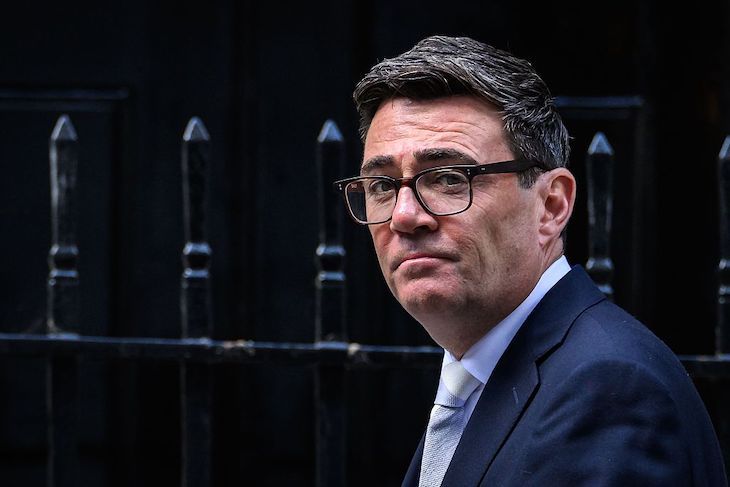
We’re still in the dead zone between Reform UK’s conference and the TUC and Lib Dems’ next week, with Labour and the Tories to follow. The main government announcement of the week, the decision by Andy Burnham and Ed Miliband to impose sanctions on Israel, seems demonstrably more likely – to put it politely – to deliver victory in the Holborn and St Pancras by-election than it is to deliver a two-state solution to the Middle East wars.
It’s worth taking stock at the end of the week about where British politics stands now. I’m grateful to Luke Tryl of More in Common for insights into his latest polling and focus grouping (none of which, he assures me, was paid for by a secret donor).
Under Keir Starmer, the public’s trust in Labour to transform their lives plummeted
The first thing to say is that Reform have not had much of a bounce out of their conference (perhaps because of the continuing furore around funding which overshadowed much of it). But the same is true of Labour. The Burnham bounce was real, but overall it seems to have peaked at around four or five percentage points, rather than the eight or nine which would have senior Labour types badgering the Prime Minister to call an early general election. What’s more, it seems to be ebbing already. The top of the table is now basically a three-way tie. More in Common’s latest polling puts Reform on 24 per cent, Labour on 23 per cent and the Tories on 22 per cent.
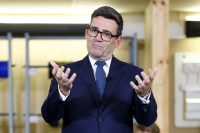
The other slightly concerning thing for Burnham is that his undoubted personal popularity (+13 approval) no longer seems to be propping up his party. This is exactly the same problem Kemi Badenoch has endured for months – a relatively buoyant personal rating (+4) running several points ahead of the still brand-damaged Conservative cause as a whole. In July, Nigel Farage had the highest net approval rating of the major leaders, now he is on -26.
Under Keir Starmer, the public’s trust in Labour to transform their lives plummeted. Just before the general election in 2024, this stood at 54 per cent. Within a year it had dropped into the 20-somethings. When it was clear that Starmer was being replaced it rose to 41 per cent, but under Burnham this confidence slid again to 38 per cent, evidence that government is difficult.
The good news for Labour is twofold. First, Burnham has dramatically detoxified his party. While the number of voters who would explicitly seek to vote against Reform has remained steady (38 per cent in May wanted to ‘stop Reform’, 37 per cent now), Burnham has driven this number down for Labour. In May, 35 per cent of voters wanted to ‘stop Labour’, but that has now fallen to 20 per cent.
Second, the left is being squeezed and votes are coming back from the Greens (9 per cent) and the Lib Dems (12 per cent), both of whom have lost support in recent months. The consequence of this is that Labour’s share of the ‘left bloc’ of voters has risen from around 45 per cent to 57 per cent, while Reform’s share of the ‘right bloc’ has fallen from the mid-60s to 50 per cent.
So what does all this mean for the by-election, where it was announced this week that Zack Polanski, the Green leader, would represent the Greens? Labour are favourites and some of Burnham’s team believe they can drive a stake through the heart of the Green threat with a win. Tryl conducted the first focus group there this week. Reading it, if I was a Labour strategist I wouldn’t be popping the champagne corks just yet.
More in Common surveyed voters who had mostly voted Labour at the 2024 General Election, but many would now be open to voting Green. Asked about Starmer, some were actively angry and disappointed, while others felt Starmer was a ‘nice guy’ but a hopeless advocate.
‘He’s the worst communicator on earth,’ said Emma, who is retired. Tommy, a plumber, noted: ‘He’s a big part of the reason a lot of older Labour supporters are going Green now, abandoning any hope on welfare.’
The jury remains out on Burnham. ‘All agreed that he was a better communicator than Starmer, and some felt that he was offering a refreshing return to Labour values,’ says Tryl. ‘But some wondered whether there was any difference in substance or just more energy than Starmer. Emma said in the focus group: ‘Cut from the same cloth. He’s got similar backers, similar funders. Is it really going to be any different, apart from the northern thing and championing Manchester?’
Calum, a semi-retired documentary film editor, complained that Burnham’s cost of living interventions were small beer: ‘We’ve heard this kind of thing for years – they tell you it’ll save the average family forty-five pounds a year. That barely gets you a round of drinks these days. It’s nothing.’
Several people around the table had already voted Green in the local elections, but some worried the Greens had lost their focus on the environment and were too preoccupied with culture wars. Angela, a charity worker, said: ‘For me, the biggest topic I’m interested in is climate change.’ Emma complained: ‘You’re not talking about the climate. I don’t know what your policy is – I know your policy is about the trans issue.’
There were also some doubts about Polanski’s personal judgement, including his retweet criticising police conduct after the Golders Green stabbing – in which two Jewish people and a Muslim were attacked. ‘I think it was really ill-judged, and he shouldn’t have done it,’ Emma said. ‘He’s obviously pro-Palestine, and I think that shaped his response — a lot of people are, but you can’t let that colour how you react to something like this. He should probably just get off social media.’
All to play for.
When I’m not writing about politics, I’m almost invariably reading about espionage, both fiction and non-fiction. On Friday 9th October, I’ll be interviewing arguably the best writers of fact and thrillers in this space – Ben Macintyre and David McCloskey. Both have superb new books out. Come and join us. Tickets here


Comments