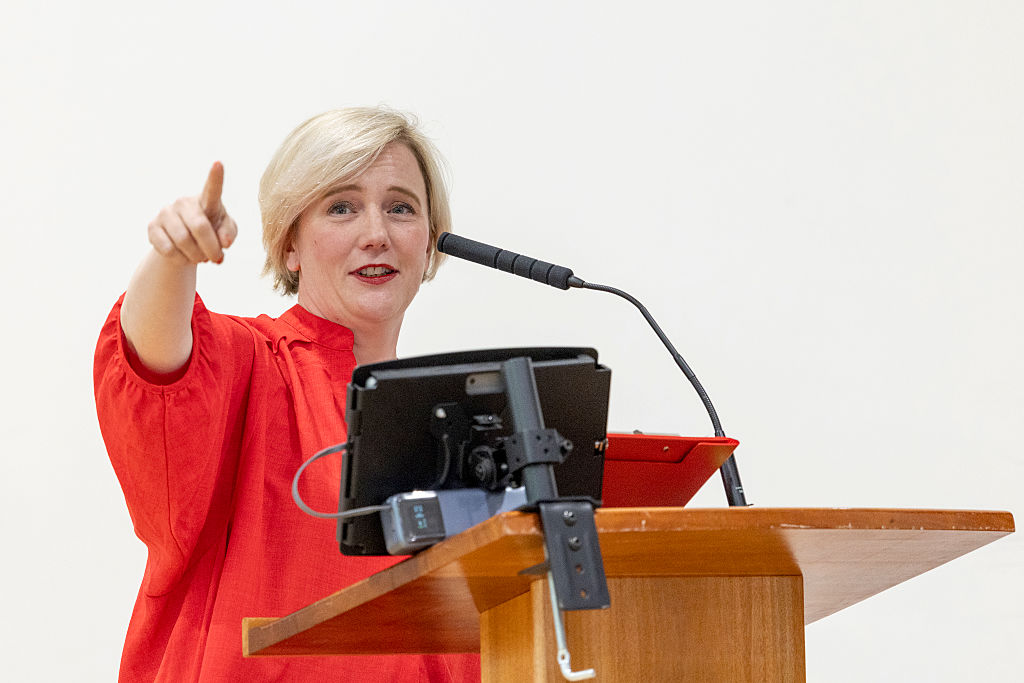
‘Stella Creasy’s bird-brained parrot alert,’ ran a Steerpike headline yesterday. The Labour MP for Walthamstow had posted a video of herself in a London park. The video showed a parakeet, with the MP explaining it was definitely not a parakeet.
‘Walthamstow has anyone lost a parrot?’ she wrote. ‘There’s one in Lloyd park right now! Please share to help reunite it with its owner!’
For centuries Londoners made fun of country bumpkins by saying they hadn’t even seen the lions – meaning those at the Tower. The lions are long gone, but somehow it is now possible to be a country bumpkin in Walthamstow
The MP has faced some serious abuse on social media in her time. In 2014 Peter Nunn, of Bristol, was jailed for 18 weeks and made the subject of a restraining order for a campaign of menacing messages towards her that included retweeted threats of rape. Creasy had offended him by supporting a campaign to put Jane Austen on £10 notes. Some of the responses to Creasy’s avian error were repulsive. Most were simply a joyous and richly deserved torrent of ridicule. Steerpike highlighted a picture of a stag, beneath which someone had written ‘Lost cat in Richmond Park! And it has a tree branch stuck on its head, poor thing. Please share.’
Wild parakeets have been noted in the UK for the best part of two centuries, although it was only from the 1960s that colonies survived. Not knowing this, I remember the bewildering strangeness of first encountering the birds while working at St Peter’s Hospital in Chertsey, just to the west of London. In some trees near the car park there was a flash of emerald green. A few pairs of birds flew a short distance to another tree nearby. Their colour, their shape, their calls, the pattern of their flight, all struck me as immediately foreign. I spent some time peering up at them in amazement before rushing inside and being equally amazed at the lack of interest my news aroused. Wild parakeets there were new to me, not to anyone else.
For centuries Londoners made fun of country bumpkins by saying they hadn’t even seen the lions – meaning those at the Tower, which everyone traditionally rushed to gawp at the moment they arrived in the capital. Those lions are long gone, and somehow it is now possible to be a country bumpkin in Walthamstow.
Escaped lions never established themselves in the British countryside. Parakeets have done wildly better. They are Indian rose-ringed parakeets rather than their African cousins, and descend from escaped pets. The rumours are sadly false that they derive from a pair released by Jimi Hendrix, or stunt parakeets imported to film The African Queen in Isleworth.
‘All things are artificial,’ wrote Sir Thomas Browne, ‘for nature is the Art of God.’ What we call the natural world is always partly our own creation. Sheep, cows, pigs and dogs were all brought to Britain by human hand, as were wheat and barley. Mice and rats were brought over accidentally, fallow deer on purpose. The Romans brought walnuts and leeks, celery, grapes, pears and plums. They also brought garlic, but we rejected it when they left, and when members of the Free French Navy demanded some during the war (not being able to fight when fed our tasteless food), our government found it easiest to have garlic exfiltrated from Occupied France by the SOE.
Grey squirrels are famously new to Britain. Many wish them gone, but while nature is malleable it cannot be reshaped by us merely wishing it so. Shakespeare would never have seen a wisteria nor a horse chestnut, but both to us are now quintessentially part of our world, as are sycamores and rhododendrons. Much of the countryside colonised by parakeets is now also home again to red kites.
The only way to avoid reshaping our world is by not living at all. ‘We are as gods and might as well get good at it,’ wrote Stewart Brand; Matt Ridley quoted him here recently: whether we like it or not, managing nature is itself part of our nature.
I happen to find parakeets rather beautiful, like the equally exotic pheasants that gild our fields with their Asian plumage. City pigeons, descended from pets and food animals, treat our buildings as the cliffs of their ancestors. They were part of my childhood. Their cooing is less musical than that of wood pigeons, which were never domesticated. In both species the sound is a pleasant reminder of their devotion to lifelong monogamy – a trait which makes me reluctant to eat them, delicious as they are.
Creasy has deleted her original post, which is a shame. We usually do better to laugh at our own foolishness than to hide it, and making a fool of yourself before a large audience is an occupational hazard of public life. Some of her follow-up messages, with parrot-themed puns, are better judged.
Words, like parakeets, have a life of their own, and once they leave us we have little control. Creasy’s failure to recognise a type of parrot is a bemusing but trivial error of biology. But there are parts of our natural world that do not yield to wishing. Her insistence in 2022 that some women are born with penises is an error of a more wilful and a harsher kind.


Comments