
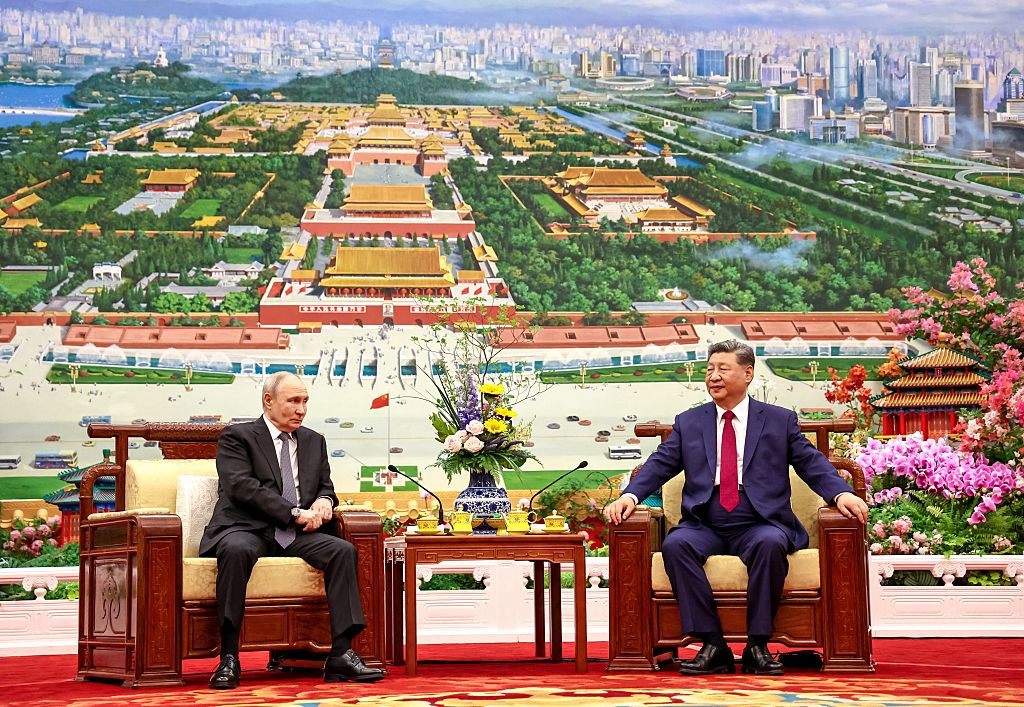
Vladimir Putin just can’t keep away. Having visited Beijing in May on the heels of Donald Trump, it has been announced that the Russian leader – who has been to China more than two dozen times during his tenure as president – will lead his country’s delegation to the 33rd Asia-Pacific Economic Cooperation (APEC) summit in November. This apparent sign of amity, though, is actually an expression of Russia’s growing dependence on China – and Putin’s growing frustration with its refusal to green-light a new gas pipeline project.
For all that some Western politicians and commentators continue to present Moscow and Beijing as marching in lockstep, the Russians themselves have few illusions as to how far the high-flown rhetoric of a “friendship without limits” really get them.
In May, the Russian press crowed that “Xi Jinping didn’t give Trump a single card.” A few days later, what Putin got was a painting of himself and Xi, in which he is about half the Chinese leader’s size. While Xi strides confidently forward, Putin follows loyally behind. Russian commentators had no doubts as to just who was being presented as the “big brother.”

Essentially, this is a pragmatic and transactional relationship. Where the two countries have shared interests, then they are happy to cooperate, whether developing shipping routes along Russia’s Arctic coast, or supplying intelligence data to Iran. However, as an expert in Moscow once put it to me, “Russia doesn’t get anything for free. It has to buy it one way or another – and the Chinese bargain hard.”
Perhaps the most concrete example is the long-running saga of the Power of Siberia 2 gas pipeline. The European Union is still Russia’s largest export market for natural gas, but China is close behind; Russia supplies more than 30 percent of its pipeline gas and more than 20 percent of its exports of liquefied natural gas (LNG).
The pipeline gas, enough to power all of New York state, comes through the 2,500-mile-long Power of Siberia, which opened in 2019. Since 2014, though, the two countries have been discussing an even higher-capacity Power of Siberia 2 pipeline connecting Arctic gas fields to China along a 1600-mile route via Mongolia.
Russia’s Gazprom corporation began a feasibility study in 2020 and in 2025 announced that it was close to finalising a supply deal. With Europe committed to phasing out its dependence on Russian energy, this had become all the more important to Moscow. Fully aware of this, the Chinese have been slow-walking negotiations, demanding not international market prices, but the heavily subsidized rates paid by Russian domestic consumers, or something like a 75-80 per cent discount.
Putin set himself up for an embarrassment when, before heading to Beijing, he talked up the likelihood of a deal being struck. Whether he misread the omens, or incautiously thought he could bounce Xi into action, he took a large delegation of energy executives with him, only to be stonewalled. Beijing has not ruled out further talks, but for now has firmly requested the Russians stop pushing until they are willing to come closer to its terms.
This encapsulates the whole relationship: superficial cordiality over bare-knuckled deal-making.
Of course, this is heavily affected by the relative asymmetry of their economies. China has alternative sources of oil and gas, but Russia is much less able to shop around for what it needs from China, ranging from microchips for its drones and missiles to smartphones to replace sanctioned Western brands (with Chinese models now accounting for 85 percent of total sales).
The Russians have few illusions as to how far the high-flown rhetoric of a ‘friendship without limits’ with China really get them
This is not regarded as an unqualified boon in Russia. If anything, it has opened up a generational divide within the elite. Putin and his fellow septuagenarians, for whom the Ukraine war will determine their political survival and historical legacy, seem broadly willing to put up with Beijing’s pressure and incursions, as a price for continued Chinese trade and support. A younger generation of leaders fear that it is easier to fall into Beijing’s orbit than escape from it. Although they are quietly expressing their concerns, from the way the domestic car industry is being undercut by imports, to the new competition Russia’s nuclear industry is facing in its traditional markets from Central Asia to Africa, Putin doesn’t seem willing to listen.
There is a difference between not pushing back and being a pushover, though. Mark Rutte, the hyperbole-prone secretary general of NATO, memorably claimed last year that, should Xi decide to invade Taiwan, “he will first make a call into Moscow to ask Putin to keep us busy in this part of Europe,” and the Russians would attack Europe at his behest.
Russian commentators and security experts alike scoffed. They noted that their military maintains a standing contingency plan for how to repel a Chinese invasion of the Russian Far East. As is, Moscow gets very jumpy whenever a new map is printed in China which gives the original, Chinese names of the cities ceded to Russia in the so-called “Unequal Treaties” of the 19th and early 20th centuries. The concern is that while Xi may not be looking to revisit the borders – he is 73 years old – a younger successor might prove more hawkish.
Although the two countries conduct combined exercises, most recently the Joint Sea-2026 naval operation, these are often more performative than anything else. They are intended to make the USA and its allies wary rather than genuinely marking the kind of integration seen within NATO. Neither side lets the others’ officers observe their strategic-level command processes, for example, and although Moscow is having to allow the Chinese to buy ever-more sophisticated systems, such as their S-500 surface-to-air missiles and their most modern jet engines, it is also trying to keep its most advanced technologies to itself.
As a result, even while their intelligence agencies cooperate in targeting the West, the Federal Security Service has admitted that Chinese espionage in Russia is now at a higher level than before 2022. Less a friendship without limits than friends without benefits.





Comments