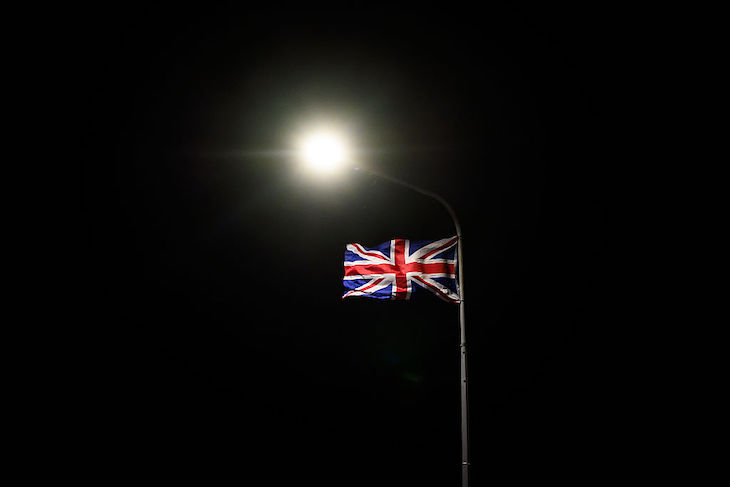
London, one of John Le Carre’s characters reflects in The Night Manager, is ‘the land of make-believe power’. These lines were written in 1993, a year when the British economy was in dollar terms larger than that of India and the People’s Republic of China combined. What Le Carre would have made of Britain today, long since overtaken economically by China, and grappling with a host of problems at home and abroad, does not bear thinking about.
Pessimism about the United Kingdom’s position in the world has a long pedigree
Pessimism about the United Kingdom’s position in the world has a very long pedigree. In 1897, at what appeared the high point of the British Empire, the ‘bard of empire’, Rudyard Kipling, penned ‘Recessional’ to mark the Diamond Jubilee of Queen Victoria. He warned that ‘far-called our navies melt away’, and that soon the ‘pomp’ of the empire would be no more than the defunct civilisations of ‘Nineveh and Tyre’. A few years later, the secretary of state for the colonies, Joseph Chamberlain, lamented that ‘the weary Titan staggers under the too vast orb of his fate’. These voices swelled after the Second World War and the onset of decolonisation, and reached a crescendo immediately following the Brexit referendum in 2016.
The critics had a point: Britain has indeed lost considerable ground since the late nineteenth and early twentieth centuries. Much of its navy has actually melted away, as the recent fiasco around the deployment of HMS Dragon to Cyprus demonstrated. Despite this, the United Kingdom still acts as one of the few Great Powers today, as a mainstay of the Western alliance with a global presence, and as the first line of defence against Russia in the Baltic and High North. It does so on the basis of its considerable resources, reach, reputation and resilience, especially when viewed in comparative terms.

Today, Britain remains the fifth largest economy in the world and until a few years ago it had long had the third largest peacetime defence expenditure. The Royal Navy is now only the eighth largest by tonnage, but it is still widely regarded as among the top two or three most powerful fleets in the world, and in its two new aircraft carriers boasts a capability which is exceeded only by the United States, though China is gaining rapidly. Britain is also one of the few countries with a substantial ‘heavy lift’ capacity, meaning that UK forces can be deployed quickly across the world. Moreover, unlike many other contenders, the UK armed forces have extensive recent combat experience.
Underpinning the United Kingdom’s conventional capabilities is the British nuclear deterrent, which consists of 225 warheads, a number set to increase. This rests on four submarines, one of which is always at sea. The current Vanguard fleet is due to be replaced by the new Dreadnought-class submarine in the early 2030s. The decision to deploy the deterrent, which is assigned to the defence of Nato allies, lies solely with the prime minister. The targeting of the weapons is also entirely independent and does not rely on American assistance. Beyond this, the UK intelligence services are the second-most significant in the world.
When it comes to reach, that of the United Kingdom is second only to that of America. There are British bases in Gibraltar, Cyprus, the Falklands and there are also British overseas territories in the Caribbean and Pacific. Until recently, this reach was supplemented by a huge overseas aid budget, formerly the third biggest in the world. In the World Bank, the United Kingdom, along with France, has the fourth largest voting power, after that of the United States, Japan, and Germany.
Britain’s great power status is also widely recognised. The United Kingdom is generally regarded as the most significant and reliable European military actor behind the United States. For example, when Finland and Sweden applied to join Nato in May 2022, it was from the United Kingdom that the two countries requested and received a bilateral security guarantee for the period between application and actual membership in the alliance. Moreover, it was striking that when President Zelensky of Ukraine visited European capitals in February 2023, he went to London before visiting Brussels and the EU member-state capitals. This was in recognition of the United Kingdom’s major role in supporting Kiev at the start of the conflict. In Moscow, by contrast, the UK is regarded as the biggest European threat, and its intelligence services are feared at least as much as those of the Americans.
Britain also enjoys a high standing in democratic East Asia, partly as a result of its military commitments to the region, but mainly because of the widespread perception that London has been leading the European effort to contain Russian aggression. A victory for Vladimir Putin in Ukraine, it is felt in Tokyo, Canberra, and Taipei, would embolden China’s president Xi Jinping to attack Taiwan or to ramp up the pressure in the South China Sea. The United States is still the main point of reference, of course, but Japan strongly welcomed the dispatch of the carrier strike force in 2021. Contrary to a widespread view, the Royal Navy, when deployed, makes a substantial difference to the maritime balance of power in the region.
Finally, the United Kingdom has demonstrated exceptional resilience as a Great Power. It enjoys the longest continuous statehood of all the major actors, going back at least to the Anglo-Scottish union of 1707, but arguably to the origins of England itself. It has lost wars and empires, but it always bounced back. It has a long record of success in the conflicts it has faced, including against Bourbon France, Napoleon, Imperial Germany, Hitler, and the Soviet Union.
The United Kingdom is still one of the four or five leading global powers – a force always to be reckoned with. For hundreds of years, Britain has coped with whatever the international system has thrown at it and if the necessary political leadership can be found it will continue to do so.



Comments