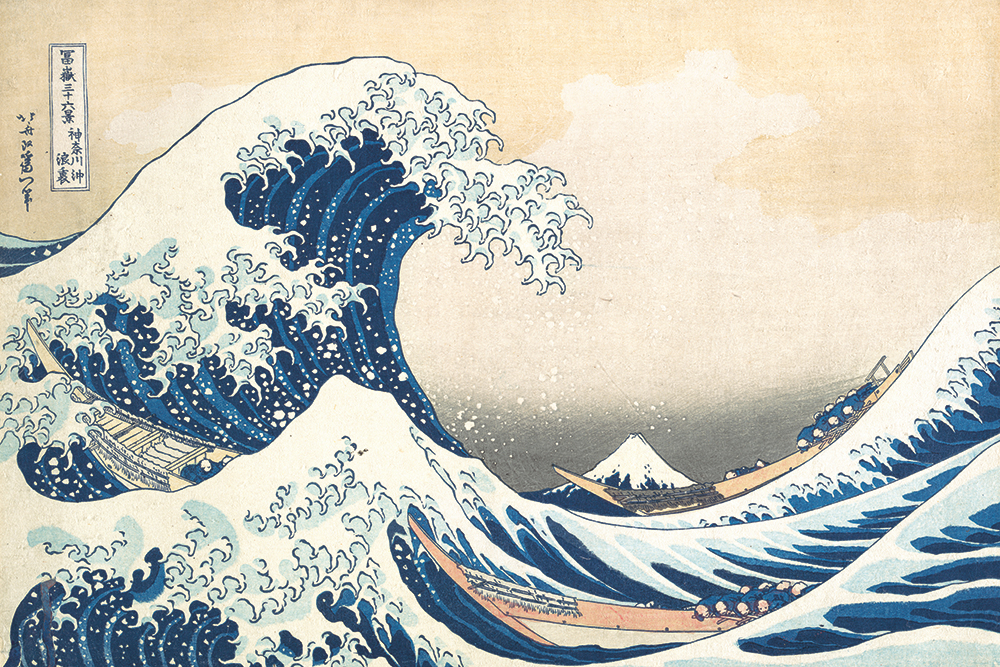
Do you know your aquatint from your drypoint? Your intaglio from your lithograph? The appearance of any one finished print can vary so much from another – the feathery delicacy of etching replaced by the bold forms of linocut or the carved sinews of a woodblock – that it can be difficult to believe they all derive from the same initial process.
What image appears when an object – be it carved, chemically altered, or engraved – is covered in ink and pressed into a piece of paper? As Holly Black explains, it is difficult to know when this technique first originated. Was it with the work of monks carving woodblocks in the mid-9th century to print the lines of the Diamond Sutra (now held in the British Library)? Or does it have its origins centuries earlier? Black draws attention to China’s 7th-century empress, Wu Zetian, who schemed and blackmailed her way from courtesan to ruler. Though no extant version now exists, she commissioned 100,000 copies of a spiritual text which appeared to predict and legitimise a female ruler. For such a large commission, surely printing would have been the medium of choice rather than the laborious work of hand copyists and calligraphers? There are enough hints in other texts – from Buddhist devotional writing to trade documents from the Silk Roads – to suggest that the woodblock was already well-known as a medium.
Andrea Mantegna ordered the murder of two printmakers he believed had emulated his work
From these inky beginnings, Black moves through ten chapters and over a millennium of art history, from early woodblocks of deities produced for the Chinese Lunar New Year to Andy Warhol’s screenprints and the developments of 20th-century mass-market production. Some chapters stand out. When covering the developments of the Renaissance, Black reveals how woodcuts and engravings by artists such as Albrecht Dürer were linked to the invention of Gutenberg’s printing press in the mid-15th century. If books could be created by the ‘kiss’ of the metal press on paper – so named for the squelching sound made when the press is lifted – what was to stop pictures being made and circulated in this way, too?
Dürer’s dense, dramatic and occasionally apocalyptic images – and those of the other artists working in the same period, from Hans Holbein the Younger to Lucas Cranach the Elder – are a part of this story of new media. Papers, pamphlets and images were being printed for the increasingly literate, artistically engaged population. Then, as now, print was a way for collectors to purchase art at a more accessible price. But there’s another story, too. These prints were often the work of many hands – the artist who drew the design, the cutter who transferred it to the metal plate and the printer who first saw the design committed to paper. Dürer, however, was meticulous about always adding his initials to his work. Though a print’s hallmark was its quick replicability, the identity of the artist still mattered. And Dürer wasn’t alone in jealously guarding his work: the Italian artist Andrea Mantegna ordered the murder of two printmakers he believed had emulated his work.

Black’s richly illustrated book covers the skills and processes of famous printmakers such as Rembrandt, Hogarth, James Gillray and William Blake, always with one eye on potential buyers for these printed works. But her research truly excels when she turns to lesser known print-making influences, from the Impressionist Mary Cassatt’s delicate domestic prints, inspired by the 18th-century Japanese movement nishiki-e, to the radical Mexican group El Taller de Gráfica Popular (the People’s Graphic Workshop), which created bold anti-fascist imagery in the years preceding and during the second world war.
Black herself is a printmaker and she has a knack for describing the many messy, involved techniques and processes which go into the art. We hear how acid eats away at exposed copper; how ‘stop-out varnish’ can prevent the erosion and preserve patches of bright white like those seen in Daniel Hopfer’s 1515 etching of a particularly gruesome devil. We learn about the intricacies of the 17th-century invention of mezzotint, in which an image is created by burnishing a metal plate which has the texture of sandpaper.
Black also dwells on those who supported the artists with these processes, from Madeleine Lacourière, who prepared the ‘sugar-lift’ mix for Picasso’s aquatints at the same time as she made her morning coffee, to Katsushika Oi, who helped her father Hokusai with his celebrated 19th-century woodcuts. Complex techniques didn’t die out with the invention of ink-jet printing. In the last chapters, Black explores the possibilities of screenprint and digital printmaking, from works by the ‘Pop Art nun’ Sister Mary Corita to April Greiman’s off-set lithographs, which were created on early ‘hair-raising’ versions of Apple software.
The book is a truly tangible art history – one which draws attention to the processes of craft with rare clarity and precision and tells a sweeping global history without ever losing sight of the minute details that make it so fascinating.



Comments