
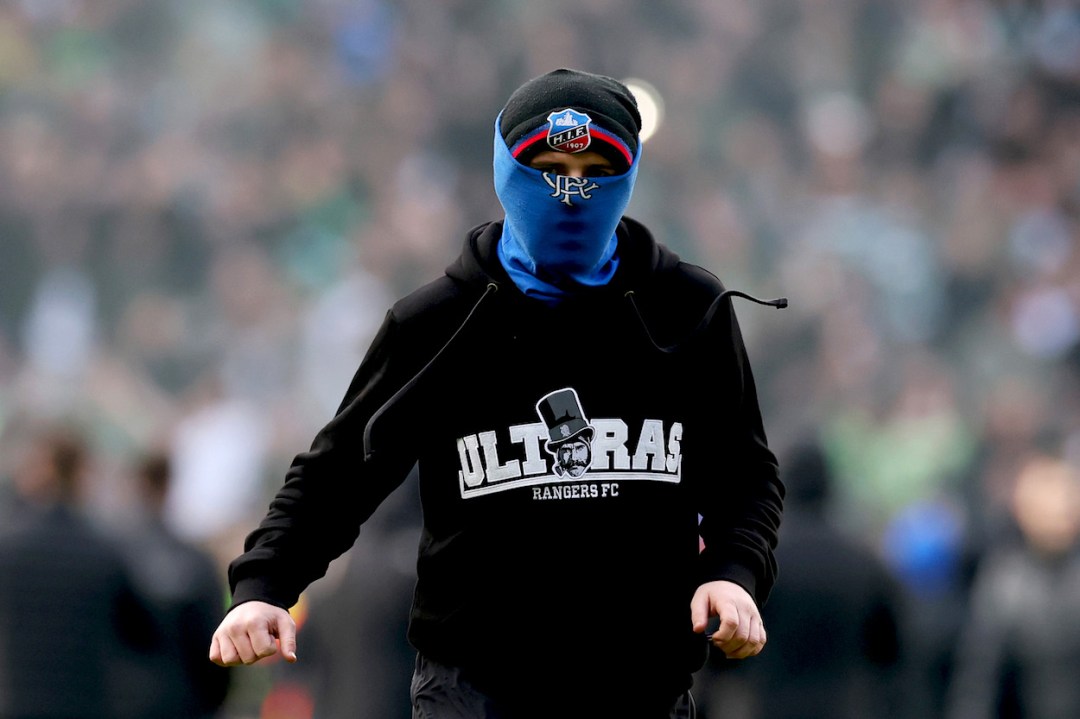
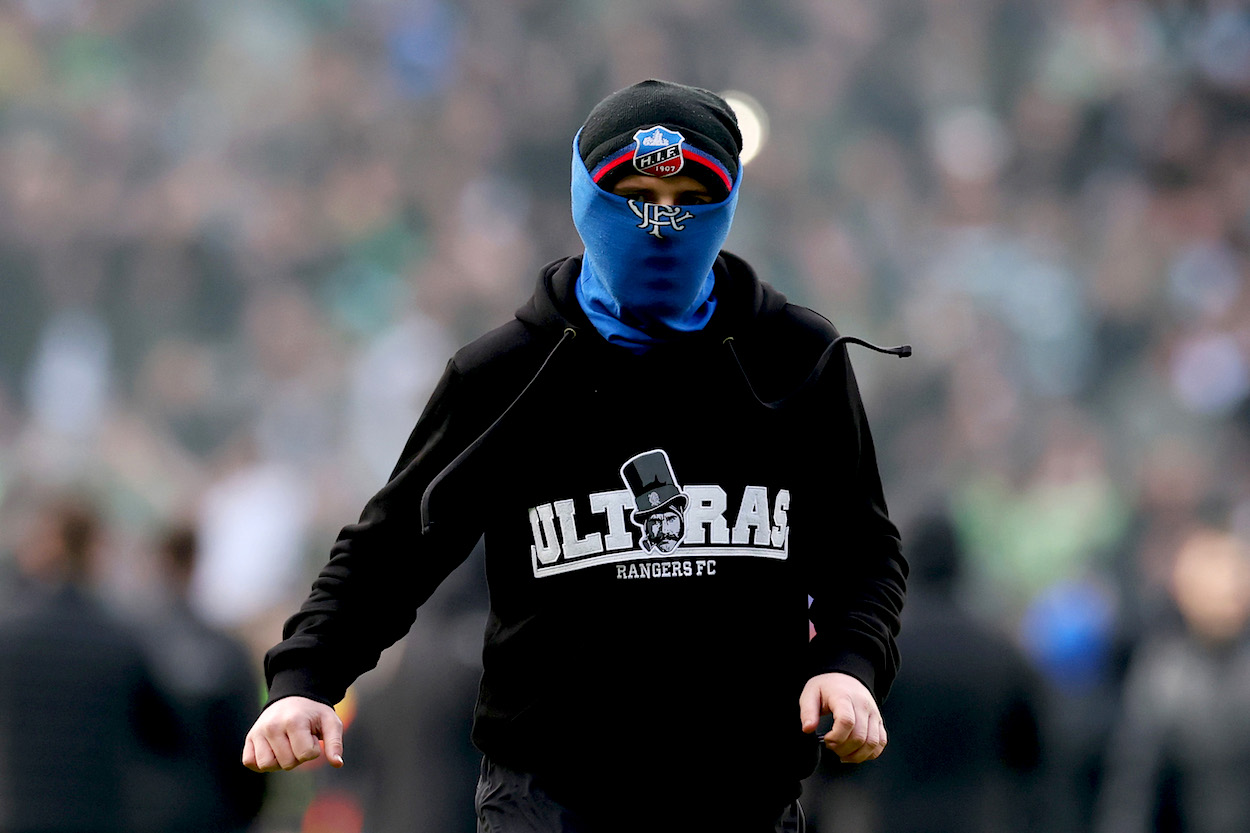
Yesterday afternoon, Rangers and Celtic played out a dismal 0-0 draw (‘eye-bleeding’, was journalist Tom English’s verdict) in the Scottish Cup quarter-final before the game was settled/put out of its misery on penalties. The game itself will soon be forgotten, what won’t be is the trouble that followed. Celtic’s ‘triumph’ provoked a pitch invasion by sinister, black-clad, masked, ninja-like supporters, first Celtic fans, then, in response it appears, Rangers. A flare was launched into the Broomloan stand, and there are reports of a Celtic official being attacked. The pitch was soon cleared, and thankfully, no one was hurt, but it was a horrible look at the end of a horrible game.
There could be serious repercussions. This was the first time in years that Ibrox had admitted a significant complement of away (Celtic) fans, and some 7,500 were present. That level of dispensation will almost certainly end. Fifa and Uefa will doubtless have noticed too, so it could impact the use of Scottish stadia for international tournaments. And I wouldn’t be surprised if the Scottish government jumped in either (they have form on this), and we know how helpful they can be.
Scotland desperately needs the Rangers-Celtic duopoly to end. Apart from the old hatreds spewed from the stands by some (spiced up by a few extra ingredients such as Palestine and the change of monarch), the Old Firm have contributed very little to Scottish football in recent years. In sporting terms, the Scottish Premier League must be the most predictable (and many would just say boring) in Europe. No team apart from Rangers and Celtic has won the title since 1985 (Aberdeen), and you have to go back an astonishing 71 years or the last time at least one domestic trophy wasn’t claimed by either Rangers or Celtic.
The two clubs win trophies galore but no new converts. They have dominated without inspiring, and in European terms, Scotland is going backwards. So dismally did Scottish clubs led by Rangers and Celtic perform in recent years that our coefficient has been downgraded, and we are set to lose automatic slots in the Uefa tournaments, and thus a vital revenue source, from 2027. This is critically important as once excluded from the top table and consigned to grabbing crumbs in the preliminary rounds of lesser tournaments, it can be very hard to regain ground.
Rangers and Celtic aren’t solely responsible, of course, but it is arguable whether the two Glasgow clubs have done anything to advance the game in Scotland recently, or much to help the national team, about whom many of the fans are equivocal at best. When the two had possession of the country’s leading homegrown players, they were notoriously reluctant to release them for international duty. Now, when they are embarrassingly weak in international terms, they seem to have lost interest and field mostly imports. Astonishingly, only one player in the starting line-ups yesterday was actually Scottish.
There is hope though, in the form of a revived Scotland team qualifying for their first World Cup in 28 years (in spite of the Old Firm rather than because of them – only a couple of Rangers and Celtic players featured) and the emergence of a potential ‘New Firm’ in the form of current league leaders Hearts and fourth-place Motherwell. Hearts and Motherwell have managed to challenge the establishment through canny investment of moderate/tiny budgets, good coaching and competent and stable management.
If Hearts can keep going – they are currently favourites and on course for the highest points total by a non-Old Firm side in the league’s history – avoiding the traumatic last-gasp meltdown that cost them the league the last time they were serious challengers (1986!), it would be like a draught of cool spring water on the dusty, parched palate of Scottish football. It would inspire provincial clubs on limited budgets and further expose how utterly sterile and redundant yesterday’s scenes were, and how a much more positive alternative vision for Scottish football is available.
For the fans, this is excellent. The progress made by Hearts and Motherwell (and let’s not forget St. Mirren winning the League Cup), has enlivened what had become a thoroughly stale product. For the first time in decades, the Scottish league is more interesting than its glittering, money-drenched English counterpart.
Gary Keown, writing in the Mail, described the prospect of Celtic and Rangers winning nothing this season as ‘the best thing to happen to Scottish football’. I suspect even a few Rangers and Celtic fans, the more thoughtful, non-pitch-invading ones, who can see that what is good for Scottish football as a whole is ultimately good for them, might secretly agree with him.


Comments