
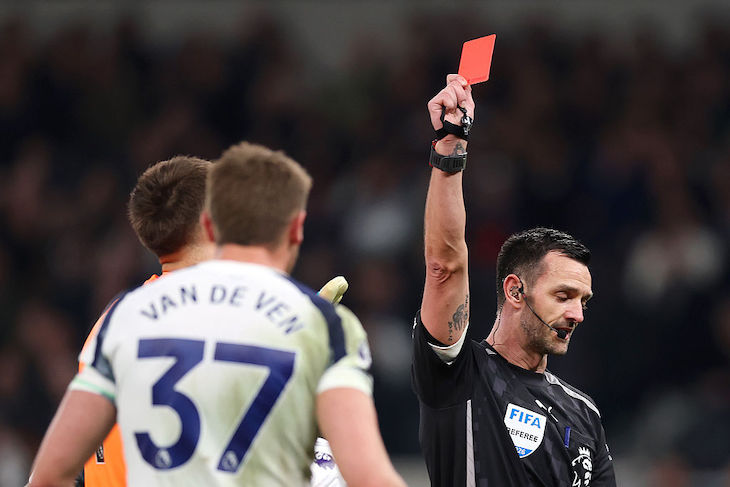
How the mighty have fallen. Tottenham Hotspur, the fifth richest club in England, the ninth richest in the world, current Europa League Champions and a mere five years ago Super League aspirants, are now facing relegation to the not-so-super league, the Championship. After yet another dismal defeat last night (1-3 to Crystal Palace), our (full disclosure: I’m a fan) fifth loss in a row, Spurs sit 16th in the league, just a point ahead of West Ham and Nottingham Forest. As the commentator on TNT said, ‘the unthinkable has now become possible’.
We thought we were too good for the Premier League. The humiliating truth may be that the Premier League is too good for us
The scenes at the Tottenham Hotspur Stadium last night somewhat recalled Hillary Clinton’s 2016 election night party after it became clear she had lost; a vista of blank, dumfounded faces, a few tears. Some had left before half-time even, but of those that saw it through to the bitterest of endings, many hung around, seemingly paralysed by the pre-grief of our looming demotion, a concept so remote from our hopes and expectations as to be virtually impossible to process. But process it we may soon have to, as may the Premier League and the wider football world.
For Spurs, the consequences have been described as ‘catastrophic’ with relegation from the top flight potentially costing the club as much as £260 million. The current £76 average price for a ticket would no longer be sustainable in the Championship, and lucrative hospitality packages would be unlikely to attract much interest if Preston or Swansea are the visitors. Broadcasting receipts would plummet, and sponsorship revenue (one major sponsor has already left) would evaporate. There would likely be a ‘fire-sale’ of players (some of the most marketable may already be looking around), and attracting first-class replacements would be difficult. Nor would an instant rebound be guaranteed; the Championship is a very tough league, and Spurs would be scrapping it out with a likely much reduced squad and greatly reduced budget.

As for the Premier League, it is fair to say that it was not designed with the idea of elite clubs being demoted in mind. The loss of one of the gilt-edged ‘big six’ clubs, especially one with a global fanbase, would be disturbing and likely provoke debate about the viability of the dreaded drop. The Premier League and Championship are separate entities, and promotion and relegation between the two take place only as long as the elite division’s executives permit it to. The fragile link between the two top tiers could be severed easily if deemed to have outlived its usefulness.
It has already happened in rugby union. Last week, Premiership rugby announced it was scrapping relegation for good from next season and turning its elite division into effectively a closed shop, thus ending 37 years of merit-based ascendancy. Henceforth, gaining access to the top tier will be extremely difficult and permitted according to non-sporting criteria, such as – you guessed it – financial stability. Premier League execs will be watching that situation closely. Last year, it was reported that some of the American owners (of whom there are 11) were unhappy with the concept of relegation, which is alien to US sports. “Nothing is off limits,” was the quote attributed to one US owner.
This is in line with the way elite football has been going for a long time, safeguarding future revenues by tweaking formats to ensure the top clubs are close to guaranteed slots in the most prestigious tournaments. The Champions’ League stopped being a league of champions in 1992 as a result of the irritating habit of the richest clubs in Europe often failing to qualify. Many want to go further; the concept of ‘legacy-based admission’, allowing super clubs who have had a poor year to qualify based on former glories, has been batted away for now but looks inevitable in some form.
If the Premier League executives are wise, they will go no further down this road. Even as a Spurs fan, I would have to admit that the jeopardy my club faces is one of the most compelling stories in the league in years. Our predicament is exceptional, but the relegation battle is usually far more entertaining than the often rather predictable business at the top of the table. Without relegation, it is hard to think of much reason for watching the last nine games of the domestic season. As it is, I and many others will be riveted.
It would provide a healthy reality check too. Many would question the word ‘mighty’ to describe Spurs that opened this article, preferring ‘high and mighty’ perhaps. Classic underachievers, we haven’t won the league in over 60 years for the simple reason that we haven’t deserved to. We have the most expensive stadium in Europe, but our feeble, panic-stricken team makes a mockery of it. Our attempt to join the European super league a few years back now looks like hubris on steroids. We thought we were too good for the Premier League, and the humiliating truth may be that, at least at the moment, the Premier League is too good for us.
A spell in the second tier might do us, and football, good. It might remind us who we are and encourage les autres at the same time. It might wean us, and hopefully others, off the ridiculous, cruel, and ruinously expensive habit of dismissing managers after every lean spell. We might remember the example of one of our most successful bosses, Keith Burkinshaw, who won more trophies than anyone apart from Bill Nicholson and was inducted into the Spurs Hall of Fame in 2004.
Keith Burkinshaw became manager in 1976, and in his first season, Spurs were relegated to the then quaintly but accurately named Second Division, where we spent one year. It did us, and football, good.






Comments