
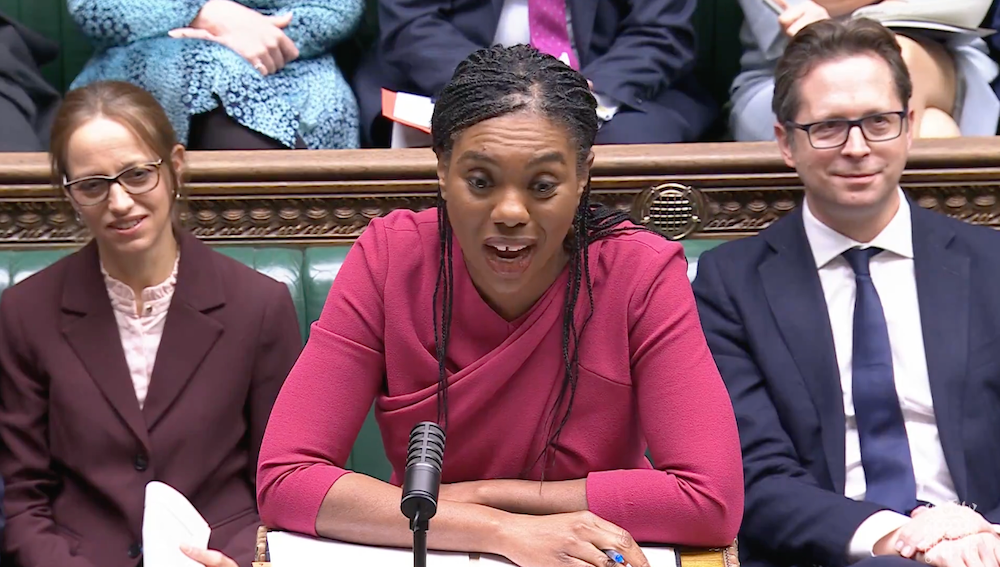
Today’s Prime Minister’s Questions was a proper battle of ideas and left both party leaders looking pretty satisfied. Andy Burnham came in wanting to say the word ‘hope’ as often as possible, while Kemi Badenoch wanted to expose that he doesn’t really intend to cut the welfare bill, and that he has no idea how to create enough jobs for young people. Both achieved their respective missions. Both have their own ideas about how to reform benefits and get young people into work. And both think they’ve got ample evidence that the other is wrong.
Hope is in fact not a policy one can legislate for, but it is Burnham’s shorthand for long-term investment in big welfare reform versus quick cuts now.
The Tory leader opened by asking whether the Prime Minister will cut welfare in this parliament. Burnham replied that ‘I will do everything I can as quickly as possible to get the welfare bill down.’ He welcomed Alan Milburn’s ‘landmark’ report on Neets (those not in work education, employment or training) and said he had asked the cabinet to reprioritise spending to put together ‘the beginnings of a fund’ to support the new youth service. There were some theatrical sounds at that from the opposition benches, presumably to underline how long all this welfare reform is going to take, given Burnham was talking about ‘the beginnings of a fund’, rather than anything more concrete.
Badenoch replied: ‘I asked him if he was going to cut the welfare bill in this parliament. I think it sounds very clearly like he is not.’ She had a good line about how long this was going to take, saying ‘those young people are not going to be young in ten years’. She also mocked Burnham wanting a ‘ten-year plan – still not ready by the way!’ Young people couldn’t wait ten years, she argued, they needed those jobs now. And she quoted Pat McFadden’s line about Labour colleagues always wanting to tax people more in order to pay benefits to others: something we will hear right up to the next election and then relentlessly through the campaign.
At this point, Burnham went more on the offensive about his own plan, repeatedly saying the word ‘hope’ as he did so. ‘We will give hope to young people and we will oppose the cuts-only approach of the party opposite.’ That’s not quite a battle of ideas, in that hope is in fact not a policy one can legislate for, but it is Burnham’s shorthand for long-term investment in big welfare reform versus quick cuts now.
Badenoch, though, zoomed in on whether Burnham is actually prepared to do any cuts at all. ‘There seems to be some confusion here,’ she told the chamber, pointing out that the Prime Minister had claimed people wouldn’t lose out, whereas Milburn had said that some would. Burnham, she said, wanted a ‘vibes-only approach’.
Burnham went right back to hope: ‘We are about giving young people hope and a better life,’ he protested. He asked whether the Conservatives would back the government’s opportunity guarantee ‘so that young people in this country can have hope’. The Tories, he said, ‘took hope from a generation’ when they were in government.
‘I’m going to cut through all this waffle,’ replied Badenoch. ‘He says that he wants to give young people a better life. All that he is offering them is false hope.’ She argued that the Conservatives were ‘not offering them false hope, we are the ones who are offering them a better plan’, and asked why he wouldn’t ‘cut the jobs tax for young people’ – as in, why he won’t reduce employers’ National Insurance contributions and the rise in the minimum wage to bring younger workers into line with older employees.
Burnham argued that she was being ‘selective’ with her facts, and once again said that ‘If she is arguing here for a cuts-only approach, well, we will stand against that… We know that our approach will work and we also have evidence that their failed comprehensively.’
This is where the battle is: both sides really do think they have a better approach to welfare reform. And those approaches make the dividing lines in first principles between the parties very clear: Labour wants more state action, the Tories want less government and lower taxes. Things haven’t always been that clear on the question of benefits.
Burnham also briefly defended his plans for a better relationship with the EU, both in his answers to Badenoch and in the wider session. He had said at the start that he would be ‘fighting in Brussels on Friday’, and clearly enjoyed his exchanges with Lib Dem leader Ed Davey about the ‘vote leave zombies’ shouting at him. Once again, it was a sign that this prime minister is confident that even his difficult positions are the right ones. But strikingly, his opponents are just as confident. Politics hasn’t been like this for a good long while.





Comments