
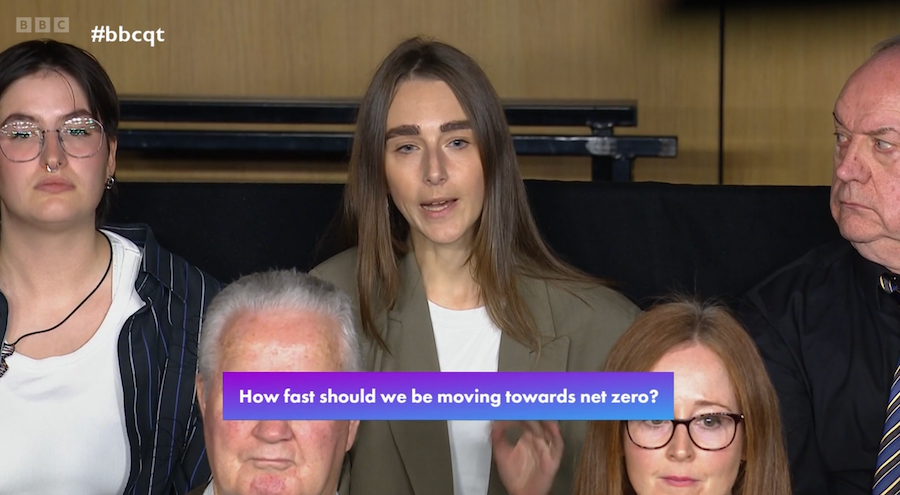
The BBC has long claimed that the Question Time audience is representative of the wider British public, pouring scorn upon claims that a metropolitan bias shapes who is invited to take part. Just at the beginning of October, the BBC refuted the Daily Mail’s claims that Fiona Bruce, who presents the show, had admitted privately that left-wingers are posing as Reform supporters to get themselves into the crowd.
The BBC said then, ‘The Question Time team vets every audience applicant, acknowledging the risk that someone may apply under false pretences’. Of the specific allegation about Fiona Bruce they said ‘we do not recognise this characterisation of events at all’.
GNDR’s main campaigning method has been to directly confront politicians, often at public meetings
Three weeks after the BBC made that statement, Reform’s Zia Yusuf appeared on the show when the topic of conversation moved to net zero. Yusuf said, as is the party line, that it:
Is madness. Reform will end it. We will put British people first, our energy security first, and scrap the net zero subsidies.
The audience contribution which followed came from a young woman in the audience. Speaking for her generation, she said: ‘I cannot believe that after the summer we have had, people on this panel are talking about scrapping net zero,’ to some cheering and applause from her fellow audience members.
However, the young woman in the video was not just a concerned member of the public, but rather an activist for a campaign group called ‘Green New Deal Rising’ (GNDR). Instagram posts from the campaign group show the group posting the exchange and boasting openly that it showed ‘one of our organisers putting Zia Yusuf in his place’.
GNDR is a youth campaign group which has been lobbying for a ‘green new deal’ since it was founded in 2020. Its main campaigning method has been to directly confront politicians, often at public meetings. In a typical video one activist will stand up and start heckling a speaker and as the security moves in to move them on, another one will stand up and start shouting (and so on and so forth). They have confronted several politicians, including David Lammy (who was told he was ‘letting our generation down’), Keir Starmer and Nigel Farage. Their website claims that they have ‘challenged hundreds of politicians’.
They also have twelve MPs who they call their ’New Deal Champions’, who they directly campaign for. These MPs are drawn from the Labour party, the Greens and two independents (Jeremy Corbyn and Zarah Sultana), with no Conservative or Reform politicians. After the 2024 election, Carla Denyer, then Green party co-leader, specifically thanked GNDR for helping get:
Four green MPs to hold Labour to account and push them to be bolder on policies that we know will make this country fairer and greener.
GNDR has received funding from Gower Street, a charitable trust co-founded by Nick Marple, who made his fortune in sports betting. The electoral register shows that Marple made direct donations to the Green party and to individual Green MPs such as Hannah Spencer in the past. As GNDR is not a charity, there is no legal requirement for the organisation to remain non-partisan.
When approached, GNDR’s press office said:
Unsurprisingly our volunteer organisers for Green New Deal Rising are politically engaged young people, and this volunteer organiser applied to be in the audience of Question Time in the usual way, raised their hand to speak in the usual way and used their time on the programme to challenge Reform’s appalling record on the climate crisis. We don’t think the BBC should be banning politically engaged young people from its programmes, we’d prefer it if they spoke to more of them.’
There is nothing to suggest that the GNDR activist has lied her way to get into the Question Time audience. Since GNDR says that she told the truth, the BBC must explain why they are permitting activists whose main trade is heckling politicians to an audience which is supposed to be representative of the public at large. A BBC spokesperson said:
Question Time selects local audiences which reflect a broad range of political views and take account of electoral support across the relevant nation.
It takes all sorts.



Comments