This is a book not so much about the Oxford Union debate of February 1933, in which a majority of the young men present voted that they would ‘in no circumstances’ fight for King and country, as about subsequent events. Part of that story concerns what happened in the 1930s to bring about the war with Hitler; another part is what became of some of the people who either spoke in the debate or simply attended and voted. The joy of writing about the jeunesse dorée of the 1930s is that they would become famous later on, so have some brand recognition for the reader. It is all too easy to see how silly young fools turned into silly old ones.
David Vaiani takes us through the debate itself, not failing to convey some of the preposterous self-importance of those who took part. But perhaps their inflated idea of their own significance was legitimate, given that the message reached Berlin and (although, as the author points out, accounts vary) may have convinced Hitler and his gang that the British were so decadent that he could do what he liked with little or no trouble from them. The star of the show for the non-fighters appears to have been Professor Cyril Joad, later to be a fixture of the BBC’s Brains Trust, who had spent the Great War in the trenches of Whitehall and whose career collapsed in 1948 when he was caught travelling on a train without the right ticket.
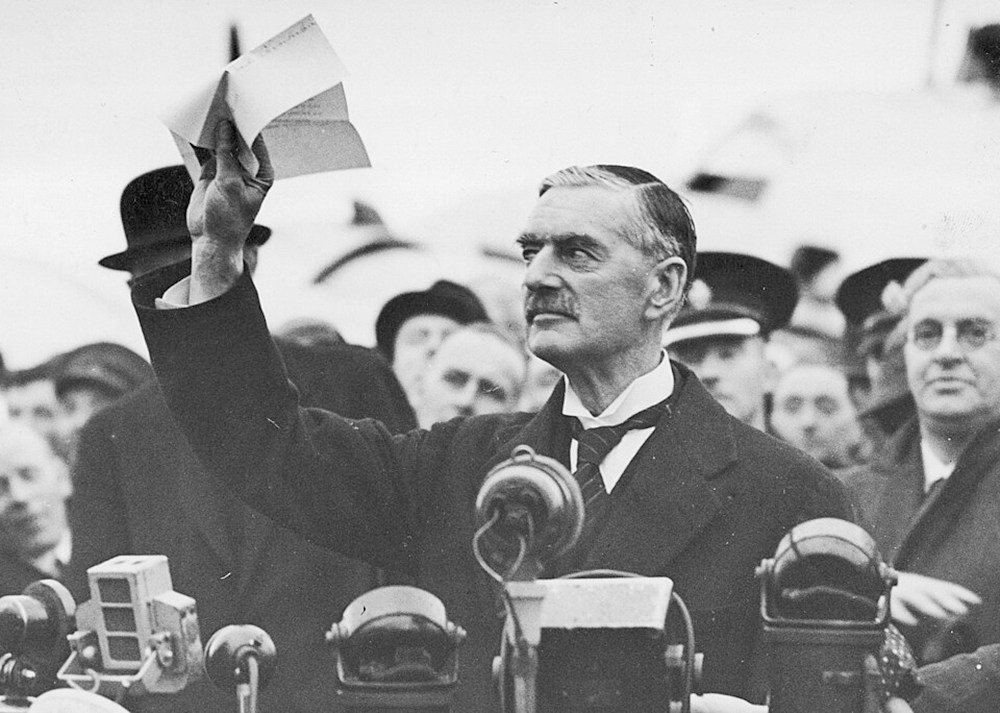
Chamberlain had little room for manoeuvre when he met Hitler before ‘peace in our time’
The main problem with King and Country is that so much of it is familiar. Vaiani does drag up the odd good story that is either unknown or forgotten – such as the 22-year old Ted Heath applying for the Conservative candidacy in the 1938 Oxford by-election and telling the selectors that he would make a better foreign secretary than Lord Halifax – but most of it is well known. Heath was unsuccessful, but Quintin Hogg – the man who did succeed both in becoming the candidate and in winning the seat – had been on the losing side in the 1933 debate. Four years after graduating he had returned to the university as a guest speaker. An officer of the Union was Michael Foot, who apparently supported the motion, but who, by the time of the Spanish civil war, changed his mind about the glories of pacifism.
Both Foot and Hogg wrote political polemics about the events of the years after, and Vaiani analyses those works. Foot was a co-author of The Guilty Men, which rounded on the Conservative-dominated National Government of Stanley Baldwin and Neville Chamberlain for failing to stand up to Hitler, and seemed to pinpoint Chamberlain as the guiltiest man of all. Hogg, in The Left was Never Right, published in 1944 in the run up to the election that Clement Attlee would win by a landslide, sought to defend his colleagues, though it was not enough.
Vaiani does not fall into the trap that still attracts too many writers today of attacking Chamberlain. But in delving into the politics of the five or six years after the 1933 debate he does not seem entirely clear about the realities of what faced Chamberlain in September 1938. He correctly identifies the weakness of Baldwin, terrified by the outcome of the Fulham by-election of 1933 (which showed conspicuous support for pacifism), in refusing at the 1935 general election to advocate rearmament, despite the rise of Hitler. He does not mention that Churchill, when chancellor of the exchequer in the second of Baldwin’s three administrations, cut defence spending in five successive Budgets from 1925 to 1929. Like Foot, Churchill would change his tune.
The fundamental point is that Chamberlain – who as Vaiani correctly says did allow significant increases in defence spending once he entered Downing Street in 1937 – had little room for manoeuvre when he met Hitler on those three occasions before ‘peace in our time’. The army had been run down since 1919; the RAF (thanks not least to some foresight by Chamberlain in 1935, when he was chancellor) was being rescued from obsolescence, but the aircraft-building programme was far from complete; and the navy, having been steadily expanded since 1935, was largely on the China station, in case Japan attacked Hong Kong or Singapore. Chamberlain could have declared war in September 1938 because of Hitler’s belligerence. It would have pleased the newly unpacific Foot and a few others like him; but it would have been at best futile and at worst disastrous. Chamberlain had been advised by his military chiefs of the realities: he would have been idiotic to ignore them, and deserves (and is gradually getting) a better posthumous press.
As well as much of this book being familiar, it is not especially well-written and does not seem to have been very rigorously edited, or even proofread. Grammatical errors abound; even if Vaiani has not been instructed about the niceties of the hanging participle, his editor certainly should have been. And there are factual errors, notably when Vaiani strays outside his historical comfort zone: the film Journey Together, in which Terence Rattigan, who was present at the debate, had a hand, was directed by the world-famous John Boulting, not by someone called John Bunting.
The main interest of the debate, 93 years later, is whether it made any difference. Did the self-regarding pacifists of Oxford, tortured by tales of the generation above them in the Great War, actually change the course of history and make the second world war less likely? The answer seems pretty obvious. Hitler was pursuing world domination and would have continued to do so even without evidence of the alleged decadence of the British youthful elite. This book adds little to what we already know of the period, and one suspects that if the world had a deferential fascination with the Oxford Union in 1933, it doesn’t have it now.




Comments