Britain’s future is in the EU. That’s the view of former Chancellor Rachel Reeves who believes that leaving the Bloc a decade ago has made Britain ‘poorer, weaker and less secure’.
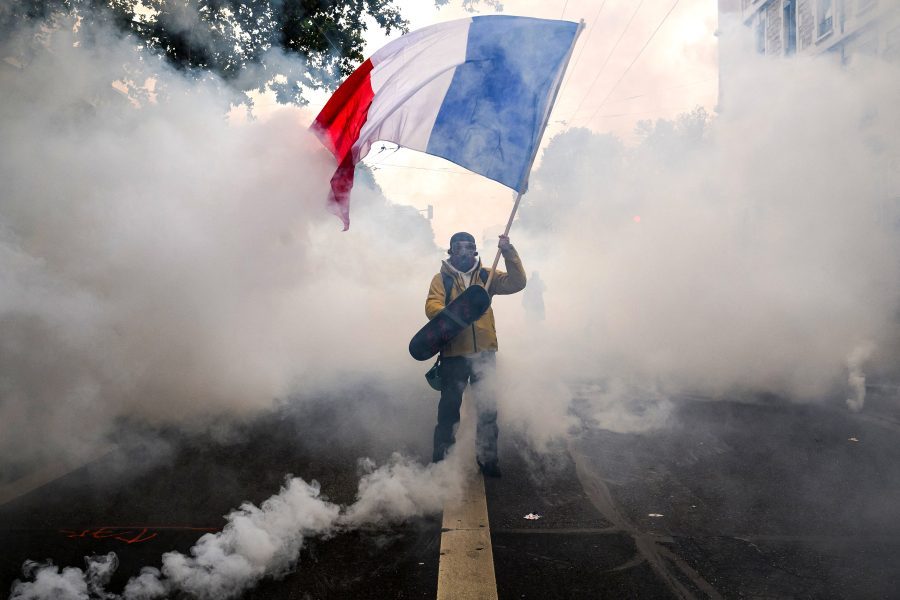
Reeves’ declaration was published just hours after thousands of rioters had run amok in Germany, Holland, France, Italy and Portugal. There have also been angry protests in Belgium, Ireland, Spain and Greece over recent weeks, while Serbia and Albania – both of whom are on the EU waiting list – have seen similar unrest.
In Germany there were reports of shops being looted in Frankfurt and Hamburg as violent clashes between the police and protestors took place in Berlin and Cologne. Police drove back rioters with water cannons as they came under attack from bricks, bottles and fireworks.
The demonstrations were organised by a campaign group called Gen Z regelt [Gen Z takes charge] in protest at education underfunding, a cost of living crisis and welfare cuts. Similar grievances are heard across Europe.
A spokesperson for Gen Z regelt, Lina Friedrich, said they were on the streets ‘to fight for peace and freedom, rather than for war and coercion’.
France is the model for the belief that the way to take power in Europe is through the firebomb
The worst scenes were in Frankfurt. Roman Poseck, the city’s interior minister, blamed the violence on ‘around 100 clearly identified left-wing extremists’. He added: ‘We all have those images from France in our minds – looting, burning houses, burning police vehicles and attacks on police officers… France must not be held up as a model in this regard.’
But France is the true model for an emboldened far-left which believes the way to take power in Europe isn’t through the ballot box but the firebomb. In the aftermath of the riots on October 17, Marine Le Pen demanded better control of France’s borders to deny entry to ‘foreign “black bloc” activists – who generally come from Germany, the Netherlands or Italy’.
Several hundred ‘black bloc’ thugs battled police in cities across France on Saturday. Marseille and Paris once more bore the brunt of the mayhem, and the capital feels like a city under siege.
Heavily armed policemen patrolled mainline stations and at potential flashpoints such as the Place de la Bastille and around the Elysee Palace, there were hundreds of officers with armoured cars and water cannons on standby.
In total nearly fifty metro stations were closed for security reasons and hundreds of shops and restaurants in the city also closed for the day, pulling down metal shutters or hammering wooden boards across their windows.
The cost to the economy is ruinous. France’s Chamber of Commerce says that the Saturday protests are reducing consumer spending in city centre shops and restaurants by 80 per cent. It is the same for cinemas and museums.
I spent Saturday walking around Paris. There were tourists but fewer than normal on a beautiful autumn day. The atmosphere around the Bastille was oppressive. Police had set up a loud-speaker system that warned people of the punishments for congregating in an area that was out of bounds to protestors.
I walked to Porte de Charenton, the terminus of the demonstration organised by unions and attended by Jean-Luc Melenchon and other members of his far-left La France Insoumise party. It was eerily quiet. Half a dozen police vans were parked up a side street.
I had left when the violence erupted between a minority of protestors and the police. Someone threw a Molotov Cocktail that landed at the feet of some officers. One later spoke to reporters: ‘It was a truly intense ordeal, with a group of individuals who were clearly intent on causing injury.’ The officer described the wounds suffered by ten of his section, which ranged from burns to head injuries caused by projectiles.
The police are worn-out and so are most of the French. ‘Ras-le-bol’ [Despair] is the front page headline in the country’s most popular Sunday paper. City centres are becoming no-go zones at the weekend and that will soon extend to other days of the week.
France will continue to degrade. Other EU countries may follow
The next nationwide protest is Thursday when the unions are calling on workers and students to take to the streets. The increasingly left-wing Gilet Jaunes [Yellow Vests] – who have started bandying about words such ‘Islamophobia’ in their communiques – have announced their intention to stage another demo on Saturday.
Yesterday Melenchon addressed a message to Emmanuel Macron, telling the president he ‘will have to give in or step down’.
He’ll do neither, so France will continue to degrade. Other EU countries may follow. After all, France is a role model to extremists, anarchists and rioters across the continent.
Which begs the question: why would any Briton in their right mind wish to rejoin an EU that in the last ten years has become poorer, weaker and less secure?




Comments