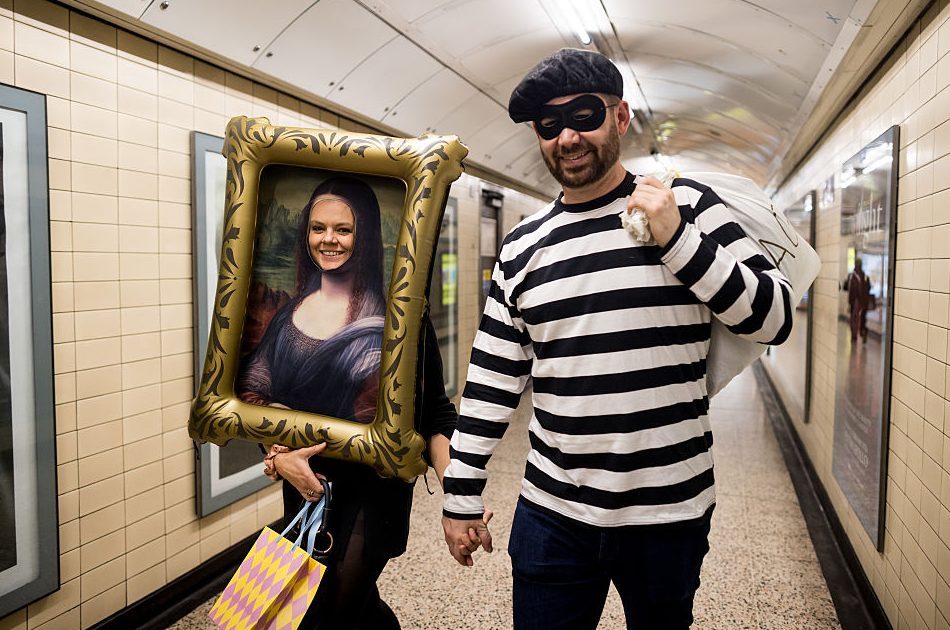
The third round of protests in France takes place this Saturday. Participants are being urged to come dressed for Halloween. Social media platforms such as TikTok and Instagram are teeming with memes about the upcoming ‘Night of Darkness’. Oh, and don’t forget to wear a mask. If the French weren’t depressed already, what with the riots and looting during the first two weekends of protest, now comes further evidence that they have lost the cultural war to America.
French baby boomers were more open-minded about America than their parents
Halloween was popularised Stateside in the middle of the 19th century, although in 1876 The New York Times declared that the festival was in danger of dying out. It rallied. This week, the same newspaper forecast that Americans are ‘expected to spend a record $13.5 billion on Halloween’ this year, most of it going on costumes, decorations and sweets. But for more than a century, France was immune to Halloween. Gallic commentators looked at the festival with horror; all that crass commercialisation…how very American.
Le Monde, France’s best-selling national daily newspaper, attempted to explain Halloween to its readers in 1953: ‘Trick or treat – that is the catchphrase that millions of American children have been repeating since last night, knocking on every door, dressed in strange costumes.’ In 2026, more than three-quarters of 18- to 24-year-olds in France will celebrate Halloween in some shape or form, and children up and down the country will be knocking on doors with a cry of ‘Des bonbons ou un sort!’ [A sweet or a spell, the Gallic ‘Trick or Treat’].
I can attest to this cultural colonisation. In my corner of Burgundy, Halloween decorations began appearing in shop windows and on front lawns at the start of October. Someone is making a killing in giant furry spiders.
I went this week to my local superstore, and it felt like I’d walked onto the set of Michael Jackson’s Thriller video. Ghouls, zombies and skeletons with too much mascara loitered around every aisle. Perched on the counter where you weigh your fruit and veg was an old hag with an axe in her head. There were pumpkins galore and all manner of chocolates and sweets with a Halloween theme.
How did the French fall for the Halloween hype? In an article in 2023, Le Monde accepted that the festival had become ‘commonplace’ in the Republic. The newspaper pinpointed 1978 as the year when Halloween began to take hold in the collective imagination. In that year, the horror movie Halloween – about murders committed in Illinois on October 31 – was released and became a worldwide box-office smash, including in France.
French baby boomers were more open-minded about America than their parents, who had grown up under Charles de Gaulle and his insistence that France was the greatest country in the world. Baby boomers had helped topple the old general a decade before. Embracing American culture was part of their social revolution.
The 1980s was the decade when France – in the words of Jérôme Fourquet, the country’s leading social scientist – began to become ‘Americanised’. McDonald’s arrived, as did Dallas. Line dancing took the country by storm.
Up until the 1980s, it was November 1 that mattered in France. They marked All Saints’ Day – La Toussaint – by visiting the graves of relatives and laying bouquets of flowers, with chrysanthemums the most common. There was a stall selling chrysanthemums outside my superstore this week, but it wasn’t doing a roaring trade.
One reason is the huge increase in cremations in France. In 1980, only 0.9 per cent of people in France chose to be cremated; in 2023, it was 43 per cent. According to Fourquet, ‘the rise of Halloween marks a shift in the aesthetics and social landscape of French society’. In 1980s France, it was ‘the era of burial rather than cremation’. No more. Halloween has now supplanted All Saints’ Day as the pre-eminent festival this week. ‘It is both a symptom of the de-Christianisation and the Americanisation of the country,’ explains Fourquet. ‘All Saints’ Day…is losing ground and faces stiff competition from this other tradition: the rather festive and highly commercial celebration of Halloween, a typically American festival…we are shifting from a France of chrysanthemums to one of pumpkins and sweets.’
If the protests in France do turn ugly this Saturday, it won’t be pumpkins and sweets on the streets of Paris and elsewhere. It will be paving stones and tear gas. The cynic might say it will be a touch of French tradition to what is normally a very American festival.





Comments