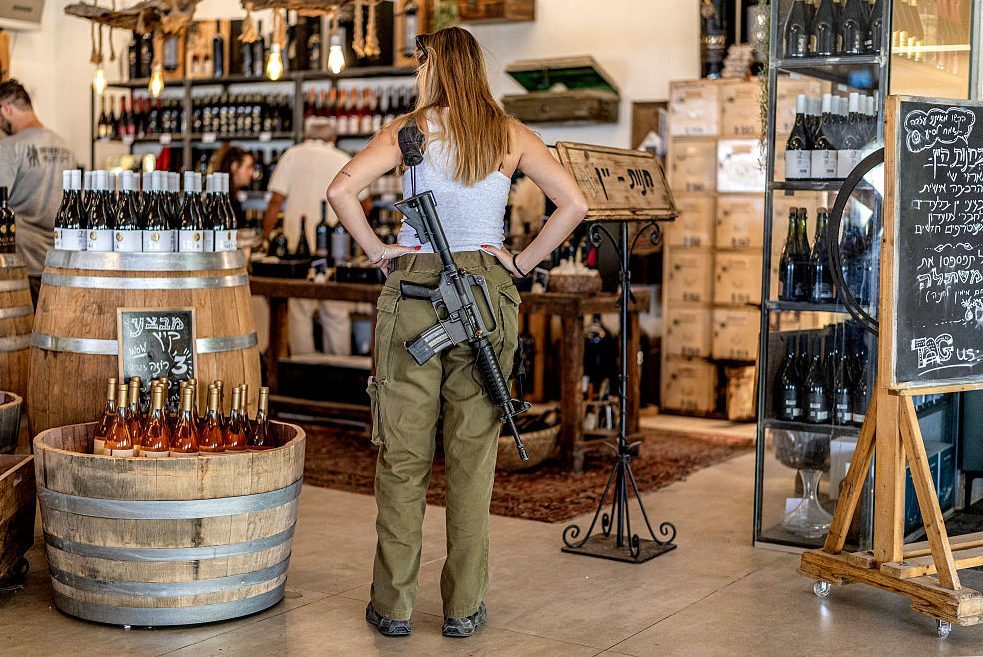
In many ways, it was like a winery somewhere remote in Spain. Dry, hot air, even in October. Scrubby, dusty hillsides, apart from the green of the vine fields. But the main building looked more American. Even the modified AR-15 above the bar didn’t seem out of place.
The tension with the Arab population is evident in what Katsof says
But I was not in Spain, nor Texas. Settlers Winery in Esh Kodesh is, depending on who you talk to, either in the Occupied West Bank or Samaria. Founded by Aaron Katsof, a reserve major in the IDF, the winery’s logo features boots on the ground. Katsof tells me this is because they ‘have to have boots on the ground to make a difference’, to establish ‘where the borders will cross’. The wine they make here will be banned from Britain under the recent sanctions announced by Ed Miliband.
Kodesh’s religious purpose here is clear. His wine is named ‘Settlers’, he told me, ‘because God tells Joshua to come to the land, cross the river… and to settle the land. Settling the land is a good thing. He comes to empty land, to break the bedrock, to plant trees, to create a better, brighter future for our children’.
Of course, Israelis today do not come to an entirely empty land. The tension with the Arab population is evident in what Katsof says. He describes how members of his family living elsewhere in Israel brought in ‘Arab contractors’ to ‘fix their swimming pool… two days after they finish the project, their house is broken into in the middle of the night. Somebody knew exactly where everything was’. He contrasts this with Esh Kodesh, where ‘we have no Arab workers, zero crime’.
Katsof goes on: ‘I planted my first vineyard in 2011. It was strictly because of the prophecies that I came to this land… I read the prophecy of Jeremiah 31. It talks about the Jewish people coming back to the land. And thou shalt plant vineyards in the mountains of Samaria – and I said, Jeremiah said it, we might as well do it. We planted vineyards in the mountains of Samaria, and then a couple of years later, we started making wine’. Describing the vineyard, Katsof says, ‘it’s blooming. It’s almost like the land has been waiting for us to come home’, which he contrasts with nearby Arab areas where ‘there’s nothing. It’s thorns until today. Nothing is growing’.
Settlers bottled their first wine in 2017 and then opened their bar in 2023. It was supposed to open that October, but, as Katsof said, ‘I guess the timing was not so good. I was the first one that was called up, and I spent a long time inside Gaza’. It wasn’t until October 2024 that they opened.
The first wine I drank, moments after stepping inside, was a frozen rosé, made entirely from Merlot grapes and churned in a Slush Puppie maker. Almost like a glühwein, it chilled my mouth and then warmed my chest. Then I sampled their 2025 Tohar Sauvignon Blanc, far sweeter and more buttery than I would have expected a Sauvignon Blanc to be. Katsof explains to me that he is not ‘trying to copy a wine that was made in Bordeaux 600 years ago… we’re not in Bordeaux. We’re in the Middle East. We’re in Israel… our foods here are much deeper, much more intense, so you don’t need to make some dry, tasteless French wine’.
It feels peaceful – and safe – drinking wine in this deeply contested space. But I sense that the tranquillity may be very recent. As gentle guitar music plays in the background, Katsof recounts events which took place here on 9 October 2023, two days after the ‘Al Aqsa Flood’, in which thousands of Hamas fighters and Arab civilians crossed the border from Gaza into Israel, committing many murders and extensive sexual violence, and seizing many hostages.
With the army calling up reserves, Katsof explains that there were ‘almost no men’ at Esh Kodesh ‘by October 9th’. He’d been called to ‘the pit’ – the name the IDF gives to its underground command centre in Tel Aviv. While there, he learnt that ‘about 60–70 Arabs’ from a nearby village had started to make their way up to Esh Kodesh, ‘like they were marching in’. He describes how the women of the settlement drove down into the valley with their guns, formed a line and, ‘when [the Arabs] get too close, they start shooting’.
The legal arguments about this land are endless. Should the 1967 borders be sustained? Should the Oslo Accords define the future of the territory, despite final-status negotiations never having been conducted? Are these lands occupied by Israel, and is Israel breaching the Fourth Geneva Convention by allowing its civilians to build settlements here? Or, as Natasha Hausdorff has argued, is Israel the successor state to the British Mandate and entitled to all its territory, and was the West Bank, or Samaria, only ‘occupied’ by the Jordanians between 1948 and 1967?
After we’ve drunk and eaten, I walk outside and sit in a swing seat overlooking the valley. On a hill opposite me sits a seemingly abandoned low, white building. I am told that it used to be a ‘Hamas outpost’ from which they shot at the inhabitants of Esh Kodesh. Now it’s safe to sit here and look at the hillsides, some thorn-strewn, some abundant with vines.
Whatever the legal arguments, one side, with its boots on the ground and religious determination, is clearly here to stay. We may soon not be able to buy ‘settler wine’ in Britain, but I suspect they’ll be making and drinking it here for a very long time.


Comments