

In July 2021, the Honda factory in Swindon closed after 36 years. Three thousand jobs were lost. One young apprentice at the plant, which produced 160,000 vehicles a year, said it was ‘like a rug had been pulled out from underneath us’. Another long-serving employee added: ‘I’d planned on staying there for the rest of my career.’
Here was a familiar tale of industrial decline in Britain. This Wiltshire town, where in 1843 Isambard Kingdom Brunel opened a locomotive works for Great Western Railway, and where Spitfire fighter planes were manufactured during the second world war, was now seemingly closed for business.
The high street reflects this. Boarded-up shop fronts are punctuated by fast-food chains, vape emporiums and bookmakers; 19.6 per cent of the adult population in Swindon is economically inactive, compared with 18.2 per cent across the south-west.
The town’s industrial past is firing again, fuelled by a powerful cluster of drone and defence firms
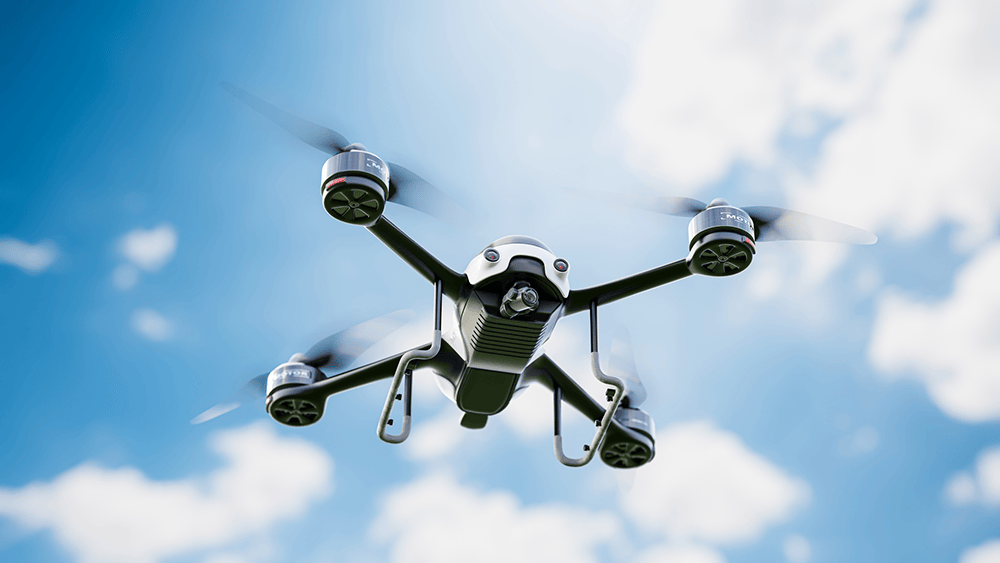
But this is not quite the full story. A couple of miles from Swindon’s fraying high street, the town’s industrial past is firing again, fuelled by the unlikely arrival of a powerful cluster of drone and defence companies, which are expected to provide thousands of jobs to local people.
Last November, Stark, a German start-up ‘delivering the unmanned weapons systems that Europe and Nato need now’, opened a 40,000 sq ft factory. Alongside Stark, others, including Flyby Technology, Munin Dynamics and Icomat, also opened. There are nine drone companies in the town. Most eye-catching is the Portuguese firm Tekever, which describes itself as ‘Europe’s leading provider of AI-enabled autonomous systems’ and is valued at $6.4 billion; it recently moved into the Norman Foster-designed Spectrum Building, which, appropriately, James Bond fans will recognise from A View to a Kill.

It is no exaggeration to describe this unassuming town, with a population of 240,000 and a team in the fourth tier of English football, as the UK’s drone hub. The technology developed here is being purchased by governments across Europe and is having a decisive impact on the war in Ukraine. Stark’s AI-powered Virtus drone, which has a cruising speed of 120km/h and can track targets from 130km, has been used by the Ukrainians since 2025; Tekever’s AR3 reconnaissance drone has completed 10,000 operational flight hours in Ukraine.
The question, then, is: why Swindon? ‘There are the ruthlessly practical aspects, such as the proximity to our military customers,’ says Mike Armstrong, Stark’s UK managing director. ‘You’ve got the army base on Salisbury Plain and the RAF headquarters at High Wycombe.’
But, Armstrong explains, Stark was also drawn to the ‘talent density here because of the automotive sector, because of Honda… Swindon has industrial DNA.’ Eighty per cent of Stark’s workforce is local and Armstrong was quick to hire a former apprentice at Honda, who was made redundant in 2021. ‘He would tell you that he is proud to be part of Swindon’s regeneration. He comes into work with purpose. I could tell you five stories and more like that.’
Tekever, meanwhile, is working with New College Swindon. ‘We want to become an integral part of the community and build local talent pools,’ says corporate director Scott McClelland.
For local MP Will Stone, a former army rifleman, Swindon’s drone hub is symbiotic with the town’s fortunes. ‘When I was elected in 2024, I knew that to deliver for the people of Swindon North, [the town] had to re-industrialise,’ he says. ‘Drone manufacturing is an industry moving fast and able to support its own growth rather than waiting on government investment.’
The UK’s Armed Forces are in crisis. Defence spending is now at just 2.6 per cent of GDP, yet despite assurances this will rise to 3.5 per cent by 2035, we have a Prime Minister adamant that any increase ‘can’t come at the expense of social security’.
This is dismal rhetoric. Sir Richard Knighton, head of the Armed Forces, has stated that the UK is ‘not as ready as we need to be for the kind of full-scale conflict we might face’. The threat from Russia is immediate and urgent; building warships and fighter planes, years-long projects, is no longer sufficient.
The answer for Britain can be found in the warehouses of Swindon. ‘Not long ago, I was talking about drones being the future of warfare,’ says Armstrong. ‘It’s not the future. It’s today… It is an unquestionable fact that autonomous drone technology is today’s warfare context.’ The data supports this: Ukraine says an estimated 90 per cent of Russian casualties are from drone attacks. Drones are the technology Britain needs now.
‘You’re in a constant game of cat and mouse [with the enemy],’ explains McClelland. Developing drone technology, he says, is about ‘rapid iteration, field testing, learning and iterating again. Tekever’s products, certainly in Ukraine, have been through hundreds of iterations and we’re doing this in days and weeks.’ And it’s not just drones. Last month, Stark unveiled its Vanta 12 unmanned surface vessel, replete with missiles, loitering munition, anti-submarine effectors, electronic warfare systems and intelligence, surveillance and reconnaissance (ISR) technology.
For all the PM’s prevaricating, the Ministry of Defence has not missed what is happening off Junction 15 of the M4. In July, it opened a 370-acre drone-testing facility in Panattoni Park, the site of the old Honda factory and four times bigger than Nato’s tactical drone centre in Latvia. And earlier this month, the MoD, under Project Corvus, signed a £400 million contract with Tekever to deliver its AR5 long-endurance uncrewed aerial system, which can carry 50kg in surveillance equipment. These will, naturally, be manufactured in Swindon.
‘We have an opportunity, if we invest now and fast, to not only supply our [Armed Forces] with the right technology,’ says Armstrong, ‘but to sell that technology, and the leadership that comes with it, on the world stage.’ It’s a neat piece of symmetry. Eighty years on from when Spitfires rolled out of Swindon’s factories, the town is once again delivering for Britain’s defence.






Comments