
On 21 September, pupils at the Lycée Saint-Exupéry in Créteil, south-east of Paris, staged a protest. They had a list of grievances. Classes were overcrowded and there was a shortage of teachers. They were also dismayed at the decaying state of some of the school buildings and the automated university admissions platform they feel deprives them of autonomy.
Pupils filmed the protest and uploaded the footage onto social media. It went viral. Across France, children in other secondary schools joined the protest. They aired the same complaints as their peers in Créteil – and more.
Some pupils described seeing rats in classrooms, others of enduring leaking ceilings and mouldy walls. For many, memories of the summer heatwave were still painfully fresh. They remembered how they sat their exams in June in classrooms where the temperature topped 38°C. At one high school in Versailles pupils took their exams in an underground car park because it was the only cool place in town.
Schools have been firebombed, shops have been pillaged, a fire engine has been attacked
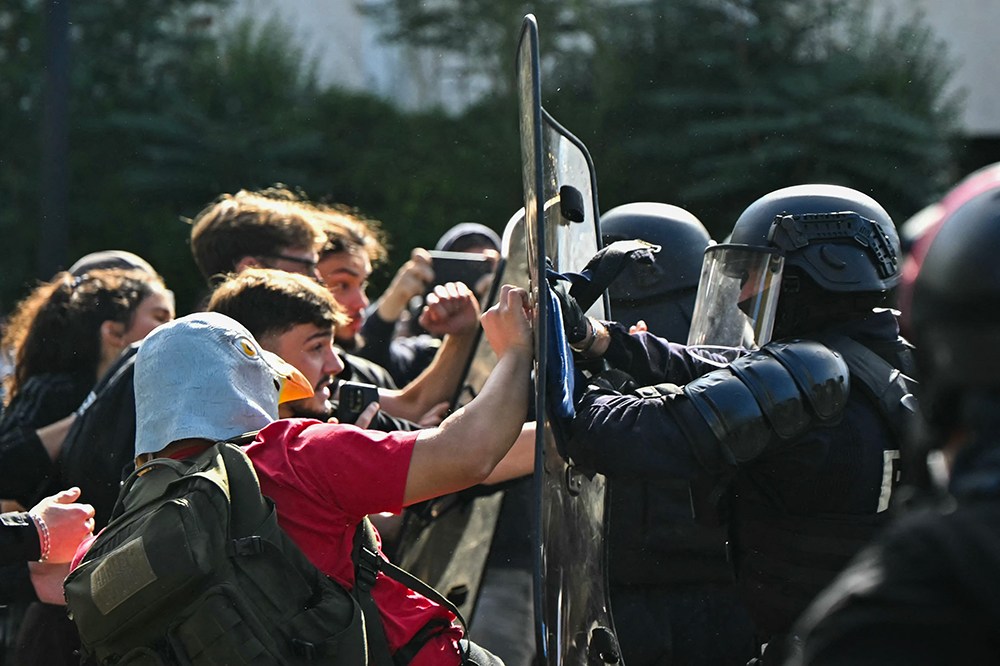
As the protests spread, so they became violent. At Saint-Exupéry school, pupils had demonstrated peacefully behind a barricade of wheelie bins. In other schools the bins were set ablaze and fireworks used as missiles. These acts of vandalism attracted the police and there were confrontations. They also attracted young men wearing hoodies and masks; young men who looked too big to be at school.
Last week the violence exploded. The statistics bear witness. More than 1,000 injured: 715 police officers, 215 pupils and 85 teaching staff.
Much of the savagery was uploaded, and it has horrified France. A policewoman chased along a Paris street and hurled to the ground; a policeman kicked unconscious by a gang of howling youths in Belfort; a woman in Marseille set on fire by a 15-year-old with an aerosol can as she told him to stop vandalising a bus stop. On Monday, a 15-year-old boy had his hand blown off by a police stun grenade outside his school in Lens.
Schools have been firebombed, shops have been pillaged, a fire engine has been attacked and buses have been vandalised. It is anarchy, and it is ongoing. After a weekend of calm, more than 400 schools experienced protests of some form or another on Monday.

The following day, higher education students and some unions joined the school protestors on their picket lines. The numbers on the streets were estimated to be somewhere around 200,000.
They were encouraged by La France Insoumise (LFI), the political party fronted by Jean-Luc Mélenchon, often described as the French Jeremy Corbyn. On its website LFI listed the main demonstration sites and the times of the protests. The party praised the students for the action, declaring: ‘Unjustly repressed by the government and its law enforcement agencies last week, they have sparked a widespread mobilisation.’
This is Mélenchon’s ambition – a repetition of May 1968 when a minor student protest at Nanterre University over access to the women’s dormitory quickly turned into a nationwide uprising. There were ten million people on the streets by the end of that month: students, workers and trade unionists united against the government and the police.
On Monday, Mélenchon proclaimed that the Republic ‘is witnessing the most powerful movement of high school and college students it has seen since May 1968’.
In recent weeks fishermen, police officers, health workers and teachers have staged protests about their working conditions. For several weeks social media has been awash with rumours that the gilets jaunes (yellow vests) will re-emerge on 17 October.
They were first seen eight years ago in what began as a protest against a green fuel tax and spread rapidly and ferociously. Demonstrators focused their fury on Paris and the perceived arrogance of Emmanuel Macron. On one Saturday in December 2018, a helicopter was reportedly prepared in the grounds of the Élysée Palace in the event that the president was forced to flee the capital.
A similar fury to that which led to the gilets jaunes in the winter of 2018-19 has been simmering for years. It is now bubbling because of rising fuels costs, energy bills and supermarket prices. The people in the provinces – the Praetorian Guard of the gilet jaune movement – are struggling to put petrol in their cars and food on their tables.
When their original protest erupted eight years ago, the gilets jaunes had the support of three-quarters of the country; a recent poll revealed that 62 per cent of the French support the high school demonstrators. It is hard not to sympathise. The average day for a French high school pupil starts at 8 a.m. and ends at 6 p.m. My daughter went through the French education system and it was demanding. Compared with the British system there is little outlet for self-expression, and opportunities for sport, music and the arts are very limited.
My wife has taught in the state sector for a decade. First, she was in Seine-Saint-Denis in the north of Paris, which has been the epicentre of the violence in recent days. Now she teaches in a large secondary school in Burgundy.
Within a week of the new school year, she was telling me about staff shortages and overcrowded classrooms. The protest movement has not surprised her or her colleagues. It’s been coming for years. I spoke to some of her pupils this week. Agathe told me about her lack of maths teaching this year, a subject she’s desperate to improve. She also mentioned classrooms barely fit for habitation. Thomas told me of a chaotic school timetable in which some subjects are overloaded and others neglected.
The protests at their school have not degenerated into violence. The atmosphere at Tuesday’s demonstration was one of cheerful determination. ‘The National Education system: more toxic than my ex,’ was one of the many placards brandished by pupils. Around 20 police officers were present, some accepting patisseries offered by the protestors.
But among some of the pupils there is an undercurrent of anxiety. Laetitia explained that she is scared of ‘outsiders’ coming to cause trouble – but she’s also wary of the police, who are under extreme pressure during the protests but occasionally overreact. Last week one officer was filmed holding a distressed 14-year-old girl in a headlock for more than a minute. The police don’t want the general public to turn against them as they did in 1968.
Most teachers across France support the protest movement. My wife does and so does her colleague Constance, a teacher for 20 years. ‘We need to change the curriculum,’ she said. ‘It’s too intense, too tiring and completely inefficient for the pupils.’
A recent poll revealed that 62 per cent of the French support the high school demonstrators
Gaspard, who’s been teaching at my wife’s school for 25 years, said constant cost-cutting had made life unbearable for staff and pupils. ‘It’s a mess,’ he said. ‘Teachers are suffering from burnout because of their workload.’ There are too many pupils and not enough teachers. He pointed a finger at Paris, accusing the government of ‘neglecting’ provincial schools like his. Certainly, it’s hard to have much clarity and vision when there have been seven education ministers since 2022.
Last Friday I was in Paris, observing a protest at a high school in the trendy 15th arrondissement, not far from Montparnasse. There were 100 or so pupils gathered outside the entrance in mid-morning. It was rather jolly. The only flash of hostility I saw was when a police car drove by and the boys and girls hissed and hollered.
The pupils sang a chant about Macron resigning and I saw one or two signs denouncing Marine Le Pen. There was no overt support for Mélenchon and the left. I spoke to a couple of 16-year-olds who said they didn’t want the movement to become political; they just wanted to be listened to.
Constance sees something more profound than a protest about class sizes and leaky roofs. ‘This is a generation a little lost, left behind,’ she says. ‘They have worries about the environment, about society and its inequality. It’s a broader revolt. There is an immense anger.’ But this anger is cross-generational. Different reasons, same rage.





Comments