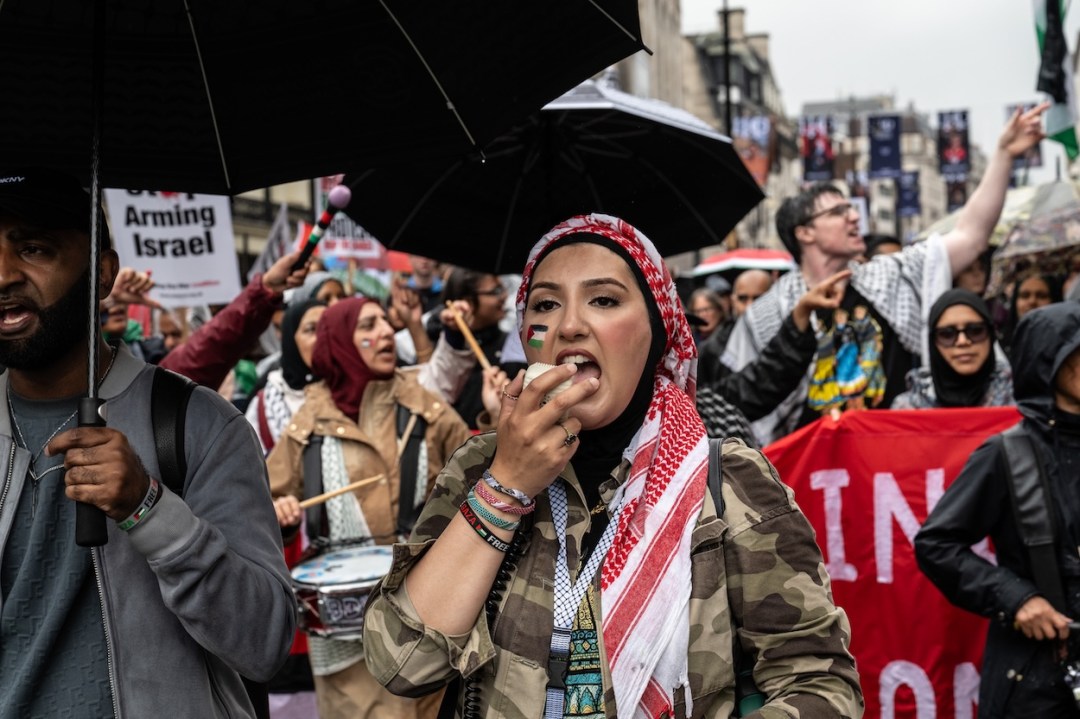
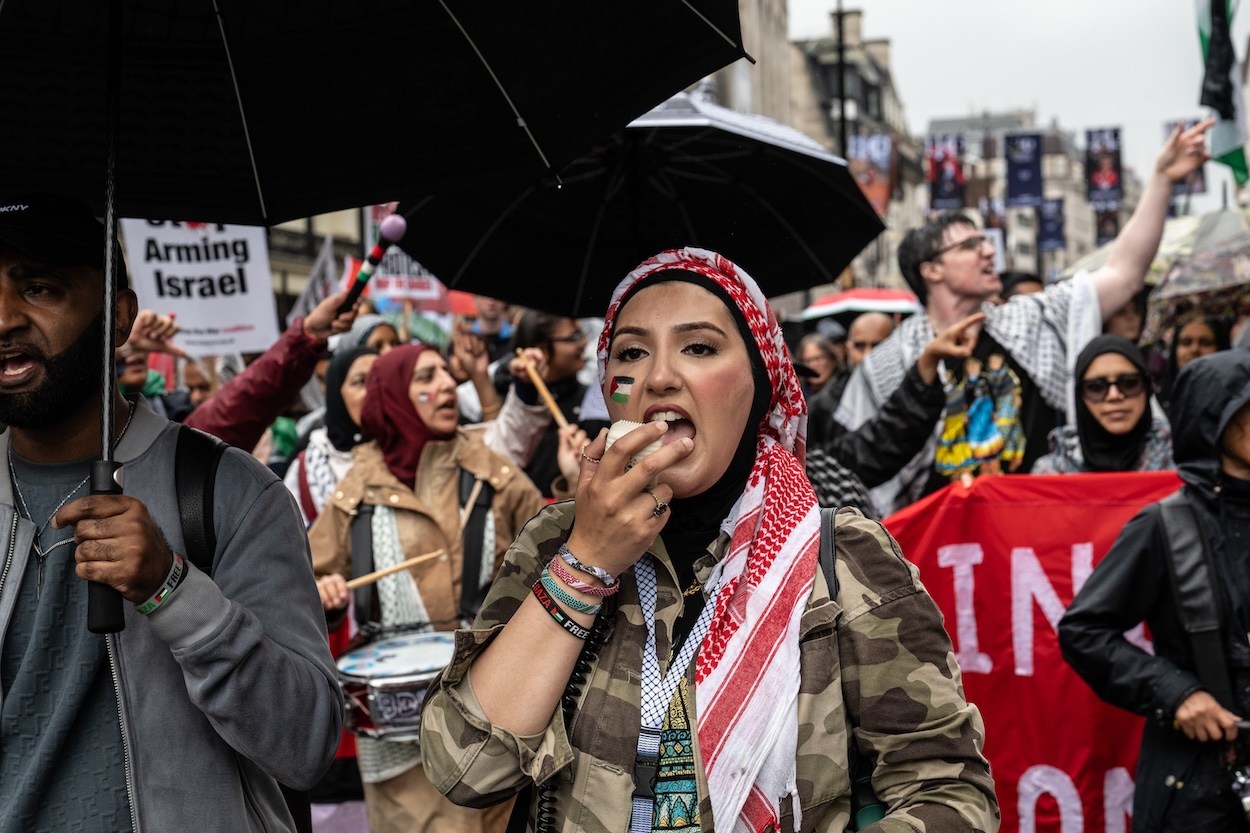
It is, of course, no accident of timing that this Wednesday – the third anniversary of Hamas’s 7 October terrorist atrocities in Israel – pro-Palestinian student protestors plan to march through central London.
The Metropolitan Police have bent over backwards in their efforts to be accommodating to the protest’s organisers. Last week, senior officers asked that the group responsible, the ‘University of London Coalition’, move the date of the protest. This week the assistant commissioner responsible for public order policing in the capital has written in the Times urging the would-be marchers to ‘reflect on the impact and distress’ marching on this date will cause.
Based on the previous actions of other pro-Palestinian groups, it is unlikely that we will see protestors responding in-kind to the Met’s reasonableness. Indeed, it is worth remembering that, as Policy Exchange revealed previously, it took less than eight hours from Hamas starting their terrorist attacks on 7 October 2023 – and well before the Israeli government could mount any substantive response – for the Palestine Solidarity Campaign to submit their application to the Met for their first large-scale protest.
Under section 12 of Public Order Act 1986, the police can impose conditions on a protest march – including specifying the start and finish times or limiting the protest to specific locations.
The power to ban a march is available only in very limited circumstances: section 13 of the Public Order Act 1986 requires that the police reasonably believe that there is a risk of ‘serious public disorder’ which conditions under section 12 cannot manage. If that threshold is met, the police must then apply for a ban to the home secretary, who is responsible for making the final decision. In such circumstances, it is likely that the march would be turned by the organisers into a static assembly which, under current law, cannot be banned.

The legislative criteria for applying conditions to a march includes: ‘to prevent serious disruption to the life of the community’. Given the impact of the date chosen for this protest, there is little doubt that this standard will be met under the current legislation and the Met should impose the most stringent conditions the law allows. Senior officers must then back those conditions with an overwhelming police presence to enable immediate enforcement should there be any breach.
Such a robust policing approach would come at a cost to ordinary policing across London; every officer involved in dealing with the protest is one not responding to burglaries and robberies elsewhere. There is also the risk that in response to robust enforcement, protestors make the choice to cause further disorder. These, however, are prices worth paying: if breaches of the law are repeatedly allowed to pass without consequence, it is the rule of law itself that is at stake.
Look at events on the south coast – with a near-constant stream of migrants unlawfully entering the UK – to see what happens when the rule of law is permitted to be so flagrantly disregarded. Indeed, while pro-Palestinian protestors are repeatedly treated with kid-gloves, the Hampshire and Isle of Wight Constabulary have applied a ‘dispersal order’ to the entire town of Gosport under section 34 of the Anti-social Behaviour, Crime and Policing Act 2014. As the police themselves said: ‘The order gives officers the power to order a person to leave the area with no return within a specified time period.’ The public is entitled to ask why there are such differences in the police’s – and wider state’s – approach.
Senior Met officers say that they do not believe the threshold of ‘serious public disorder’ to ban the students’ march has been met. But key to this sort of operational policing decision is the ability to effectively gather and analyse information and intelligence. Last week, the Met conceded that ‘finding the organisers [of the protest] has so far proved difficult’. This group is apparently a collection of students – if they can keep their identities secret from the Met, what confidence can we have in the force’s ability to seek out more dangerous or extremist groups? Neither should we forget that it was during protests by students in November 2010 that we saw serious disorder occur near to parliament. On that occasion, a fire extinguisher was launched off the roof of a 33-storey building which, terrifyingly, nearly struck a line of police officers.
As is so often the case when it comes to policing and the criminal justice system, many of the roots of failure lie within the policies of the Conservative-Liberal Democrat coalition government. Between 2010 and 2015, there were large reductions in police funding which led to a collapse in both police intelligence capabilities and the number of trained public order officers. Neither has ever truly recovered.
The Undercover Policing Inquiry, announced by then-home secretary Theresa May in 2014 and now chaired by former High Court judge Sir John Mitting, was established in response to the worst excesses of historic undercover policing activity since 1968. Twelve years on from being established, the inquiry is still going on, with an interim report not expected until late 2027. The inquiry’s chilling effect on policing may well have finished off intrusive police-led intelligence operations for good.
The Conservative-led coalition’s record also fell short on the relevant public order legislation. The Police Reform and Social Responsibility Act 2011 repealed sections 132 to 138 of the Serious Organised Crime and Police Act 2005. Those Blair-era provisions required organisers of demonstrations within a ‘designated area’ near parliament to seek police approval in advance – and made it an offence to organise or take part in a demonstration if that approval hadn’t been given. While this week’s protest would not have been within that legislation’s ‘designated area’, the regular disorder around parliament over recent years has emboldened many protest organisers to be as disruptive as possible wherever their protests take place.
The current prime minister should establish when the Home Office intends to publish the now year-long Independent Review of Public Order and Hate Crime Legislation by former director of public prosecutions Lord Macdonald of River Glaven KC. Whatever that review’s outcome, the government should restore the legislation which protected the area surrounding parliament, while also limiting the sort of large-scale and disruptive protest which pro-Palestinian groups have spent the last three years indulging in. Kemi Badenoch should offer Labour the support of her MPs in doing so and pledge to repeal the coalition’s 2011 public order legislation so as to restore the previous legislative regime.
In reality, changes to legislation will take time and – based on Burnham’s positioning of his party further to the Left – seem unlikely this side of a general election. In the meantime, the police have made their appeal to reason: if that appeal is now ignored by the student protestors, as it almost certainly will be, senior officers must be ready to take immediate action to enforce the law. Otherwise, it is the rule of law itself which is at risk.






Comments