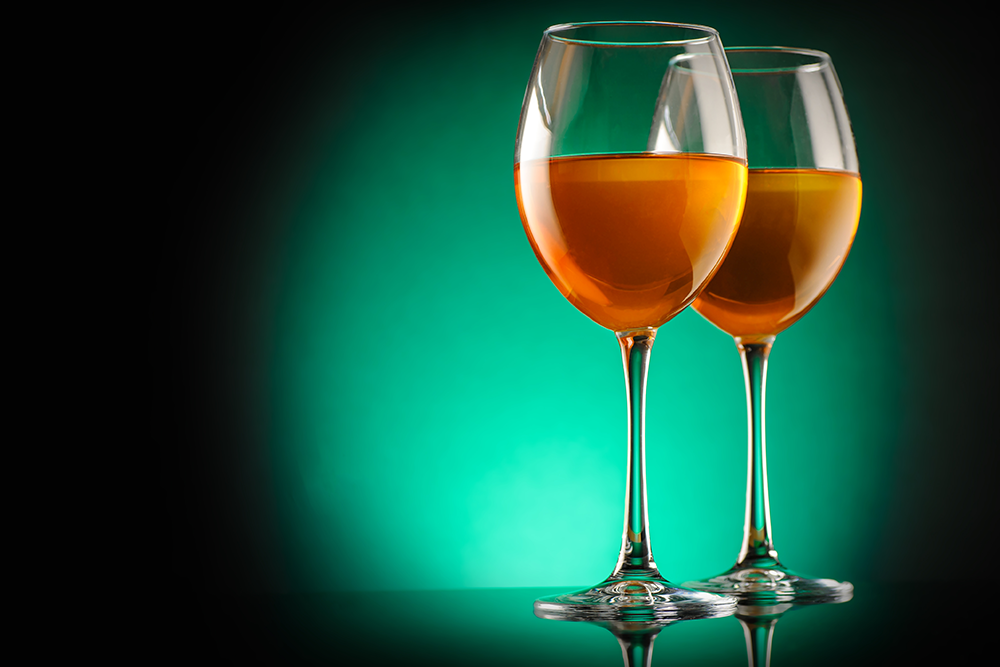
Orange wine is on my mind. On a recent stroll down Westbourne Grove, and with a bit of time on my hands, I stopped into Franklin’s – a sea of tranquillity in the bustle of nearby Portobello market. This local wine bar is run by two wonderful chaps, Luigi and Lucio. The former is from Naples and the latter from Valencia, so they know their wines. And when I asked to try something unusual, I was presented with a glass of orange wine.

Their choice was the Bodegas Verum Ulterior Naranja 2024 – as is evident from its name, an orange wine produced in Spain. Rich and creamy, what sets it apart from other orange wines is that it is a blend of red and white grapes: mostly Albillo Real, an ancient Spanish white variety, which is mixed with a little Moravia Agria, a rare indigenous red grape. My interest piqued by its organic freshness, and tales of how orange wine is all the rage with London’s hipsters, I trotted off into the night determined to see what else this stable had to offer.
Now, before you despair that this column has gone woke, it’s worth considering the distant origins of orange wine. Perhaps as long as 8,000 years ago the good folk of Georgia developed a method of wine production that created an unmistakably orange hue.
It’s bottled to resemble a premium rosé and is heavy on the nose and then surprisingly light on the palate
The key to this art is the qvevri, a giant clay pot used to ferment, store and age traditional Georgian wine. Instead of taking the juice out of the grapes, they would put them, with skins on, in the qvevri and bury it for months. The result of that skin contact is the distinctive orange colour. Obvious to some, but maybe not to others, there are no oranges in orange wine.
And while that history lesson might sound like a sidetrack, there are Georgian wine-makers who to this day use the same process to produce excellent orange wines. The first to recommend is made by the Dugladze family, with white Rkatsiteli grapes grown in the Kakheti region. After three months’ storage in a qvevri, their Ranina Kakhuri is delicious and full-bodied with a distinctly dry finish. If you’re looking to sample what’s out there, at roughly £15 a bottle it will be hard to beat as a value proposition.
For something a little more complex, and about an additional £10 a bottle, the same family produces a Qvevri Kisi 2023. Comprised entirely of Kisi grapes, this has a darker hue than the Ranina, as it spends six months in the qvevri. It’s bottled to resemble a premium rosé and is heavy on the nose and then surprisingly light on the palate; a real treat. If the orange wine movement can seem trendy today, these two wines pay homage to thousands of years of tradition and the almighty qvevri.
Because of orange wine’s surging popularity, producers across Europe are experimenting. Italy and Slovenia have both turned out excellent examples in recent years. The final one that grabbed my attention, however, is French. Made with Soleil grapes in Languedoc, Château Vieux Moulin’s Le Soleil is a lightly sparkling delight with the same tint from skin-contact fermentation. This is the one to serve if you have a guest you’d like to impress and can spare the £25 price tag.
It might be too soon – or, given the drink’s long history, too late – to say that orange is the new white. But when the sun is still shining, yet without summer heat, these wines offer something different: lighter than red and more full-bodied than a dry white. Even the colour matches the leaves soon to adorn the garden. In drinking them, you’ll be saluting both the ancient Georgian method of production and the fact that it’s a continuing story of innovation.






Comments