It was summer 1874 at Claude Monet’s house in Argenteuil on the Seine just outside Paris. Édouard Manet arrived from his house at Gennevilliers, on the opposite bank, and began painting Monet’s wife and infant son in the garden. Auguste Renoir turned up and started to paint the same scene alongside Manet. The little masterpiece he created is in the forthcoming exhibition Renoir and Love at the National Gallery.
In 1924, Monet recalled that day half a century earlier:
Manet, seduced by the colour and the light, decided to paint a picture en plein air of people under the trees… Renoir arrived… He asked me for my palette, a brush and a canvas, and there he was, painting away beside Manet. The latter watched him out of the corner of his eye, from time to time looking at the canvas. Then he made a face, passed discreetly by me, and whispered in my ear about Renoir: ‘He has no talent, that boy! Since you are his friend, tell him to give up painting!’
He churned out canvases and could knock off a portrait in 45 minutes
Ouch! This was an uncomfortable joke at best (Monet drily remarked to his interviewer: ‘C’est drôle, hein, de la part de Manet?’). Manet, while charming, could be extremely touchy. Renoir advanced his own art by picking up the manner and approach of his contemporaries, and Manet must have found it irritating that day, because Renoir’s handling was so obviously indebted to his. And Manet may well have been more thin-skinned than usual because his own painting, ‘The Monet Family’ (1874; Metropolitan Museum, New York), was new for him as an exercise en plein air – a practice that he had sneered at in the past but to which Monet and Renoir were devoted.
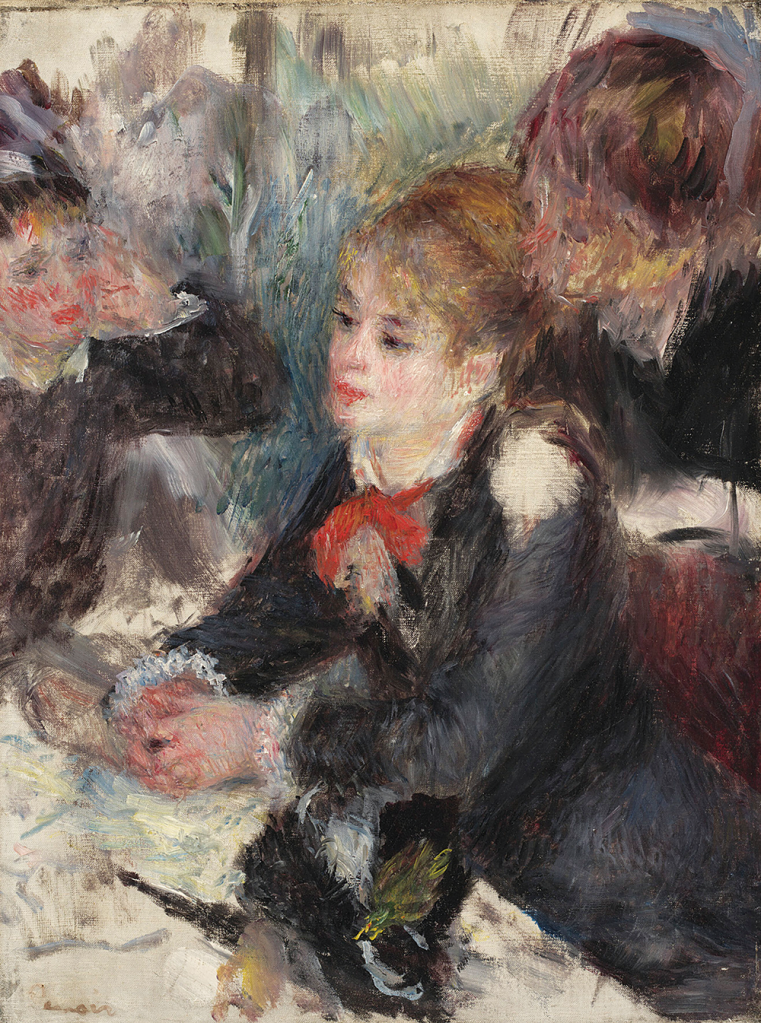
Renoir had already been studying Manet, as one look at ‘La Loge’ (1874; Courtauld Gallery), exhibited at the first impressionist exhibition in April the same year, reveals. The younger artist had mastered Manet’s signature use of black, and also followed him in depicting a scene from modern life. That said, the subject matter was quite new: a couple in their box at the theatre. Suddenly everyone wanted to paint scenes inside the theatre. This masterpiece was not in the Paris showing of Renoir and Love (which I was lucky enough to see), but it will be on view at the National Gallery, which is appropriate, since it was one of the very first impressionist paintings to be seen in London.
Monet himself was always relaxed about Renoir’s habit of imitation and was happy to have him painting by his side. For some weeks in 1869 they both worked at a Seine bathing spot called La Grenouillère, with the tiny island known as Le Camembertin front of them (grenouilles was slang for the good-time girls who thronged there). Renoir does not suffer in the comparison with Monet, as a marvellous oil sketch in the exhibition demonstrates.

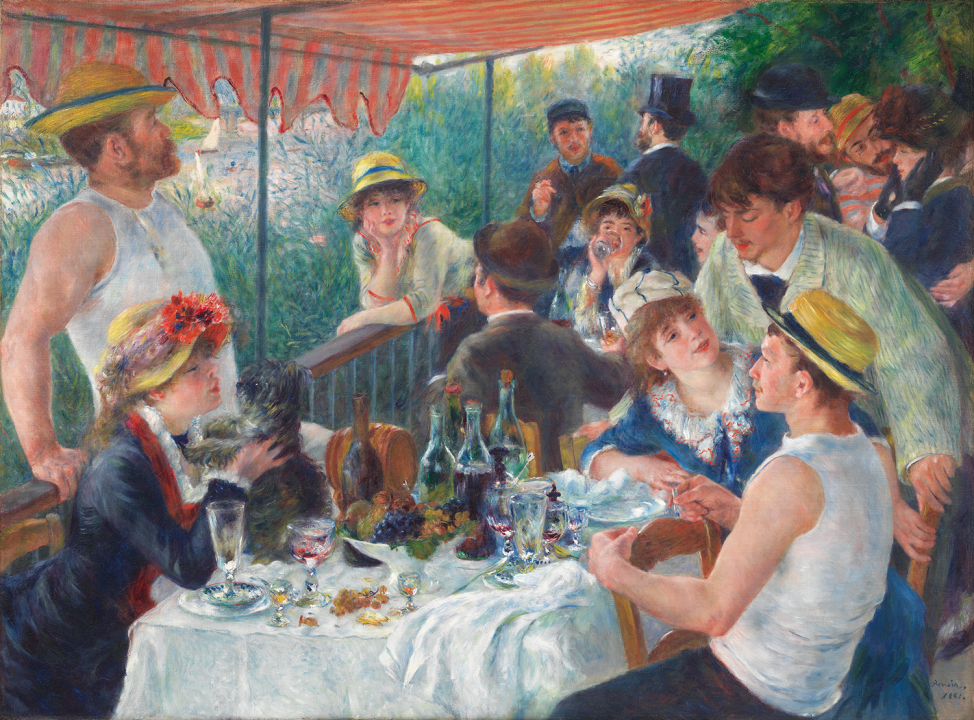
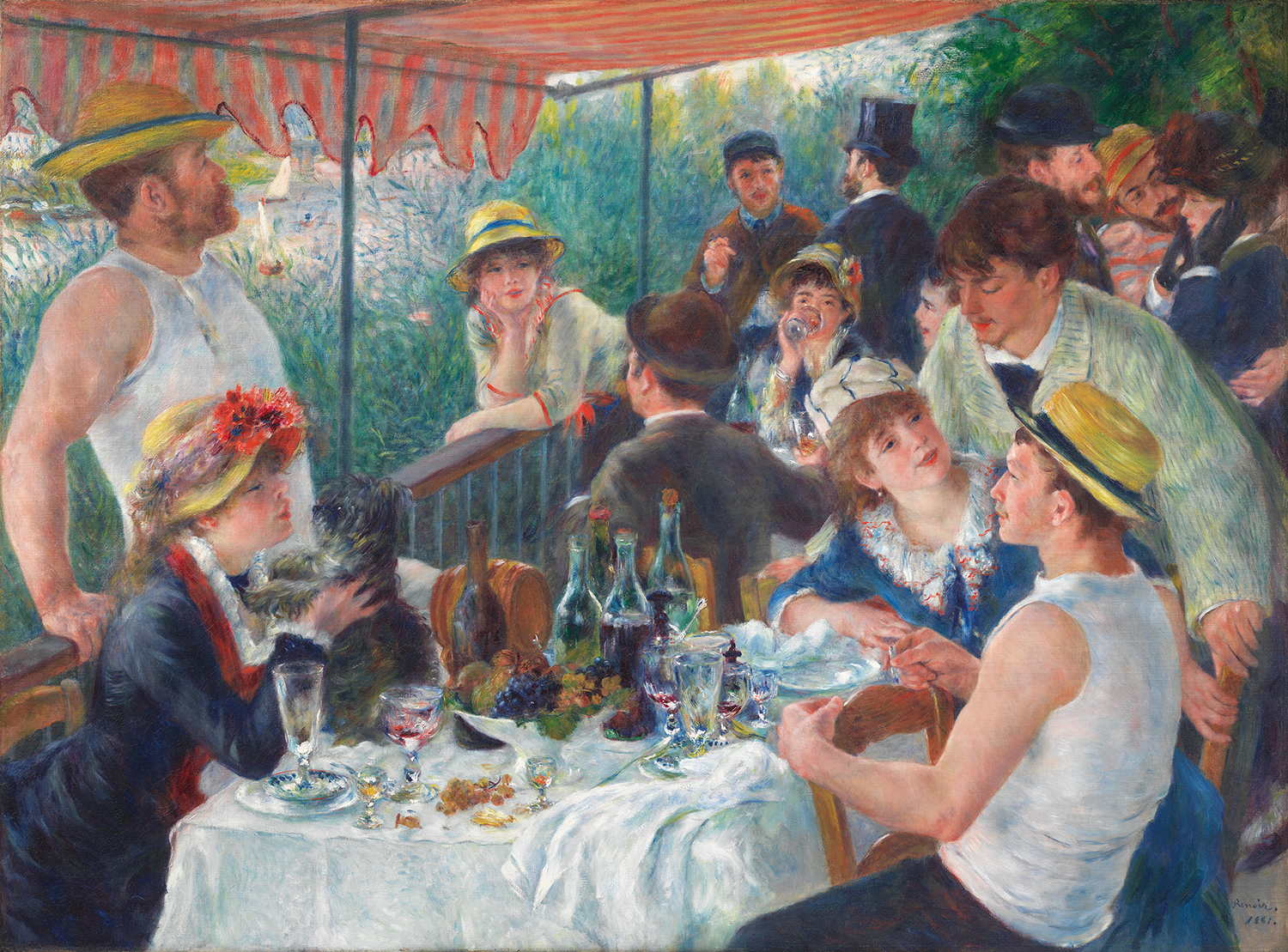
Renoir was often sentimental though, in a way that Manet and Monet never were, and his underlying structure, in perspective and the relative planes of a composition, was rarely as secure. But he was full of original ideas and, as time went by, both Monet and Manet learned new tricks from him, and all three became friends (not always an easy thing with Manet). But the quality of Renoir’s work could vary alarmingly. After he had been to Venice, he exhibited at the seventh impressionist exhibition in 1882, and Manet’s brother Eugène told his wife that, while Renoir’s ‘Luncheon of the Boating Party’ (1880-81) looked good, his views of Venice were ‘hideous, real failures’.
Renoir did not help his own reputation. The trouble was that he simply loved to paint. He churned out canvases and could knock off a portrait in 45 minutes. Staggeringly, he painted between 4,000 and 6,000 pictures – no one really knows how many. When he was confined in old age to a wheelchair and could hardly hold a brush, he still kept painting – another 400 of them. And he lacked quality control. He was often happy to use an inadequate shorthand for faces and for someone who understood how to paint water much better than most, he was often liable just to sketch it in, sometimes behind an equally sketchy – and hasty – foreground.
Looking at Renoir’s paintings en masse is like being on an artistic rollercoaster. He was sometimes penetrating and focused, at other times soppy and sentimental, especially in his images of plump women and tiresomely cute infants. When Renoir was good, he was very, very good, but when he was bad, he was horrid. Fortunately, this exhibition benefits from the expert selection of its curators, Christopher Riopelle and Chiara di Stefano of the National Gallery. It concentrates on the things that only Renoir could do, and do supremely well.
As the title suggests, his best work was driven by love for his fellow human beings, expressed in conviviality. Renoir loved women, he loved company and he loved good food. He painted cheerful people having a good time: no gloomy absinthe drinkers for him. He said: ‘I know it’s hard to get people to admit that a painting can be a great painting and still be happy.’
The key pictures in this exhibition are the incomparable ‘Dance at the Moulin de la Galette’ (1876) and ‘Luncheon of the Boating Party’. Both restaurants where Renoir imagined these superb creations are still in situ, the first in the heart of Montmartre and the other, Maison Fournaise, on the banks of the Seine at Chatou on the edge of Paris, and very good they are too. The dance area at the Moulin has gone, but the balcony with its awning at Maison Fournaise is still there – and I can vouch that there is nothing quite like the feeling of dining inside a great painting.
The two pictures are very different. The ‘Dance at the Moulin de la Galette’ is a virtuoso feat of unifying a busy crowd of people through the distribution of dappled light across the whole surface. The painting is also set in a middle key, a tricky thing if you are to keep a picture alive, which this abundantly is. ‘Luncheon of the Boating Party’ is painted in a much higher key, in an almost impossible array of tone and colour, an irresistible embodiment of the gaiety of the occasion. Bang in the front is one of those stunning Renoir still lifes of wine bottles, decanters and grapes that tell in delectable detail the story of what has been eaten and drunk by the end of an excellent meal. In a brilliant touch, the dags (look it up) of the red-and-white awning of Maison Fournaise flutter in the breeze in a moment of the most acute observation and execution. It’s my favourite Renoir touch.
When Renoir was good, he was very, very good, but when he was bad, he was horrid
Renoir recorded most such effects in smaller oil sketches on the spot, while the finished grandes machines were usually put together in the studio. At Maison Fournaise, the most indulgent restaurateur would have drawn the line at having a 6ft canvas hogging valuable space for weeks on end. The Moulin’s dance area, however, afforded some space, and so Renoir grabbed the opportunity to paint there on his massive canvas every afternoon. Renoir’s friend Georges Rivière recorded, with some feeling: ‘We carried that canvas every day from [Renoir’s studio a short way up the hill] to the Moulin, because the picture was executed entirely on site. We managed it, but not without difficulty, since when the wind blew the whole thing threatened to fly away like a kite.’
I saw an interview on BBC’s Monitor in 1962 between the ineffable Huw Wheldon and Renoir’s son, Jean, the great film director of La Règle du jeu, who made a remark that I have always remembered. Renoir would evidently sometimes paint from memory, when Jean and the family had no idea what might emerge as the first dabs of paint were applied here and there across the surface. A landscape? Flowers? A nude? And then, Jean said, it was like developing a photographic plate: Renoir’s process uncovered what, it seemed, had been hidden there all along. Unforgettable – and an apparently unwitting echo of Michelangelo’s famous remark about carving ‘David’.
This is a great and adventurous exhibition, glowing with the quality that Renoir possessed above all, which he certainly needed during a career that saw more than its share of slings and arrows. He was irrepressible.
Renoir and Love is at the National Gallery from 3 October until 31 January 2027.




Comments