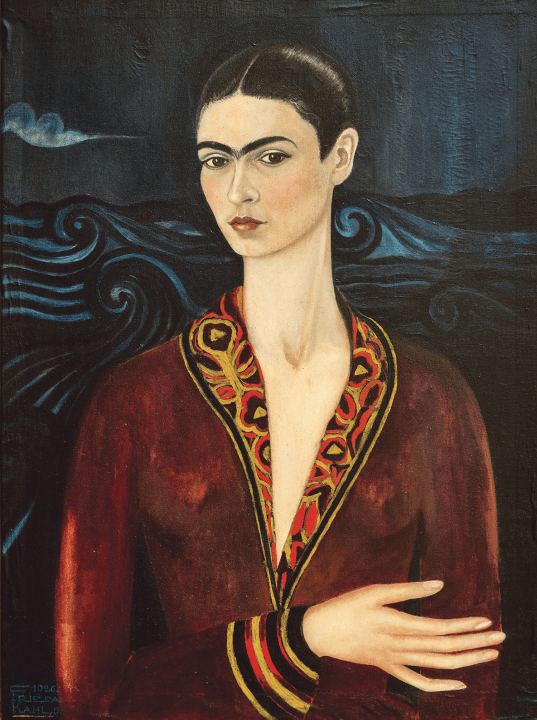
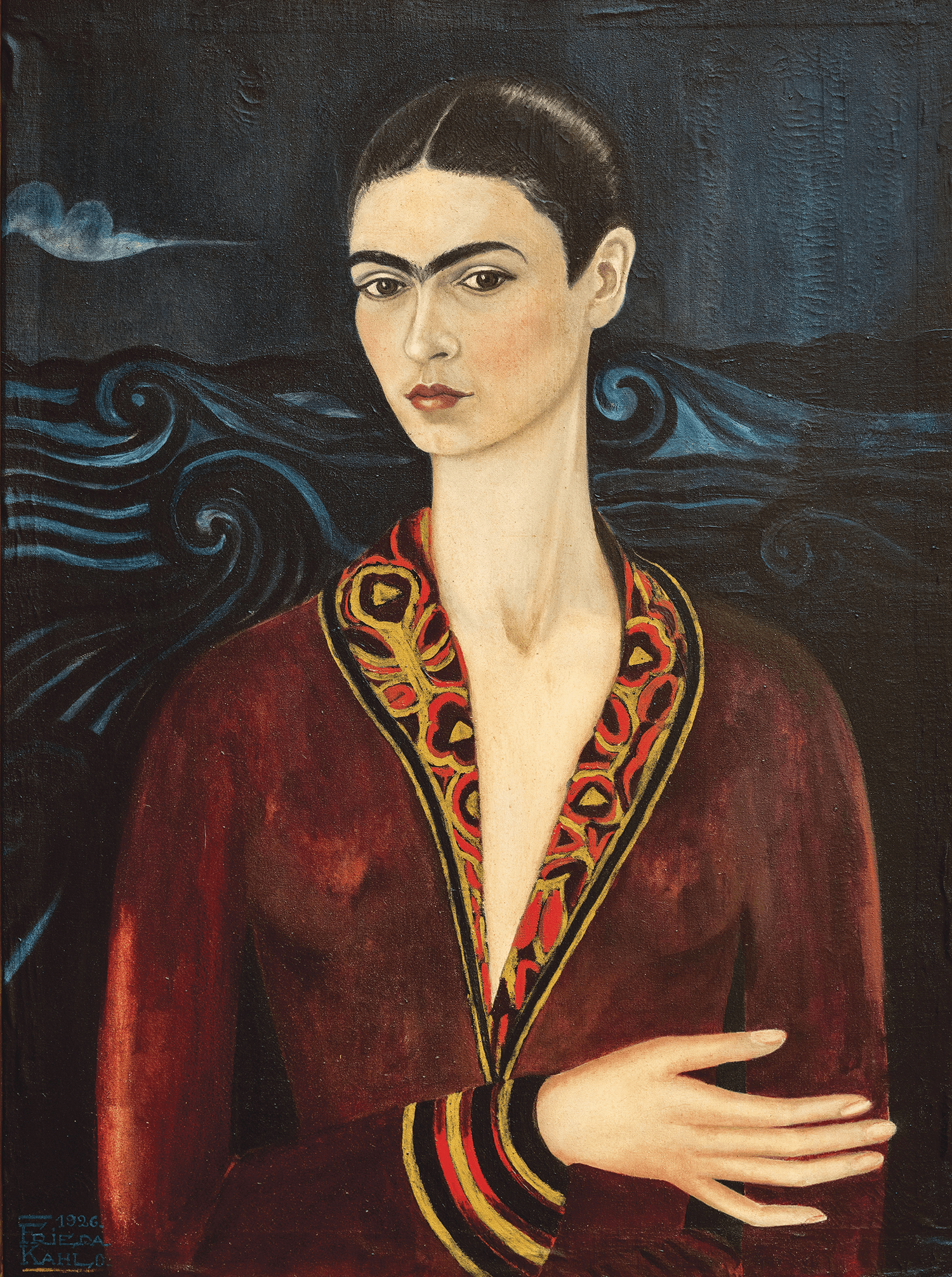
A Max Beerbohm cartoon famously reduced Arthur Wing Pinero (author of that interesting play, The Second Mrs Tanqueray) to a single eyebrow and a fur coat. Frida Kahlo’s fame rests upon little more: not so much anything she painted but her eyebrows – or should that be eyebrow? – and her moustache. If you get the impression that her output contains an awful lot of images of her face, you would be right. She painted 55 self-portraits – more than a third of her output.
Hers is a strange cult, but a cult it is, and Making of an Icon is what the Tate exhibition subtitle says, not ‘Making of an Artist’. The show is drawing the pilgrims in record numbers. Kahlo functions as a modern secular saint before whose icon come to pray those eager not so much for an aesthetic experience as for, among other modish things, ‘gender fluidity’. And, sure enough, there is a large room in this sprawling exhibition devoted to ‘Gendered Dialogues’.
As a painter, she functions at the level of those gifted people who composed wonderful shop-window displays
It so happens that, alongside the Kahlo, Tate Modern has another sell-out exhibition devoted to a woman artist, Tracey Emin, and reviewers have referred to her, too, as an ‘icon’. They have much in common, not least a fascination with unmade beds: I take it Emin got the idea from Kahlo, who even painted in bed (when chronic sickness demanded it). In both cases, we are not talking great art, but fame and celebrity, a modern phenomenon that has made artistic discernment irrelevant.
So what of Kahlo’s paintings themselves? There are not many on view: just 23 of them, dotted about among the productions of 86 other artists – a mix of her Mexican contemporaries and modern disciples aboard the bandwagon. When you do find a Kahlo canvas, you may find it difficult to love. They are flat – as if made with shiny household paint – and, to me at least, stale and unprofitable to boot. Unsurprisingly, her pictures were little esteemed during her life. But all that has changed, and she holds the record for any work by a woman sold at auction. This is ‘El sueno (La cama)’, which fetched $54.7 million last year. And yes, it shows her in bed, dreaming. Viewed just as a piece of painting, it is a slight and even clumsy thing – but that is clearly not the point.
Frida was born in Mexico in 1907 to German and Spanish parents and was 15 when she met the then superstar of Mexican art, the 36-year-old Diego Rivera, who soon made her his third wife. As a combined icon, they were an odd couple. While she was slight and short, he was fat and tall, a Mr Blobby figure evocative of the pneumatic figures of the Colombian artist Fernando Botero.
Rivera, though, could paint, and he produced murals on a vast scale that are rightly still appreciated. It was Rivera who encouraged Frida as an artist, but their marriage became more famous than the work of either, as they both continued, with much publicity, to have affairs, he with women, including Frida’s sister. That episode led to divorce in 1939, only for a remarriage the following year. Frida, for her part, had affairs with both women and men, including Leon Trotsky, who soon afterwards encountered that fatal ice-pick in her home town of Coyoacan.
Frida exploited her sister’s betrayal by creating a painting of it. It is in the present exhibition and what can you say? – it is no better or worse than the others. As a painter, she functions at the level, I would estimate, of those gifted people who, in the great days of department stores, composed wonderful shop-window displays. They could knock off this kind of thing before breakfast. Truth to tell, Kahlo was more of a designer than an artist, although she was no kind of draughtsman. And what did the late David Hockney say about that? ‘Art should move you…’ Pause. ‘…I suppose design could move you, if it was a well-designed bus.’
Frida’s art barely exists outside the world of her self-obsession and her relationship with Rivera
Kahlo used the same painting recipe all her life. Take some rather dark colours, with no understanding of or use of light; add in Mexican exotica; blend with a touch of surrealism. The meaning of most of the pictures is only of interest if you are interested in her, which, of course, she was – to the exclusion of almost anything else.
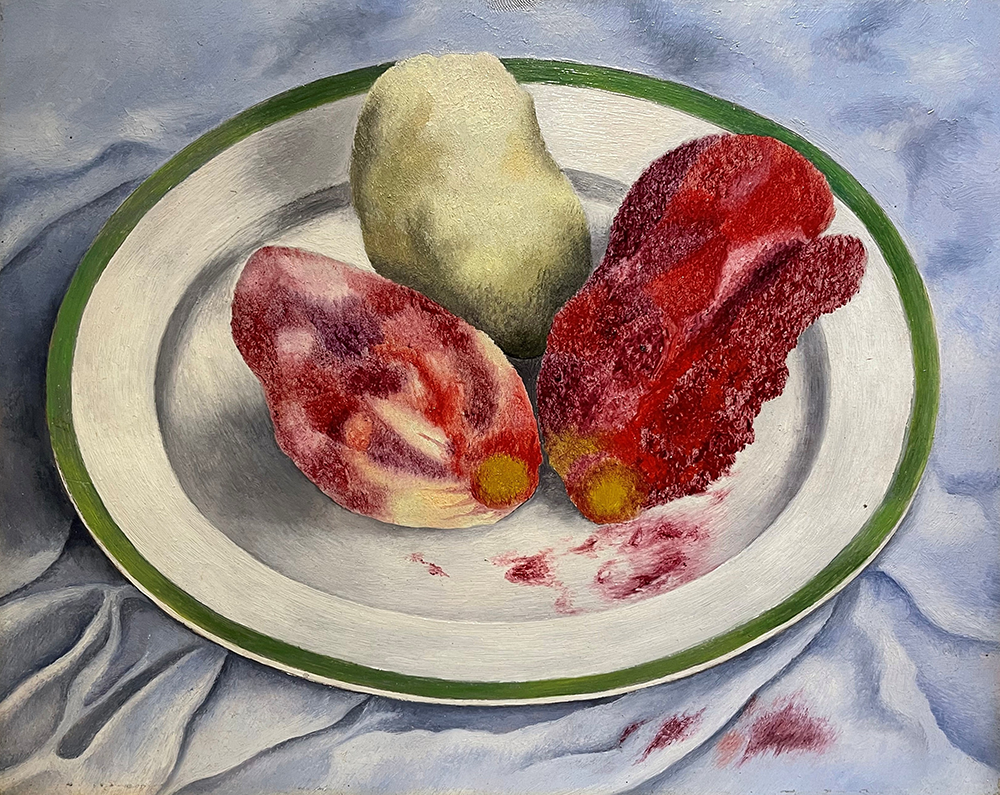
There are two exceptions here: one is a lovely little still-life of prickly pears (she should have done more) and the other a late, lucid, pared-down picture of herself in the company of a portrait of her equally monobrowed doctor on an easel.
Frida’s art barely exists outside the world of her self-obsession and her relationship with Rivera. In this exhibition, it is reduced to a side show. But then, it always was.



Comments