Dappled light falls across the lobby of Pripyat’s abandoned Hospital No. 126, now so smothered by vegetation that it is almost invisible from the road. The silence in this ghost town in northern Ukraine is broken by an irregular crackle: sharp clicks like static from an old radio. As the radiation level rises, the clicks quicken into an urgent rattle.
Anton Yukhymenko, 40, passes his dosimeter over the lobby’s reception desk. At one spot the rattle becomes an angry electronic chatter and the figures on the screen race upwards: 150 microsieverts an hour, an abnormally high dose rate. ‘It was here,’ he says. ‘I can’t believe it’s gone. It was dangerously contaminated.’
He is referring to a firefighter’s helmet that for decades had rested on the desk. Said to have belonged to one of those brought here after the explosion on 26 April 1986, it had remained as a grim relic of the worst nuclear accident in history. Twenty-eight firefighters and emergency workers died from acute radiation sickness in the months that followed.
The war has also brought danger back to Chernobyl’s radioactive heart
Now the helmet has disappeared. ‘Probably taken by someone as a souvenir,’ says Yukhymenko, who has worked here as a guide for 20 years, clutching his forehead in exasperation.
Forty years after the disaster, and four-and-a-half years after Russia’s full-scale invasion of Ukraine, the Chernobyl exclusion zone – a strategically important swathe of land between Kyiv and Belarus – is adapting to another uncertain future. ‘This is just one example of the bad things that have started happening since the war came to the zone,’ he says.
Russian troops seized Chernobyl on the first day of the invasion and occupied it until the end of March 2022. Since their withdrawal, thousands of Ukrainian troops have moved into or through the exclusion zone. Checkpoints guard the roads, barbed wire crosses the landscape and anti-drone nets hang above approaches to sensitive installations.

For Yukhymenko, the zone has become a lifelong obsession. Broad-shouldered and bear-like, with close-cropped hair, a neat beard and kind eyes, he is a softly spoken, gentle presence. ‘This place means everything to me,’ he says. ‘Of course, on one side I have my wife and daughter. But on the other, I have the zone. I have dedicated half my life to it.’
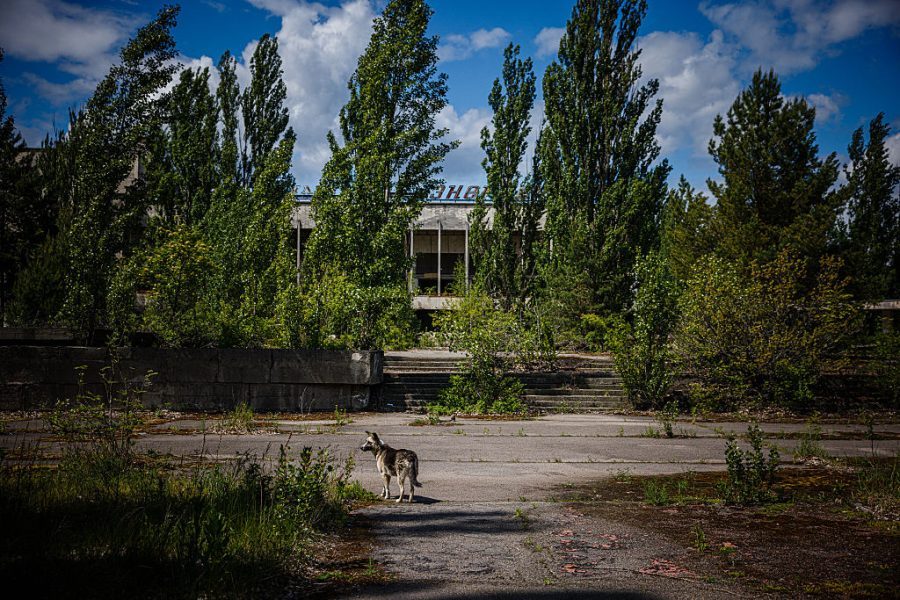
He speaks as he weaves his SUV through Pripyat, the model town built to house workers at the neighbouring nuclear power station. The city’s once-broad boulevards have narrowed into woodland tracks. Birch and pine crowd against decaying apartment blocks, now barely visible from the road. Creepers climb through broken windows and spread across rooms abandoned in haste four decades ago.
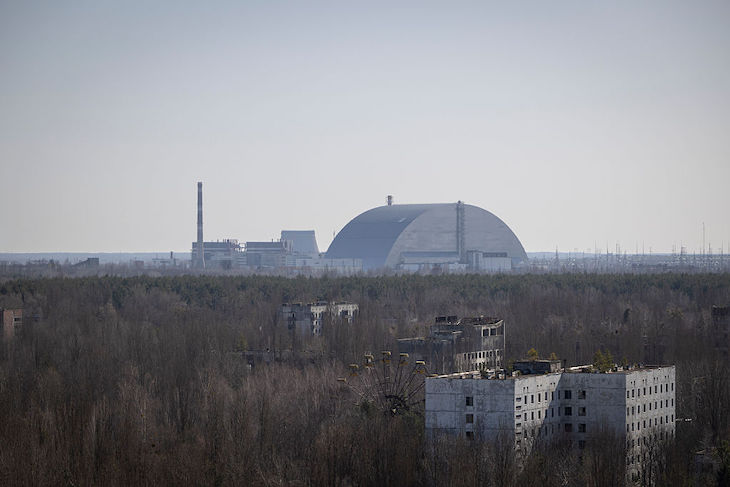
‘The emotions here are sad and happy at the same time,’ Yukhymenko says. ‘You feel sad when you realise how many people died, but you also understand the power of nature to resurrect itself.’ Four silent reactors and the unfinished shells of two more loom incongruously above the forest, the industrial skeleton of the disaster now half-swallowed by the same wilderness it once poisoned.
What has happened beyond them has astonished scientists. ‘What surprised me most was how quickly nature returned after people left,’ says Denys Vyshnevskyi, head of the scientific department at the Chornobyl Radiation and Ecological Biosphere Reserve. ‘Five to ten years was enough for nature to stabilise and recover.’
The exclusion zone covers about 1,000 square miles and has become one of Europe’s largest nature reserves, giving wildlife a vast territory almost devoid of people. ‘The absence of humans is key,’ Vyshnevskyi says. ‘This territory really looks like wild territory now.’ Brown bears have returned after more than a century. Lynx and elk stalk the forests, while Przewalski’s horses, introduced in 1998, roam through abandoned settlements.
Standing on the roof of the Hotel Polissya, Yukhymenko gazes across rooftops now barely visible through poplars that have raced up to conceal them. He points towards the main square. ‘Early one cold winter’s morning I was up here and looked down to see a pack of ten wolves patrolling the streets,’ he says. ‘That was a special moment.’
Before the war, humans too were beginning to return. About 200 guides took tourists through Pripyat and the surrounding villages. ‘It was becoming a kind of Disneyland,’ Yukhymenko says. ‘But the people who came here protected and respected the abandoned places. The presence of military personnel has changed that.’
At its busiest, he could manage three coachloads of 45 visitors in a day. The invasion ended all that. ‘Many of the guides went off to fight,’ he says. He pauses. ‘Many are now dead.’
The war has also brought danger back to Chernobyl’s radioactive heart. In February last year, a drone carrying a high-explosive warhead tore into the New Safe Confinement, the vast steel arch built over the remains of reactor four. Ukraine identified it as a Russian Geran-2 attack drone; Moscow denied responsibility.
The impact ignited insulation between the structure’s inner and outer layers. ‘It burnt for 17 days before our firefighters managed to extinguish it,’ says Hanna Pidhaina, representative of the Chernobyl nuclear power plant. ‘They had to cut more than 300 holes in the outer metal covering. It was dangerous work.’
The arch was designed to keep the remains of the reactor sealed and dry. The strike compromised that protection. ‘Without the airtight seal, there is a risk of radioactive contamination escaping into the environment,’ Pidhaina says.
Mines have killed some of the Przewalski’s horses, while trenches can trap larger mammals
No rise in radiation was detected, but the International Atomic Energy Agency subsequently concluded that the structure had lost some of its principal safety functions. Repairs could cost at least €500 million (£367 million) and take until 2030.
Then, on 7 June this year, another drone struck the fuel-reception building at the centralised spent fuel storage facility. Ukrainian authorities blamed Russia. No spent fuel was inside the building at the time and radiation levels remained normal.
Now, war is also reshaping the wilderness that 40 years of abandonment created. During the Russian occupation, two large wildfires burnt about 1,000 hectares of the reserve, according to Vyshnevskyi. Shot-down drones and cruise missiles continue to start fires, while military defences have fragmented parts of the landscape.
Vyshnevskyi says about a quarter of the reserve is now inaccessible to his researchers because it is under military control. Mines have killed some of the Przewalski’s horses, while trenches can trap larger mammals. Military traffic has also increased road deaths.
Yet he remains cautiously optimistic. ‘There is enough space for the large animals to survive comfortably during the war,’ he says. ‘The territory lives for animals now. After the war, they will get it all back.’
For Pripyat’s buildings, the future may be less forgiving. Yukhymenko points towards the former city administration building on the central square. Its windows are shattered and its walls peppered with bullet holes.
‘These windows were not broken before,’ he says. ‘Parts of the city are used for official training activities. They practise shooting here. But why do they need to destroy this building?’
There is a painful paradox at the heart of Yukhymenko’s love for Chernobyl. He marvels at nature’s ability to reclaim a landscape poisoned by man, even as that same wilderness slowly erases the city he loves. War is accelerating the loss.
Inside Pripyat’s Palace of Culture, water drips steadily through the roof. The parquet floor beneath our feet has become a swollen, sodden pulp. Yukhymenko doubts that Pripyat will ever reopen to the public. ‘Sometimes when I enter these buildings, I think it may be for the last time,’ he says. ‘Unless they are properly maintained, very little will remain in 20 years.’
He knows that a country fighting for its survival has more urgent priorities. ‘The city,’ he says, ‘will slowly disappear.’



Comments