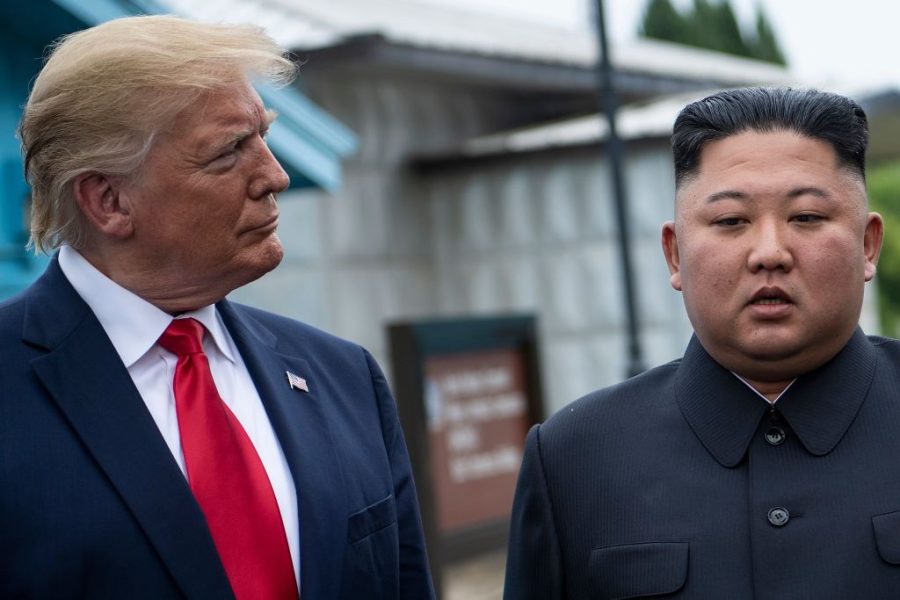
Will Trump and Kim Jong-un meet again? This is the million-dollar question after President Trump lauded his ‘very good relationship’ with Kim and ordered a scaling back of US-South Korean military exercises earlier this week.
Hours later, Trump elusively mentioned that the North Korean despot had responded ‘positively’ to his overtures. Another rendezvous between the two leaders cannot be dismissed, especially with Kim Jong-un in a stronger position now than during the first Trump administration. But unlike during the Trump 1.0 years, which saw three meetings between Kim and the President, things are different now. Back then, neither leader had met the other before; kindling a bromance was a novelty. Now, however, it will be a case of déjà vu. Even if Trump’s charm offensive bears fruit, Kim will want to ensure he is in the driving seat.
When, on 12 June 2018, Trump and Kim met for the first time in Singapore, it was an occasion that very nearly didn’t happen. Weeks before the summit, tempers had flared. North Korea abruptly severed its then-ongoing high-level dialogue with South Korea after US-South Korean military exercises had taken place. Soon after, Trump pulled out of the summit after North Korea affirmed its status as a nuclear weapons state. Pyongyang sought to regain the US’s attention by partially blowing up tunnels at its nuclear test site at Punggye-ri. It worked. Eleven days before the date of the summit, Trump agreed that it would go ahead.
North Korea is, during Trump 2.0, getting everything it needs from Russia and China
The two leaders’ subsequent bonhomie, however, would be short-lived. In Singapore, both sides pledged to work towards the ‘denuclearisation of the Korean Peninsula’. Trump, then as now, used North Korea’s language of ‘war games’ to deride the ‘provocative’ longstanding US-South Korean military exercises. Yet, pleasantries aside, North Korea had no intention of giving up its nuclear weapons. For all the post-summit oleaginous letters between the two correspondents, their second meeting at Hanoi in February 2019 confirmed the reality. North Korea’s unwillingness to abandon its ‘treasured sword’ led to Trump and Kim parting ways before lunch on the summit’s second day. After both sides walked out, US-North Korea relations plummeted.
With Trump now in the Oval Office for a second time, Kim could not have been clearer about his terms for talks, namely, his ultimate goal: recognition of North Korea as a nuclear weapons state. Whilst this might suggest that the door to talks has been closing, the North Korean leader has not bolted it completely. In September last year, Kim recounted his ‘fond memories’ of Trump, telling his rubber-stamp parliament that there was ‘no reason for us not to sit down with the United States’ so long as the US dropped its ‘obsession’ with North Korean denuclearisation. A much-speculated meeting during Trump’s visit to South Korea in October, however, failed to materialise.
Unlike during Trump 1.0, North Korea is, during Trump 2.0, getting everything it needs from Russia and China. Why, then, would Pyongyang need Washington? Whilst the North’s alliance with Russia might give Kim greater incentive to rebuff any Trumpian olive branches, this new geopolitical reality could, in fact, spur the North Korean leader to meet his US counterpart – at little cost.
Were Kim to capitalise upon Trump’s penchant for dialogue (and a Nobel peace prize), any summit could give the North Korean leader exactly what he wants, even if it would likely produce much less substance than previous tète-â-tètes. Kim could offer no nuclear concessions; avoid any detailed discussion of denuclearisation; and tease out acceptance, however tacit, from Trump of North Korea’s self-declared status as a nuclear weapons state. And with such recognition in his hands, Kim could later call for an end of sanctions (which are tied to North Korea’s nuclear programme), a peace treaty to end the Korean war, and a removal of the approximately 28,500 US troops stationed on the Korean peninsula.
The real risk of any such possibilities will be borne by South Korea. Certainly, this is not the first time that joint military exercises have been scaled down. Several were suspended after the Singapore summit in 2018. The following spring, large-scale exercises were downsized. But this time round, any resurrected Trump-Kim bromance risks marginalising Seoul.
South Korea will no longer be needed as an emissary between Pyongyang and Washington irrespective of the recent proposals by its progressive president, Lee Jae-myung, to engage in talks with North Korea to end the Korean war. Seoul must also recognise that strengthening its own capabilities should take place in tandem with bolstering its alliance with the United States. The former will benefit the latter. And as for the calls by the South Korean left to reduce Korean military exercises in favour of pursuing ‘peace’ with North Korea? These will only play into Pyongyang’s hands.
When Presidents Lee and Trump first met in August last year, Lee asserted that only Trump could make progress on the North Korean issue, since Kim would be waiting for his pen pal of old. We do not know where or when Trump and Kim will meet again, whether after the US midterm presidential elections in November (especially if they do not turn out in Trump’s favour) or at another time. We also do not know just how Kim responded to Trump’s Truth Social post. But if North Korea can reap benefits from all sides whilst giving away as little as possible, then we should not rule anything out.





Comments