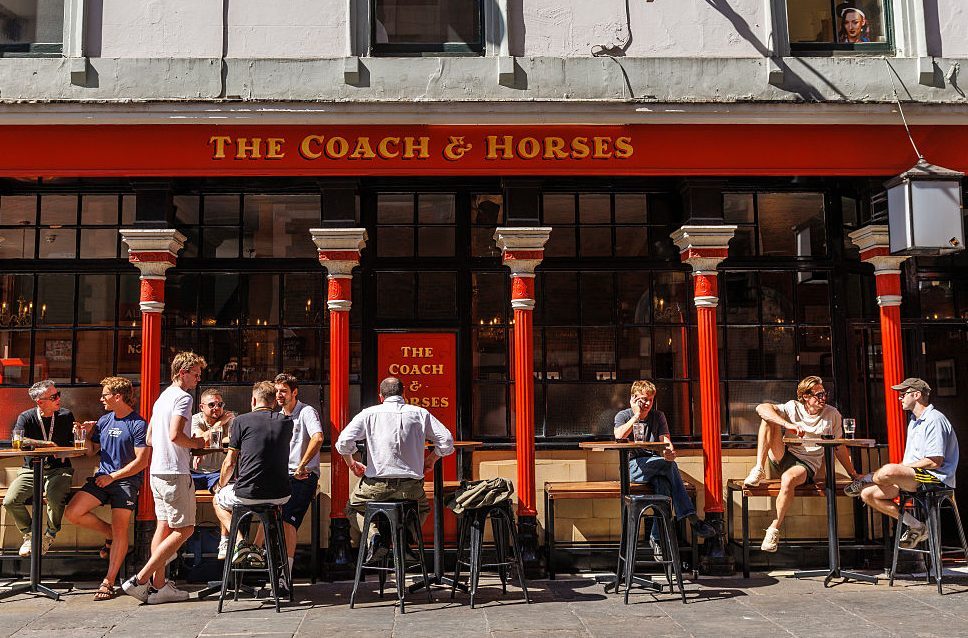
I’ve been spending a lot of time standing in Soho this summer. No, not leaning on a lamppost next to Walker’s Court and the staircase that says ‘girls upstairs’. Instead, outside my favourite pub, with a whiskey in a plastic glass, getting grumpy that there’s nowhere to sit and the music inside is too loud. I’m only thirty-five but after nearly twenty years working in hospitality, can I please just have a chair? Around me everyone else is perching, leaning, shifting from foot to foot, vapes in hand, moaning about the security guards. But we put up with it. You’ll probably find us there tomorrow.
Pubs have never been structured, and they shouldn’t start now
Westminster Council has been in the news recently for a draft licensing policy under which an applicant who ‘remove[s] opportunities for vertical drinking’ in favour of table service is more likely to succeed. ‘Vertical drinking’ is not, as I first assumed, some obtuse reference to binge drinking, just drinking while standing up. Cue widespread outrage that the Council is limiting our God-given freedom to get sloshed in Soho’s pubs.
The English have a reputation for two things: obsession with class, and queuing for everything. Pubs exist precisely because they break both rules. It is one of the only socially acceptable places to say hello to a stranger. Even the scrum at a pub bar is on the face of it a disorderly mess but runs on an unspoken system where everyone knows their place and scowls at anyone who queue-jumps. This baffles tourists, who can be seen walking into pubs, sitting at tables and waiting for service that never comes. Then when they go to the bar, their hand waving at the staff gets them served slower.
Then there’s a pub code for seats and tables. Only the owner, manager or a regular gets a stool at the bar, issuing instructions with just an arch of an eyebrow. Tables close to the bar must be shared – if you try to be two people at a four, you’ll be joined, and your complaints ignored. The further you are from the bar, the more private the tables become. The rear of the pub is where the most intimate behaviour is acceptable – like snogging in a dingy corner near the lavatories. In time we all learn instinctively where in a pub we can seclude ourselves if we need.
Standing is what you do when you want to meet the public. This rule is true inside or out, summer or winter, soft drink or intoxicating. Anyone of any race, religion, or creed can meet here, usually over a cringe dad joke or a remark about someone’s appearance that elsewhere would get you punched. Places are even more sociable if the venue has some edge of exclusivity: a gay bar, a subculture haunt, a Westminster local for politicians, or a working-class local, but it stays open to everyone regardless.
Soho’s Francis Bacon knew these rules better than anyone. Pubs then were barred from opening in the afternoon, so he joined a private members’ club to get round the law. The Colony Room’s proprietor, Muriel Belcher, was described by Christopher Hitchens as a ‘bat-like old lesbian’ who ‘would perch by the bar, screeching obscenities like the pirate captain’s parrot… terrorizing all bores and all those who were too slow.’
Bacon himself, per the Daily Mail, ‘would stand by the bar in his tight-fitting leather jacket, generously dispensing champagne to the assorted rogues and roués.’Belcher’s genius was a tiny room, with almost no seats, where anyone could meet anyone, as long as they weren’t boring. The whole club existed as a workaround to the law, so when the 1988 Licensing Act allowed pubs to stay open in the afternoon, the Colony’s reason for existing disappeared.
Go back to the First World War, and the state tried something similar. Buying a stranger a drink briefly became an offence, the ‘No Treating Order,’ after Lloyd George declared ‘we are fighting Germany, Austria, and drink; and, as far as I can see, the greatest of these three deadly foes is drink.’ Newspapers reported a man was fined for buying his wife a glass of wine, ‘the crime of asking “what’s yours”’as they put it. This order died with the war’s emergency legislation. Full prohibition, though briefly floated by the Liberal Party, never came to the UK.
Today, pubs are adapting to their environment, much like the Colony did. Soho was once a place with a reputation for squalor, drugs, and prostitution, but is now London’s hospitality destination, with eye-watering rents to match. Gone are the days a publican could run a decent business without being packed each and every night, having arcades, a dance-floor, food or a garden. If Westminster dissuades pubs from increasing capacity with standing, they’ll have to raise prices, add service charges, turn into restaurants, or just not exist. In a city already pricing out its subcultures, political intent matters here, not to speed pubs’ decline, but to arrest it.
What’s really at stake isn’t the standing, it’s a common space with inherited, unspoken rules.You learn how to relax in a pub by getting insulted, elbowed, or into a playfight in one, not by reading an arbitrary set of club rules or terms and conditions, an increasingly strange idea to a generation raised on apps that signal every user need. Worse, international culture keeps homogenising our own, so every venue must now work the same way: table-service, a host who seats you, menu-ordering, a bill printed and brought over. Pubs have never been this structured, and they shouldn’t start now. It’s a specifically British thing, which we all must learn, worth keeping simply because it’s ours.
My feet still hurt when I stand outside all afternoon. I still worry about varicose veins when I’m older. But I’ll put up with it because otherwise London will become as lonely as people say it is.



Comments