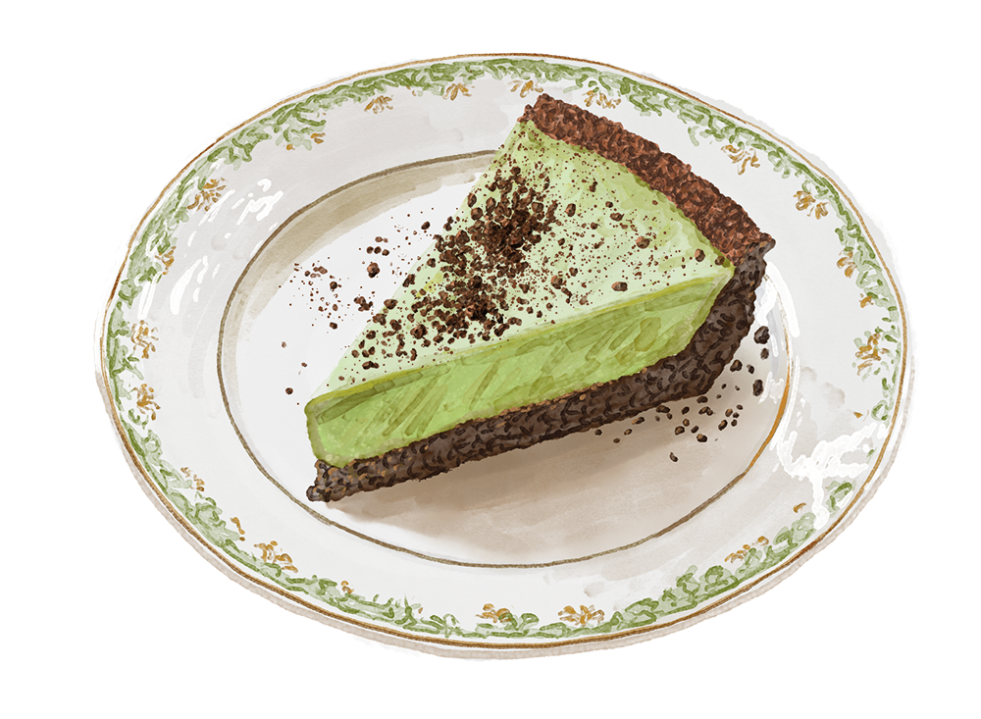

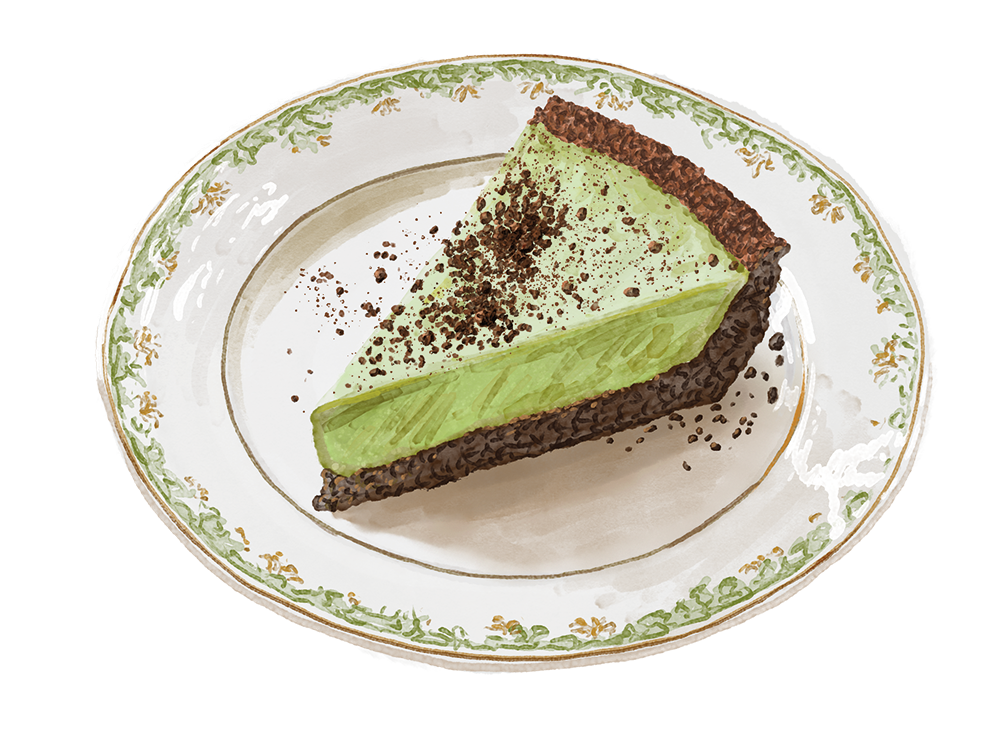
Grasshopper pie is an unlikely dish: bright green, mint-flavored, combined with obscure liqueurs and set with marshmallows, all sitting in an Oreo crust. It feels like the fever dream of a sweet-toothed teenager who’s been let loose on their parents’ drinks cabinet, and will regret it tomorrow.
The pie is based on the cocktail of the same name, which combines equal parts crème de menthe, crème de cacao blanc and cream. It’s a heady mix of mint, white chocolate, dairy and alcohol. The cocktail hails from New Orleans and its origin is claimed by Tujague’s in the French Quarter, where it was supposedly invented by the owner, Philip Guchet, in 1918. It tastes exactly as you’d imagine and is, forgive me, far better suited to a pie filling than it is to a drinks party. The creamy, boozy froth is transformed into a smooth, balanced, no-bake filling. It became a popular pie in the 1950s, when chiffon no-bake pies were all the rage. But this filling is particularly clever. Instead of using the meringue and gelatin typical of a chiffon-style pie, the setting agent here is marshmallows. These marshmallows are melted down in milk before being whisked into heavy cream, along with the various types of liqueur that flavor the pie. The result is soft, fluffy and set with only the slightest wobble.
What is almost as unlikely as the pie itself is that it was one of the first things I ever cooked. I don’t remember how I came across this curious, extremely American pie, but I do know I was living in a flatshare in London with two other girls, one of whom loved mint chocolate. So, I set about making it for her birthday. It was deeply inauthentic.
It feels like the fever dream of a sweet-toothed teenager who’s been let loose on their parents’ drinks cabinet
Oreos weren’t as easy to come by then in the UK, so, from what I remember, I would have used bourbon biscuits, which lack the dark cocoa intensity of the Oreo, and that particular, nostalgic vanilla flavoring. I cannot believe I made it with proper booze (if I had, the remnants of those bottles would surely still be sitting at the back of my cupboard, so rare is the call for either of them), so it was likely flavored with peppermint extract, adding a touch of mouthwash to the proceedings. When it came to the green food coloring, I channeled Kermit. It was vivid. It is fair to say that it lacked subtlety in almost every conceivable way. And then, just as I’d finished my work of art, someone knocked into it, denting it irrevocably.
It sat on top of our microwave, in all its dented glory, for days. It was extremely well received by the flatmate, but that might have been kindness on her part, as it was a synthetically flavored, radioactive mint monstrosity. My memories of it are not favorable: toothpastey, overly sweet and garish.
Returning to this pie many years later, and making it properly, I couldn’t believe just how good it can be. The flavor of mint the liqueur provides is nothing like the waft that hits you as the bottle opens: alongside the crème de cacao and marshmallow cream, it’s softer, mellower and light. The crust is buttery, salty, crumbly and the perfect dark, intense foil to the whimsical sweet filling. The texture is remarkable: using marshmallows is such a clever hack to achieve a texture that tastes as if you’ve used a terribly complicated culinary technique.
You can skip the food coloring, but the shade of green from the crème de menthe alone will be far paler than from a bottle. Part of the joy of making a pie with a name as silly as this one is ensuring that its appearance is as daft as its flavor. You don’t need to go as fluorescent as I did in my first attempt – adding a smear of green gel food coloring will give a softer, sherbetty green (just go slowly to avoid it looking like promotional material for Wicked).

Despite the boozy contents, the assembly is child’s play. The base comes together in a matter of moments, and then is satisfyingly like molding wet sand. The filling is easy too, but make sure you don’t overwhip the cream before or after adding the melted marshmallow, as this can cause it to split. The finished mixture should just about hold its own weight, so it piles up in the crust, sloping down towards the edges. It will likely feel too loose, but those magical marshmallows, along with a decent spell in the fridge, will give you a perfectly sliceable texture.
Serves: 8
Hands-on time: 15 minutes (plus chilling)
Cooking time: 5 minutes
For the crust
- 2⅓ oz salted butter
- 10½ oz Oreo cookies
For the filling
- 7 oz marshmallows
- 5 fl oz whole milk
- 2 fl oz crème de cacao blanc
- 2 fl oz crème de menthe
- 13½ fl oz heavy cream
- Green food coloring
- Melt the butter. Blitz the cookies in a food processor, and then add the melted butter, pulsing the mixture until it begins to come together. Reserve two tablespoons of the crumb, then press the rest into a 9in tart tin. Compress the crumb with the back of a spoon, and push it into the sides to create a rim of cookie crust. Leave to refrigerate for at least two hours
- Place the marshmallows and milk in a pan over a low heat, stirring until the marshmallows have completely melted. Add in the crème de cacao blanc and the crème de menthe and set aside to cool for ten minutes
- Place the heavy cream in a large bowl or the base of a stand mixer and add a little green food coloring – exactly how much will depend on the type of food coloring, and how vivid you want the pie to turn out. Whisk until the cream sits in soft peaks. Add the marshmallow mixture and briefly whisk to combine
- Spoon the mixture into the center of the tart tin, piling it up in the middle. Refrigerate overnight
- Just before serving, sprinkle the remaining biscuit crumb over the top of the pie. Remove from the tin carefully, and serve in slices




Comments