
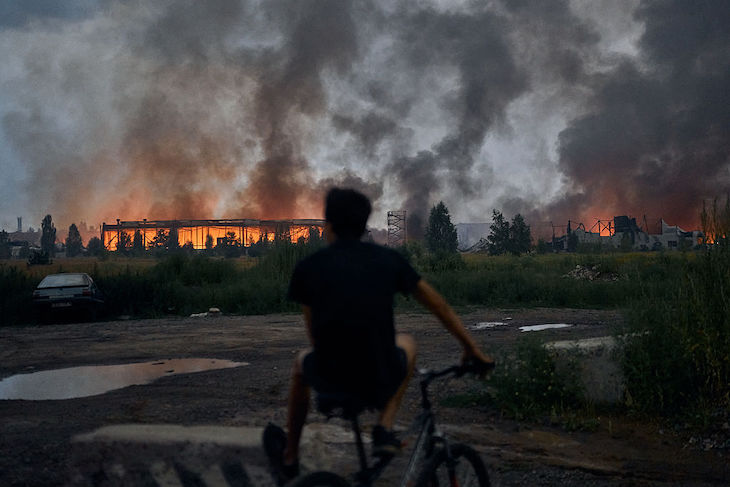
An important turning point has been reached in Russia’s war on Ukraine. But unfortunately for Kyiv, it’s not the ‘tide is turning’ in Ukraine’s favour narrative that Volodymyr Zelensky has been pushing ever since his long-range drone attacks began smashing oil refineries and logistics warehouses deep inside Russia and sinking dozens of ships in the Sea of Azov. Rather, last night not one of the 27 ballistic missiles fired by Russia at and around Kyiv was shot down. At least seventeen people were killed and a series of huge warehouses and major Ukrainian retail outlets were devastated.
No grain vessels have docked for almost two weeks as Ukraine’s summer harvest season enters full swing
By the terrible arithmetic of war, the casualty numbers were not in themselves game-changing. But Ukraine’s inability to stop incoming ballistic missiles – especially Zircon and Kindzhal hypersonic missiles that travel at up to nine times the speed of sound – is a fundamental strategic flaw that the Kremlin is exploiting mercilessly. As Zelensky himself said last month, “ballistic missiles are Russia’s last strategic advantage.”
The reason that the skies over Ukraine are now open to ballistic attack is that Kyiv’s arsenal of US-made PAC-3 Patriot interceptors is used up – and there’s little prospect of any more coming because the US has used up almost all its own reserves defending against Iranian missiles. Last month in Washington, Zelensky pleaded for 300 Patriots to defend Ukraine this winter. But according to the Center for Strategic & International Studies (CSIS) the US Army’s reserves are down to just 750 missiles. Patriot’s manufacturer Lockheed-Martin currently produces between 50 and 60 new units a month – compared to Russia’s monthly production of at least 120 regular ballistic missiles, plus four to seven Zircons.

Even if Zelensky’s dreams came true, therefore, 300 Patriots would not be nearly enough. According to EU Defence Commissioner Andrius Kubilius Russia launched over 900 ballistic missiles at Ukraine last year. Now that rate of fire is stepping up, with 377 missiles fired in July alone. In more ominous news, Andrii Cherniak of Ukraine’s Main Directorate of Intelligence this week said that units of North Korea’s 112th Missile Brigade have begun deploying to Voronezh (on Russia’s border with Ukraine), which could be equipped with “six launchers and up to 120 ballistic missiles.” That’s in addition to batches of North Korean KN-23 and KN-24 missiles already sent to Russia, plus Fath-360 short-range ballistic missiles bought from Iran.
Ukraine’s spectacular strikes on refineries, shipping bound for Crimea and on a succession of Wildberries warehouses – Russia’s equivalent of Amazon – have made headlines around the world. But while those attacks did bring the reality of the war home to millions of Russians for the first time since Vladimir Putin’s invasion of Ukraine in 2022, the Kremlin’s war economy is still far from crippled. Total Russian refinery capacity fell by a painful but not fatal 13 per cent. Millions of Wildberries customers and private suppliers will be affected and the company maybe bankrupted – but the idea that this will lead to the collapse of VTB bank, its main creditor, and with it the whole Russian banking system are fanciful.
Russia’s tit-for-tat retaliation, meanwhile, is having a far more devastating effect on Ukraine’s already-wrecked economy. The vital port of Odesa and neighbouring harbours have effectively been put out of action after being struck by 67 Russian ballistic missiles during July alone, with 35 merchant vessels attacked in port and 22 at sea. Alternative grain export routes from Ukraine will “cover only half of volumes handled by Black Sea ports,” warns agriculture minister Taras Vysotsky. The Black Sea grain export corridor brokered by Turkey at the beginning of the war to secure world food supplies is effectively dead too as shipowners suspended calls at the ports around Odesa. No grain vessels have docked for almost two weeks as Ukraine’s summer harvest season enters full swing. The closure of the Greater Odesa seaports has also halted Ukrainian iron ore exports, threatening the financial stability of the country’s steel sector and cutting off billions of dollars in annual revenue. The Southern Mining and Processing Plant in Zelensky’s hometown of Kryvyi Rih has announced a total production halt as a result.
But far more worrying for Zelensky is Russia’s ability to continue its systematic destruction of Ukraine’s energy, water, petrol distribution and heating infrastructure. During an earlier phase of tit-for-tat, Russian short-range missiles smashed up almost every petrol station in Kharkiv province and beyond, forcing drivers to carry spare cans in order to make it to less devastated areas. Now the Kremlin has set about wrecking not only retail facilities in retaliation for Wildberries but also taking out vital water aqueducts and heating pipes. Four winters of regular attacks have wiped out roughly 61 per cent of Ukraine’s electricity generating capacity according to the International Center for Ukrainian Victory. DTEK, Ukraine’s largest private power company, had lost 90 per cent of its generation capacity while every one of 15 of Ukraine’s gas- and coal-powered thermal power plants have been damaged or destroyed, with their share of the energy mix collapsing to around five per cent.
Last winter a slew of major Ukrainian cities – including Kyiv – already came perilously close to becoming uninhabitable after Russian missiles knocked out heat and power. Hundreds of high-rises had to be evacuated and the heating systems drained of water lest hard frosts crack the pipes. Power cuts in the capital reduced electricity supply to just a few hours a day.
The Kremlin’s war economy is still far from crippled
As long as Ukraine’s skies remain open to the Kremlin’s ballistic missiles, it’s a certainty that this coming winter will be even worse – with dangerous consequences for Ukraine’s war effort, and for Zelensky’s support. Small wonder that Zelensky has upped his calls for any kind of interceptor system from any Western allies willing to donate. But Europe’s newly-launched minted anti-ballistic coalition FREYJA, created to “coordinate joint defences against Russian ballistic missile attacks,” so far hasn’t got any workable alternative to the Patriot. At the Nato summit in Ankara, Donald Trump dangled the possibility for licensing Patriot production to Ukraine (and France), but has since walked back that promise. Boeing, too, which makes the vital targeting systems for PAC-3 Patriots has also refused to share the technology, fearing (not without justification) that Ukraine’s intelligence networks are thoroughly penetrated by Russian agents. And in any case setting up the production process would take at least two years – not counting setbacks from the inevitable Russian attacks on the plant.
Since the 2022 invasion, the Ukrainian leadership has maintained a constant faith that the next wonder-weapon will win the war – whether it’s M-777 rocket propelled artillery, Leopard tanks, HIMARS and ATACMS short-range cruise missiles, SCALP/Storm Shadow medium-range missiles, or F-16 fighter jets. All these systems have (eventually) been provided by Western Allies. None have actually turned the tide. Instead, its been Ukraine’s own long-range drones and, soon, Flamingo cruise missiles that have begun landing strategically painful blows on Russia.
But there is one wonder-weapon which truly could turn the tide of the war, and it’s the PAC-3 Patriot. Except this time the logic is cruelly reversed. Having Patriots had not resulted in a Ukrainian victory. But their absence could pave the way to defeat.




Comments