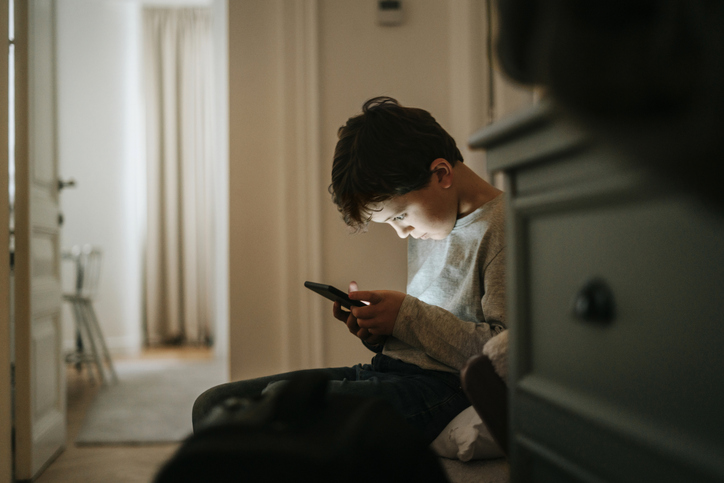
My 22-month-old son has just started enjoying imaginative play, and it’s a wonder to behold. There is little better than watching him feed his toy monkey a syringe of fake Calpol to make him feel ‘better’, or ‘discovering’ an imaginary bear or dragon when we are walking in the woods, or playing ‘cafe’ in his toy kitchen (even if the service is terrible).
Yet imaginative play – whether that’s building a den, exploring outdoors or making up new games and words – increasingly seems to be a thing of the past. New research suggests that four- to nine-year-olds are more likely to ask for a screen than use their imagination. When bored, only one in ten would consider going outside to be the first thing to do, whilst one in four would instead ask for a phone, tablet or television. The survey also revealed that nearly two-thirds of parents thought that they themselves were more imaginative at the age their children are now, and the vast majority said today’s generation had less capacity to invent games.
I fear that this loss of childhood magic and awe will only worsen as AI infiltrates our lives
The problem is that nowadays people see boredom as a pathology to be cured rather than an opportunity to develop creativity, reflection, resilience and autonomy. The author Isaac Rudansky has warned before that:
We are raising a generation of kids who have never known true boredom, never felt that maddening itch of an empty afternoon that can only be scratched by creating something new.
Rudansky is right. Whether it’s micro-managing middle-class parents who have been supervising and facilitating their children’s entertainment from day one, or a room packed full of an overwhelming number of close-ended toys for a specific purpose, children are not given the time and space to develop a sense of wonder, or discover their passions and purpose.

Instead, they are overstimulated, overscheduled and overly reliant on technology as a substitute for learning and social connection: even the most ‘imaginative’ screen time is consumed in a structured, passive way. Video games have defined rules, YouTube videos follow a predetermined algorithmic sequence, and all social media is designed to capture our attention, stealing any opportunities for spontaneous creation. As Rudansky writes:
Every time we surrender and hand over the iPad… we are erasing our children’s ability to create their own entertainment, their own stories, and their own memories.
Contrary to new government guidance, in the UK, 98 per cent of two-year-olds watch screens on a typical day, on average for more than two hours, and almost 40 per cent of three- to five-year-olds use social media. Those who spent the most time – around five hours – had limited vocabulary compared with those who spent the least and were twice as likely to show signs of emotional and behavioural difficulties.
Reception teachers complain about students’ lack of creativity, problem-solving skills and patience for activities that are not instant or seamless. I fear that this loss of childhood magic and awe will only worsen as AI infiltrates our lives at an earlier and earlier stage. There are reports of parents using AI to produce personalised bedtime stories, carry on conversations tailored to a child’s interests, and generate photorealistic images of the most far-fetched flights of fancy. For a child who cannot yet read, write or type, surely this digital wizardry stifles, or at the very least confuses, their imagination?
Last year, Tom Rogers, a history teacher and founder of Teachers Talk Radio, tweeted that he was considering:
Setting up something called the Boredom Club – school workshops where leaders create situations where children have to be bored and the challenge is to stay bored. Silence… Do it outside. Sit and look at a view. Zero tech. Pen and paper to doodle maybe…
He was being facetious, but the truth is that our education system also leaves little opportunity for students to explore rich imaginative worlds. ‘Play’ is sidelined in favour of products, measurable skills, demonstrable outcomes and objective data: even in creative writing, students must be assessed against clear criteria, which can make them feel self-conscious and stifled. Write a sentence, but it must start with a fronted adverbial. Write a paragraph, but it must follow the PEAL structure. Write a poem, but it must have this particular rhyme scheme. Write a story, but it must follow the conventions of science fiction. These imposed instructions and limits have their place in certain contexts (and for certain ages), but sometimes it’s fun to treasure the more open-ended, the more absurd, the more free.
We have arrived at a strange paradox where children nowadays have more planned activities and passive entertainment at their fingertips than ever before, but less free time to dream, make-believe or stumble upon what they truly love. With children spending up to seven hours a day on screens, they have little time for creativity, exploration, invention or self-discovery – and they will suffer later in life for it.






Comments