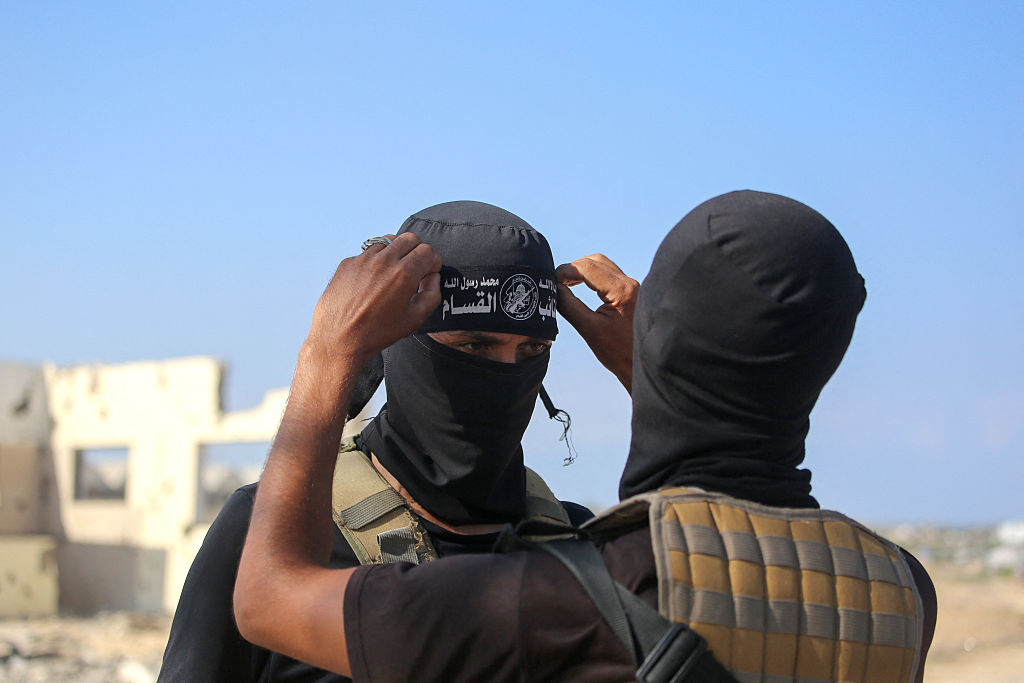
No one imagined that Hamas would voluntarily hand over its weapons and turn to politics and peace in the Gaza Strip. Even when President Trump announced his Board of Peace and 20-point plan toward a settlement to end the war with Israel, the sticking point, every analyst insisted, would be the disarmament of an organization designated a terrorist group by the United States, Britain, the European Union, Australia and many other nations.
It’s unlikely that Hamas will cooperate unless Israeli troops withdraw as per the agreement
Now, after months of negotiations – involving Trump’s two Middle East envoys, Egypt, Qatar and Turkey – and without any fanfare, the seemingly impossible has been achieved.
In what could be on one his most auspicious Truth Social posts, Trump announced that Hamas had finally agreed to disarm.
Nothing in the Middle East is as simple as that. There are conditions which at this point might also appear to be unresolvable. For example, the Israel Defense Forces (IDF) will have to withdraw totally from their current occupation of around 50 percent of Gaza.
The announcement by Trump envisions a phased and concurrent disarmament and troop-withdrawal process. Under its new leader, Khalil al-Hayya, appointed less than two weeks ago and with a reputation as a tough negotiator, it’s unlikely that Hamas will cooperate unless Israeli troops withdraw as per the agreement.
Indeed, Hamas’s position prior to the Trump announcement was that the IDF had to withdraw from its so-called Yellow Line before any disarmament took place.
Nevertheless, the Trump Truth Social post provided the US president with the first piece of positive diplomatic news for a long time. The five-month war with Iran has not gone the way he had wished and the Pentagon had promised, and the challenges ahead are becoming more complex and more frustrating for the White House as the strikes and counter-strikes continue.
The Hamas breakthrough, if it turns out to be genuine, might just give Trump new momentum toward his dream of a grand bargain for the Middle East, with or without the hardline mullahs and generals in Tehran.
Trump’s envoys, Steve Witkoff, the President’s billionaire business friend, and Jared Kushner, his son-in-law, have been putting in the hours along with the regional mediators to push Hamas to this point. But there is still a long way to go and a large part of the future focus will be on persuading Benjamin Netanyahu, Israel’s Prime Minister, and his most right-wing cabinet members that this is a golden opportunity not to be missed.
Under pressure from Trump, who has said he will be “very, very disappointed” if Netanyahu fails to back the progress that has been made in recent months, the Israeli government will have little choice but to react positively, although no doubt with a large slice of skepticism and caution.
History has shown that terrorist organizations do disarm (the Provisional IRA in 2005 and the Basque separatist group ETA in 2017, as just two examples). But so much more is at stake with the Hamas decision. Could this lead, as Trump hopes, to a new, democratic and incorrupt government in Gaza, a decent life for the two million Palestinian people and ultimately an independent nation, living in harmony with its Israeli neighbor?
All these political objectives might seem far-fetched today when one remembers what happened on October 7, 2023. Will Hamas genuinely transform itself from being what Israel views as a band of murderers, rapists and hostage-takers to an organization prepared to sacrifice its bloodcurdling past for a fresh start?
There are too many questions to be answered before any judgment can be made.
For example, despite the IDF’s destruction of much of Hamas’s weapons stocks and underground war tunnels, the organization still has a limited arsenal of anti-tank missiles, short- and medium-range rockets and rocket-propelled grenades, and the means to produce more in bunkered workshops.
Who will they hand the weapons to, where will they be held, or will they be destroyed? And how will the withdrawal of IDF troops from the Yellow Line in Gaza be orchestrated?
Trump has talked about a new Palestinian government. But will Hamas be represented if the disarmament process is completed? And will the Israeli government under its present leadership ever agree to an independent Palestinian state?
Netanyahu is standing for re-election in October. There seems to be zero chance that he will accept this situation if he wins.






Comments