
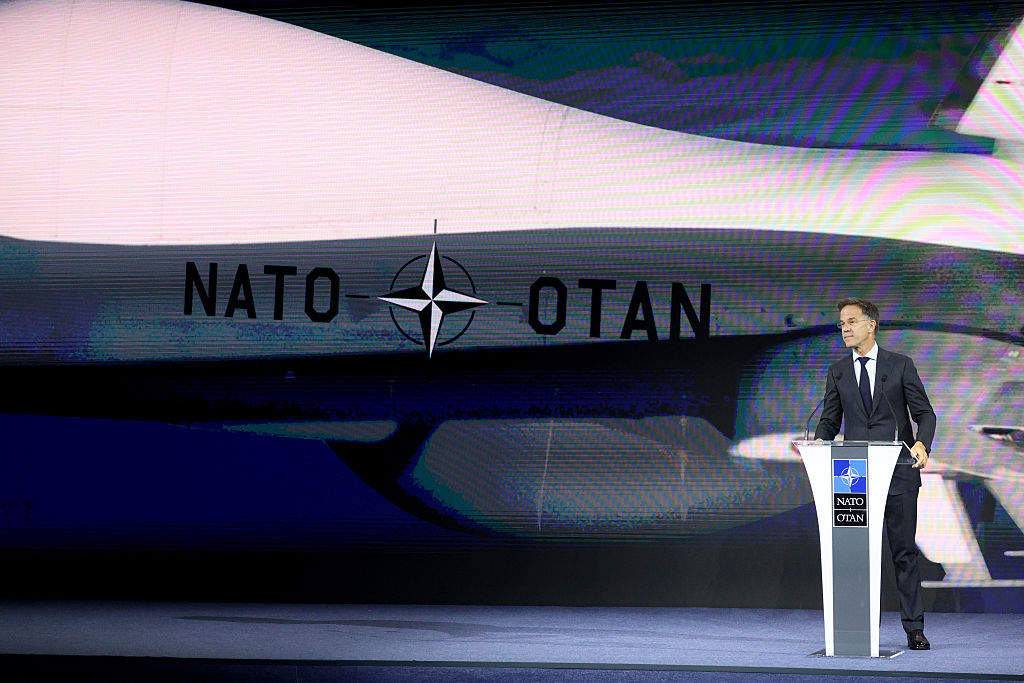
With all the Hollywood drama and heart-pounding music of a Mission: Impossible trailer, NATO screened a short promotional film at its Ankara summit to showcase the military hardware it plans to buy to hit Donald Trump’s defense spending target. One of the aircraft featured in the mini-movie was even an A400M – the heavy-lift plane that Tom Cruise clung to the side of in the fifth installment of his action film franchise.
When the lights came back up, NATO’s Secretary General, Mark Rutte, shook hands, slapped backs and made clear that NATO had not only chosen to accept Trump’s mission to boost spending, it was now delivering. He went on to say “President Trump [is] basically achieving what, since Eisenhower, American presidents tried to achieve, which is to equalize defense spending between the US and Europe.”
Going further the next day, Rutte wrote in the Washington Post that NATO members had come up with “concrete and credible plans” of how to invest 5 percent of GDP in defense and security, as Trump has demanded they must. He wrote that “European defense orders are already sustaining 195,000 American jobs – $54 billion in 2025, with $300 billion more in the pipeline. And in Ankara we’ll take this further.”
The message he wants Trump to hear loud and clear is that NATO, the recalcitrant child, has listened to “Daddy,” the term Rutte used to refer to Trump last year and, grateful and chastened, mended its miserly ways and is buying American.
But what Rutte, a walking charm offensive, failed to mention is that NATO is actually reducing its US defense spending and instead investing in the European defense establishment. Contradicting Rutte’s numbers, the EU Institute for Security Studies found that European countries in fact accounted for $38.6 billion in US Foreign Military Sales in 2025, a sharp decline from 2024 when Europe spent $76.7 billion.
As much was clear in the action-packed promotional video Rutte screened. It showcased how NATO itself would buy ten SAAB airborne early warning jets to replace its aging fleet of Boeing E-3 Sentries – replacing American planes with European aircraft. And it would purchase a fleet of Airbus A400Ms and take delivery of its tenth Airbus A330. Airbus is a European firm with stakes owned by European governments. Rutte did add that NATO would also purchase five surveillance and reconnaissance Triton drones from US defense contractor Northrop Grumman.
Trump has also breathed new life into the European defense industry at a cost to America’s own
This is not at all what Trump had in mind when he began demanding in his first term that NATO increase defense spending. He expected that as well as reducing the burden on America for the protection of Europe and beyond, the US would experience a defense industry jobs boom funded by euros and pounds. The Trump administration explicitly told NATO allies to buy American weapons and military equipment in order to maintain the alliance, according to European officials.
But it was fanciful of Trump to believe that after denigrating NATO, pulling US troops from European bases, demanding that Greenland becomes part of the US and cozying up to Putin that member countries would come running towards the US with open checkbooks. NATO has come to view the US as an unreliable ally, just as Trump views the alliance.
As such, the European Union last year created an $860 billion defense fund that is now causing consternation in the White House. The defense fund, to prepare for war with Russia, pushes for the majority of weapons purchased in Europe to come from European factories by 2030. US defense contractors, who’ve dominated European military sales for decades, would largely be shut out of the biggest spending surge since the Cold War.
Matt Whitaker, the US ambassador to NATO, said before the Ankara forum that while Washington welcomes “European efforts to increase defense production and reduce regulations” the US does not support “the protectionist language that oftentimes many European defense initiatives have included.”
One compromise that has already been agreed at the summit is to produce some key American arms in Europe. NATO countries will manufacture Abrams tanks, ATACMS missiles and Stinger missiles under a new initiative between major US and European defense companies. But American arms manufactured in Europe are not exactly the heartland jobs that Trump envisaged.
A similar arrangement will come into force if Trump, as expected, allows Turkey to buy F-35 fighter jets. His first administration blocked the deal because Turkey bought the Russian S-400 air-defense system. US officials feared that the system could gather details about the F-35’s radar signature and send it back to Moscow. If Trump resurrects the old deal, and it is ratified by Congress, it will see Turkey manufacture F-35 fuselage and engine parts. Jobs for Istanbul not Idaho.
Of course, one mustn’t shed a tear for the US military-industrial complex. War with Iran has been good for the bottom line of US defense contractors, as has the arms race to modernize drone tech, and the war in Ukraine. The Trump administration has just requested a record-shattering $1.5 trillion defense budget for the Pentagon. War remains a lucrative racket.
But, inadvertently, Trump has also breathed new life into the European defense industry at a cost to America’s own. As he ratchets up the pressure on NATO by withdrawing the US military from Europe, Europe is quietly withdrawing its defense spending in the US. And on the 250th anniversary of American independence, Europe dreams of one day declaring independence from the US military-industrial complex.




Comments