



Max Jeffery has narrated this article for you to listen to.
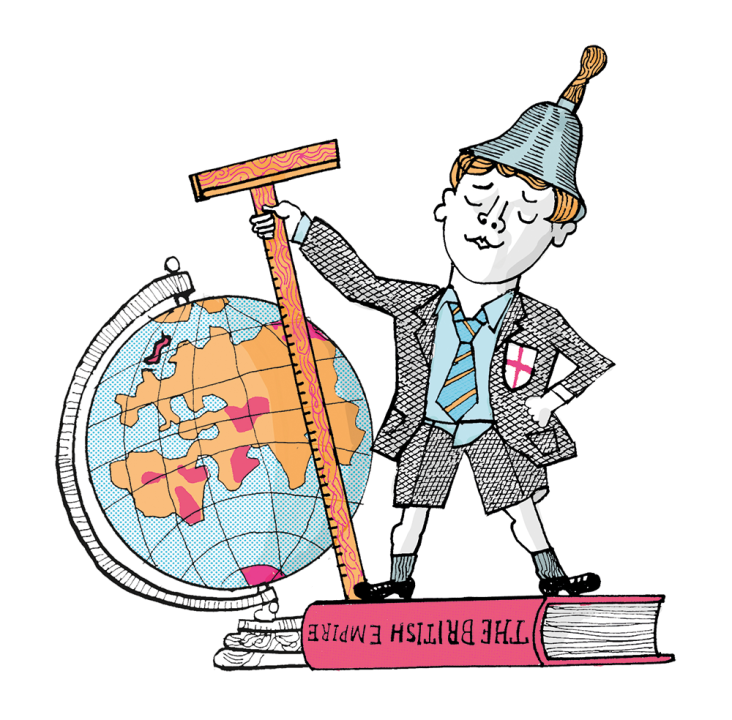
William Dalrymple says that children ‘don’t learn’ about the British Empire at school. It is an ‘elephant in the room’, he claimed on the Green party leader Zack Polanski’s Bold Politics podcast last week. This isn’t true. I learnt about the Empire at school. Studying A-level history a decade ago, we spent a year covering the Raj. The Indian Mutiny, 1857. The Amritsar Massacre, 1919. On viciously cold mornings, my teacher, Ms Pearmain, would open the windows and say that boys’ brains were slowed by comfort. It kept her lessons in my head.
It would have taken Dalrymple a few seconds to do some research and realise his error. In schools which follow the national curriculum, lessons about the British Empire are prescribed by the government. In Years 7, 8 and 9, the curriculum demands that pupils learn about Britain’s ‘ideas, political power, industry and Empire’. This has been the case for 13 years.
Most state secondaries are academies or free schools; they don’t have to follow the national curriculum. Yet still they teach about the Empire. At my old secondary, an academy, Dr Challoner’s Grammar School in Buckinghamshire, KS3 pupils today learn about the British Empire and examine the carefully pitched question: ‘When was India most free?’ On his podcast, Polanski says that the British Empire is ‘not taught’ in schools, but at his alma mater, Stockport Grammar in Greater Manchester, an independent, KS3 history lessons today cover the origins of the British Empire and slavery.
These compulsory history lessons in Years 7, 8 and 9 are, for many, only the beginning of an exhaustive schooltime study of the British Empire’s chronology and realities. All the major exam boards – AQA, Edexcel and OCR – permit the history of the Empire to be taught at GCSE and A-level. Dr Challoner’s teaches its GCSE history pupils a module called ‘Migrants in Britain, c. 800 – present’, looking at transatlantic slavery, the end of the Empire and decolonisation. At Furze Platt in Berkshire, another state academy, staff even recommend that A-level history pupils listen to Dalrymple’s podcast, Empire, a thrice-weekly unpacking of imperial history. Dalrymple records the show in the compound in New Delhi where he lives, a chuntering sun king in a solar system of gardeners, cooks and helpers.
So Dalrymple and Polanski are wrong. Of course they are. They know that. What the pair really want is kids to study history in a different, more ‘progressive’ way. On Polanski’s podcast, Dalrymple says that pupils should learn about the Empire in the context of a world economy that was previously dominated by the East. He says the Empire was a historical aberration (not true!) which – with China and India’s ascendance – will soon be redressed. Dalrymple has also previously said that not teaching about the Palestinian Nakba in schools is ‘the most culpable act of historical amnesia in modern British public life’. (Wrong again! At the independent Ampleforth College, Dalrymple’s old school, pupils study the Middle East from the Balfour Declaration to the 2008/09 Gaza War.) He and his kind want history to be morally instructive, with the lesson always the same: Britain has done bad.
Dalrymple and Polanski don’t care about the content of Britain’s history lessons. If they did, they’d be overjoyed. A wealth of ‘progressive’ history is now taught to kids. At Furze Platt, for instance, Year 9 pupils look at ‘how LGBT history has changed in the modern period and to what extent LGBT has achieved rights by the 20th century’. At Toot Hill School in Nottinghamshire, pupils read Black and British by David Olusoga. My second year of A-level history was spent on progressive turf. We studied American slavery and the history of communism. (Ms Renyard taught us that all Russian history is dictated by three factors: bread, trains and women.)
Dalrymple and co want history to be morally instructive, with the lesson always: Britain has done bad
A straight teaching of history can lead to adverse results – to opinions of which Dalrymple disapproves. This week, I spoke to Mike Wells, a writer and former history teacher of 38 years who has assessed A-level history exams since 1976, and who also writes textbooks for OCR’s A-level history specification. When I called, he was in the middle of marking an essay which discussed how British rule in India benefited Indian people. ‘They’ve looked at various debates and come to their own conclusions,’ he told me, as if it were the most obvious thing in the world. ‘History teaching is about assessing interpretations, isn’t it? Rather than dishing them out.’
I asked Wells whether the British Empire is covered adequately in Britain’s schools. ‘I don’t think it’s taught either as a good thing or a bad thing,’ he said. ‘It’s taught fairly objectively, as much as you can in history.’ He said the purpose of history classes is partly to confer knowledge, but also to get kids to ‘have a critical view of evidence’. In that sense, the exact period that pupils studied is irrelevant. And when schools don’t teach about the British Empire, there is an obvious reason for it: they can’t teach every-thing. ‘Choices have to be made,’ he said.
Many schools’ history departments have subject experts who feel best equipped to pass information about particular topics on to their pupils. Others just think that certain classes will prefer to learn about certain periods. The curriculum is fine as it is, whatever Polanski and Dalrymple might say.




Comments